'This cannot be a coincidence' — Ukraine's Starlink access restricted without warning, Zelensky adviser says
 on Google



Key developments:
- SpaceX implemented speed restrictions on Starlink systems for the Ukrainian military on Oct. 14 without warning, limiting speed to 100 miles per hour (160 kilometers per hour)
- The unexpected restriction disrupted active military operations, including the use of mid-range strike drones and interceptors
- Ukrainian officials said they believed the move was tied to the Trump administration's intensifying pressure on Kyiv to stop strikes on Russian oil assets
- Elon Musk said Trump holds ultimate authority over Starlink speed and usage limitations for Ukraine
- Starlink service has stabilized, but the speed cap remains in place, Ukraine's Defense Ministry said
Ukraine's Starlink access has been restricted without warning, severely disrupting "several" military missions, presidential adviser Serhii "Flash" Beskrestnov said on Oct. 14.
The speed restrictions were accompanied by signal disruptions and instability, even at lower speeds. Military personnel from mulitple units reported serious issues with Starlink throughout the day.
"I confirm that (Starlink owner) SpaceX implemented speed restrictions on Starlink terminals while in motion last night. Currently, the restriction applies to the Starshield 'military service package' and limits speed to 100 miles per hour (160 kilometers per hour)," Beskrestnov said in a post on social media.
Ukraine's Defense Ministry later told journalists that the actual speeds available during the day were even lower than the 160 kph limit. By the end of the day, service was reportedly stabilized, but the restriction remained in place.
SpaceX CEO Elon Musk said only U.S. President Donald Trump had the power to determine the speed restrictions for Starshield systems.
"Any limits on speed or usage are decided by the U.S. military and ultimately (the president). .... Usage of Starlink is limited to civilian or defensive activities and cannot be used for offensive military action," he said.
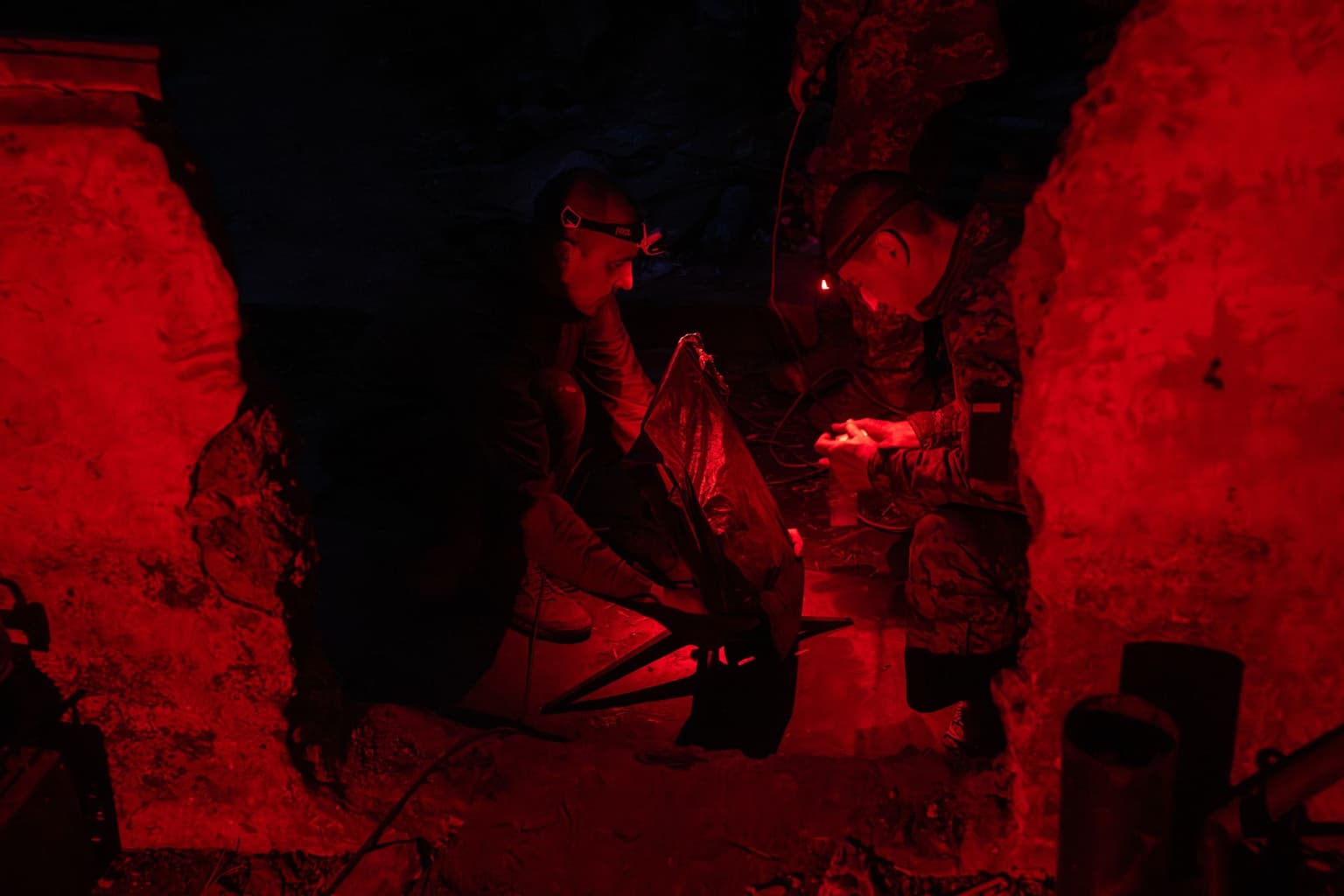
Ukraine relies on Starlink for several military applications including operating its "middle strike" campaign in Russian-occupied Ukraine, as well as interceptor drones that defend against Russia's new jet-powered attack drones.
This mid-range strike campaign this year has allowed Ukraine to strangle Russian logistics, hampering its ability to fight on the front lines.
Sudden disruption on the front lines
A source in Ukraine's Defense Ministry confirmed to the Kyiv Independent that speed limitations had been discovered and the cause was being investigated.
"This complicates drone missions —specifically those involving interceptors and mid-range strike drones — and hampers capabilities for frontline logistics, reconnaissance, and signal relay," the source added.
A soldier working on mid-range strike drone operations, who requested anonymity, confirmed that "certain issues are being observed" but declined to elaborate, citing operational security.
Two other commanders — both from elite drone units working on the eastern and southern front lines — reported issues with Starlink terminals on "middle strike" drones flying at higher speeds over the last 24 hours.
Both likewise requested to remain anonymous, and declined to describe the problems in more detail, so as to not assist the enemy.
During the day, Ukraine's 7th Air Assault Corps said on social media that it was experiencing a "throttling" of its Starlink connectivity.
"The consequences are already being felt in the field. Since the start of the day alone, a drone unit operating within the 7th Corps' area of responsibility in the Huliaipole sector has had to cancel a number of missions due to these connectivity issues," the corps said.
Service restored — with a speed cap
Later in the evening of Oct. 14, ex-Defense Minister Mykhailo Fedorov — who famously negotiated with Musk to cut off Russian forces from Starlink while in office — announced that service was being restored, with the speed limit in place.
"Attack drones and interceptor drones should be operational again," he wrote. "Now, the focus should be on completely removing the speed limit for Starshield."
Fedorov, who no longer holds a position in the Ukrainian government after being dismissed by President Volodymyr Zelensky in July, did not provide evidence for his claims or explain where he got his information, though he thanked Musk in his post on X.
The Defense Ministry confirmed that service had been stabilized at a speed of 160 kilometers per hour.
"SpaceX continues to maintain the 161 km/h limit. Throughout the day, the actual limits were significantly lower. However, as of now, we observe that connection quality has improved at speeds up to 160 km/h," the ministry said in a comment to reporters.
The Defense Ministry is currently negotiating with partners and with SpaceX "regarding stable service conditions and the prevention of sudden restrictions."
But Musk's response was not encouraging — particularly for Ukraine's middle-strike campaign.
"Starshield systems are owned and controlled by the U.S. government," he wrote in response to Fedorov.
"Any limits on speed or usage are decided by the U.S. military and ultimately (the president). .... Usage of Starlink is limited to civilian or defensive activities and cannot be used for offensive military action, as doing so would be inappropriate for a commercial company."
Is Trump to blame?
Musk comments point to a link between the Starlink disruption and Kyiv's deteriorating relationship with the White House — a fear voiced earlier in the day by Beskrestnov.
"Obviously, this action cannot be a coincidence and is associated with the current political situation," he said.
As reported by the Kyiv Independent on Oct. 12, U.S. President Donald Trump has threatened Ukraine with the withholding of intelligence and other assistance in a bid to protect Russian oil refineries.
Beskrestnov did not provide evidence that the Starlink restriction was connected to U.S. pressure on Ukraine, and the White House has not commented on the issue.
Serhii Sternenko, an activist and former advisor to Fedorov, also reported the restriction of access, saying "SpaceX likely took these measures at the request of the Trump administration."

The development comes after Ukraine worked with SpaceX earlier this year to deactivate unauthorized Starlink terminals being used by Russian forces. Starlink has played a critical role in Ukrainian military communications throughout the full-scale war.
The threats came after a confusing 48 hours during whichTrump announced a controversial "deal" with Russian President Vladimir Putin to import Russian diesel, followed by repeated demands that Ukraine replace Zelensky as president, followed by Trump announcing a unilateral "energy ceasefire" between Russia and Ukraine, which blindsided both Moscow and Kyiv.
Ukraine has since refrained from attacking Russian oil refineries but Russia has continued its blitz on Ukraine's energy infrastructure, most recently overnight on Oct. 14 when "several" power plants in Kyiv were hit. Trump has refused to accuse Russia of breaking the ceasefire.
Consequences of US pivot
The reported Starlink restrictions come as questions have been raised about U.S. intelligence sharing in relation to Russian ballistic missile launches, following two straight nights of attack on Kyiv with little to no warning.
Five Russian S-400 missiles struck the Ukrainian capital shortly after 10 p.m. local time on Oct. 12, causing "massive explosions," Kyiv Independent journalists reported. Air raid sirens and mobile alerts sounded only after the attack.

Zelensky described the strike as "particularly vile," saying Kyiv "received no early warning from our partners about this strike." His remarks raised questions about whether Washington had suspended intelligence assistance to Ukraine.
Despite the failure of Kyiv's early warning system and threats to halt U.S. intelligence sharing with Ukraine, Washington made no such decision, Ukrainian and American sources told the Kyiv Independent on Oct. 13.
But later that day, around 10:30 p.m. another wave of ballistic missiles hit Kyiv, again without the usual warning.
At least three women were killed, and another 24 people, including a 7-year-old girl, were injured as a result of a hit on a residential building in the Desnianskyi District. Three more waves of ballistic missiles struck Kyiv throughout the night.
Air Force spokesperson Yurii Ihnat told Ukrainian TV that Ukraine received no warnings from its partners about the first wave, though it did for the following three.
"Ukraine did not attack Russian oil refineries, yet Trump has already begun imposing sanctions on my country. Meanwhile, sanctions against Russia have been eased," Sternenko said.