20 years after his murder in Britain, Alexander Litvinenko's wife writes memoir to remind of Russian threat
 on Google

Russia's threat to international security was apparent long before its invasion of Ukraine. One of the clearest and most chilling warnings came in 2006, with the murder of Alexander Litvinenko, a former FSB agent turned outspoken Kremlin critic.
At great risk to his own safety, Litvinenko had worked to expose the Kremlin's links to organized crime, publicly accusing Russian President Vladimir Putin and his inner circle of using political violence to tighten their grip on power and deploying Russia’s security services to silence critics. Despite gaining asylum in the U.K., Litvinenko was poisoned by Russian security service agents with polonium-210, a highly radioactive substance.
British officials decried the Kremlin for carrying out an act of "nuclear terrorism" on their soil that not only robbed Litvinenko of his life but put the safety of countless others at risk via nuclear contamination. Though for Litvinenko's wife, Marina, that wasn't enough — she wanted justice for her husband.
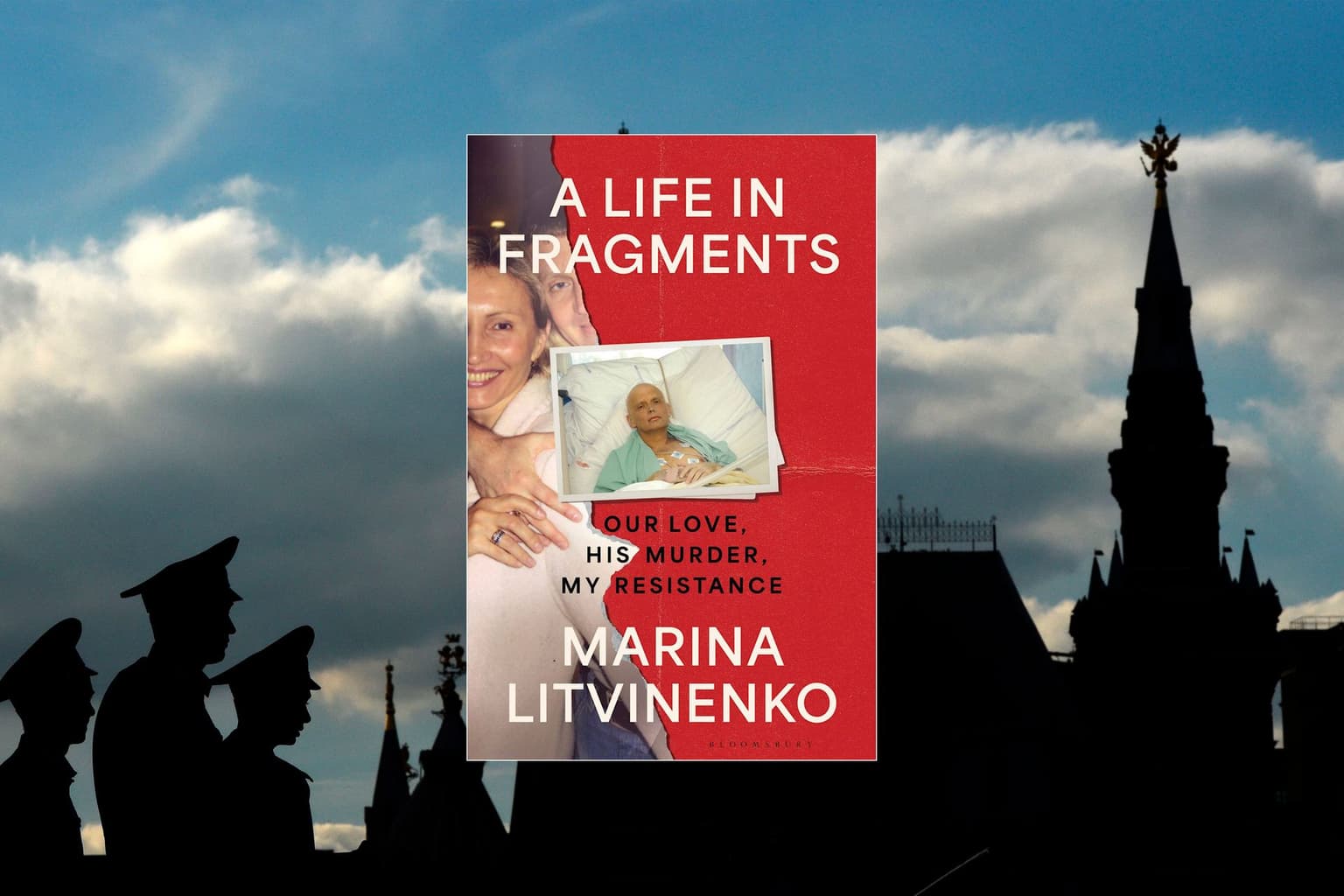
"I wasn't content to accept his death as an appalling tragedy, or retreat quietly into being 'just' a widow. Instead, I would fight for justice — no matter the personal cost," she writes in her new memoir "A Life in Fragments: Our Love, His Murder, My Resistance."

The memoir traces the start of Marina and Alexander Litvinenko's relationship, his career in Russia’s security services, the risks he took by speaking out against corruption and organized crime, the exile that followed, his murder, and Marina's years-long struggle to hold his killers accountable.
In 2021, the European Court of Human Rights found beyond reasonable doubt that Litvinenko was poisoned by Russian agent Andrey Lugovoy. The assassin is now a Russian lawmaker.
Alongside the story of Marina and Alexander runs a wider account of Russian state violence — from the 1999 apartment bombings across three cities that frenzied up public support for the Second Chechen War, to the full-scale invasion of Ukraine — each episode offering further proof of the regime's brutality.
Marina's account of her husband throws into relief the road not taken by Russia’s post-Soviet elite. When he was assigned to a unit in the Russian security services for officers thought willing to cross boundaries, she describes it as “one of the most ill-judged recruitments in history."
Litvinenko's decision to publicly reject any involvement in the unit's kidnappings and murders proved life-changing. After spending weeks in pre-trial detention on trumped-up charges designed to break his spirit, he fled Russia for good. Living in exile, he worked with the British and Spanish governments by providing intelligence on Russian organized crime and the activities of Russian intelligence operatives, while continuing to speak out against corruption and abuses of power within the Kremlin.
What makes this sequence of events so compelling is Marina's ability to give us insight into the evolution of Litvinenko's views. If his moral compass was firmly set from the start, it became even more sharply attuned as he came to terms with Russia’s crimes against not only its own people but against neighboring countries too. Friendships with people like Akhmed Zakayev, the Chechen independence leader and foreign minister-in-exile, played an important role in this.
"Through their long discussions, Sasha (Editor's note: Sasha is the diminutive form of Alexander) learned of the abuses committed by Russian forces in Chechnya – executions, torture, systematic rape. He started to properly understand Chechnya's history of oppression, and why independence was so important to its people, who had their own language and traditions," Marina writes.
"Sasha came to share Akhmed's ambitions for a free Chechnya and vowed to do what he could to support the struggle."
Marina's own resilience is worthy of attention in this retelling of these events. In "A Life in Fragments," she emerges as far more than the wife of a dissident. The reader is introduced to someone who, from an early age, declined to accept authority unquestioningly — a quality that, amid the Kremlin's barrage of propaganda, would have served her compatriots well.
Despite the ever-present shadow of fear that came with Litvinenko's stand against the criminals in power, Marina and her son, Anatoly, accompanied Litvinenko into exile, ultimately resettling in the U.K., where they were compelled to reinvent their lives in the fullest sense.
The force that sustained all of this, for Marina, is almost disarmingly simple: love. As she herself observes, it was her devotion to her husband — rather than any particular animus toward Putin — that gave her the courage to persist. It was also her refusal to be consigned to the role of "merely" a widow that enabled her to recognize the necessity of stepping beyond the boundaries of her former life, and to assume her own part in the pursuit of justice that her husband had begun.

The chapters of "A Life in Fragments" that follow Litvinenko's murder are especially hard to bear for readers now living through the war in Ukraine, as they echo a familiar refrain from Western allies: that support against the Kremlin will last "as long as it takes." British officials assure Marina that those responsible for her husband's death will be brought to justice, yet with time, they yield to the illusion that cooperation with Russia — whether in pursuit of trade or in the fight against the Islamic State in Syria — remains possible.
In that sense, "A Life in Fragments" is more than a chronicle of private grief or a family tragedy. It is, above all, a stark reminder that the boundaries between the personal and the political are neither fixed nor impermeable. Marina's story traces the ways in which state violence, propaganda, and international complacency ripple outward, shaping the fates of individuals who never sought the spotlight.
The book offers no easy consolation, but instead insists on the necessity of bearing witness — of refusing to allow even the most intimate suffering to be swallowed up or explained away by the abstractions of geopolitics. In this, it demands a reckoning not only with the circumstances of one family, but with the moral evasions that recur whenever justice is deferred in the name of expedience.