Analysis: How Ukraine's new middle strike drone campaign aims to strangle Russian logistics
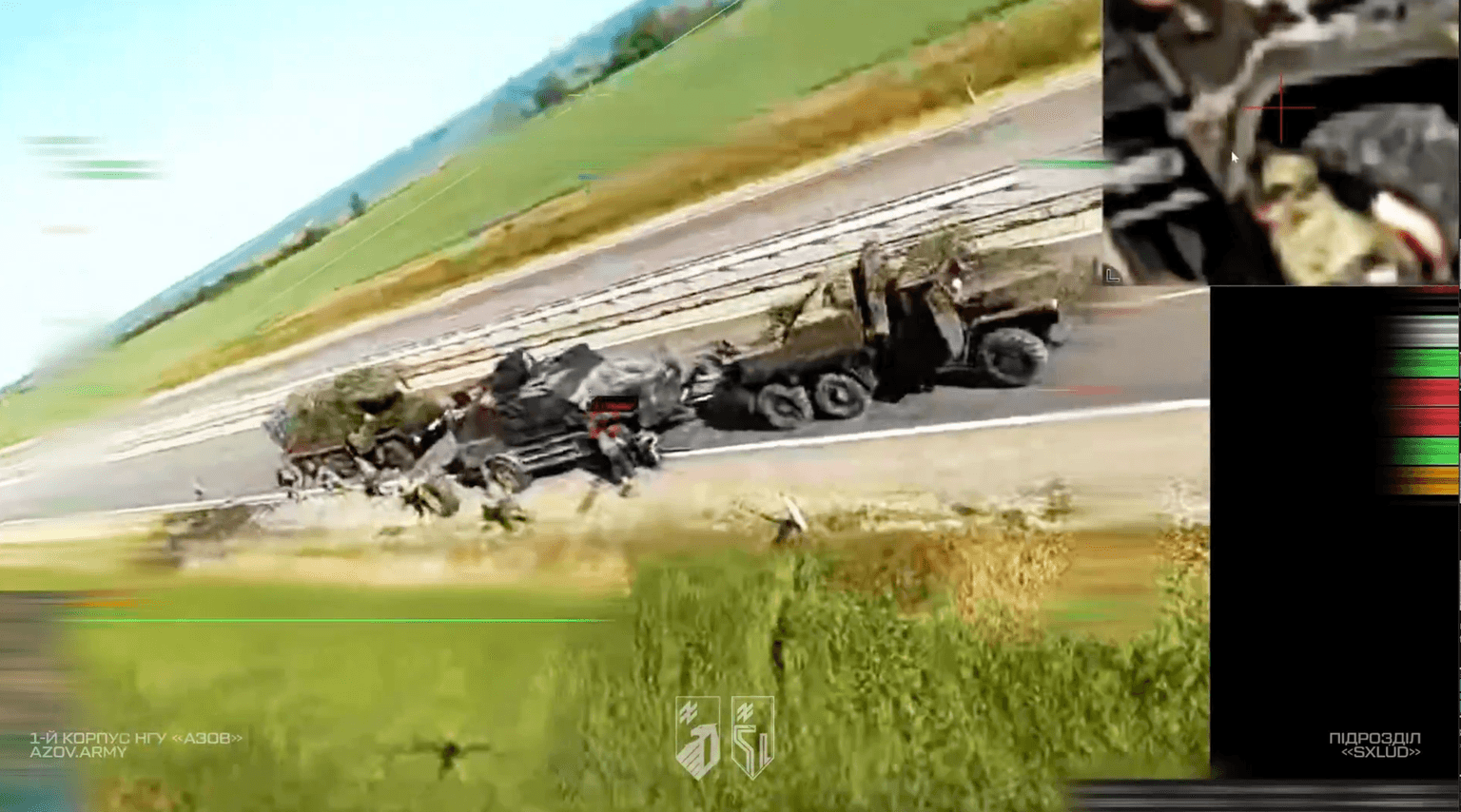
A screenshot from a video released by Ukraine's Azov Brigade on May 25, 2026, showing a drone strike on Russian military vehicles (HUR/Telegram)
 on Google
A charred Russian KAMAZ armored vehicle sits by the side of the road, the latest victim of a Ukrainian drone strike. Two Ural heavy recovery trucks can be seen parked either side, while several Russian mechanics attempt to replace the vehicle's melted tires.
Another incoming Ukrainian drone dives, nearly silently, towards the recovery operation, aiming directly for the Russian soldiers. The footage cuts out just before impact.
The video is just one of many that have flooded social media in recent weeks, each showing the devastating impact of Ukraine's relatively new middle strike campaign against Russian logistics which began in earnest in early April.
Ukraine has been routinely using mid-range drones to strike Russian targets at operational depth behind the front — typically defined as between 25 and 200 kilometers (15 and 124 miles) from the front lines — for well over a year, with air defense systems, command centers, and ammunition dumps all being targeted.
The explicit focus on destroying Russian supply trucks and disrupting logistics is new, and has the potential to cause severe problems for Moscow, something that Russian military analysts are well aware of.
"They're just burning everything down," Russian milblogger Victory Volunteers complained.
"How to deal with this? For now, there's no solution," he added.
Ukraine's expanding drone campaign against Russia
The strikes in the video above were carried out by Ukraine's Azov Corps using "Hornet" drones, manufactured by ex-Google CEO Eric Schmidt's Perennial Autonomy. Costing just $5,000, carrying a 5kg warhead, and with a range of up to 200 kilometers, the Hornet features semi-autonomous targeting and is able to be mass-produced.
The small drone has emerged as a key part of Ukraine's increasingly potent arsenal of mid-range strike drones, which are increasingly hunting Russian logistics vehicles deep behind Russian lines.
The initial success of the middle strike campaign was partly due to an ad-hoc Ukrainian modification to their Hornet drones.
"It was Azov's initiative to add a Starlink satellite communications system onto the Hornet," Rob Lee, senior fellow at the Foreign Policy Research Institute and an expert on the Russian military, told the Kyiv Independent, a modification that significantly increased its range and resistance against Russian jamming.
Crucially, Perennial Autonomy welcomed Azov modifying their drone in a way that increased its combat effectiveness. "They're supportive of any way to improve the product," Lee said.
Azov began publicizing their attempts to paralyze Russian logistics in mid-April, in a video showing their Hornet drones striking Russian targets and overflying iconic landmarks such as the Donbas arena in occupied Donetsk.

A later video on May 8 showed Azov's Hornets in the skies above the unit's occupied home city of Mariupol — a symbolic return to the city where the group fought their last stand at the city's famous steelworks in the early months of the full-scale invasion.
Azov's campaign of strikes has so far focused on Russian logistics traffic deep behind enemy lines. A Kyiv Independent analysis of footage released by Azov alone shows over fifty strikes on Russian targets on key roads in occupied Ukraine, such as the so-called "Novorossiya" R-280 military logistics route in occupied southern Ukraine which links Rostov-on-Don with occupied Crimea and runs through several occupied Ukrainian cities.
The real toll of the campaign is likely to be "significantly higher," according to Anton Zemlianyi, a senior analyst at Kyiv-based think tank the Ukrainian Security and Cooperation Center.
Open-source monitoring group Tochnyi were able to geolocate 55 strikes on Russian logistics vehicles in April and 130 strikes in May, with the number increasing on a daily basis.
Zemlianyi said that according to their military intelligence sources "125 Russian trucks had been hit on key logistics routes, of which over 80 were destroyed or burnt," adding that this assessment probably also undercounted Russian losses.
The effects of the campaign are already being felt in occupied Ukraine.
Russia's collaborationist "governor" Volodymyr Saldo issued a decree on May 21 restricting non-essential traffic along R-280 in occupied Kherson Oblast, citing the threat of Ukrainian drones.
In Sevastopol, occupied Crimea, filling stations ran out of gasoline, while diesel fuel was only sporadically available, according to Mikhail Razvozhaev, the Russian-appointed governor of the city.
In occupied Melitopol, footage posted on social media showed long lines at filling stations as locals queued to refuel their cars as supplies ran low. Occupied Mariupol also saw lines at filling stations, and soaring prices.
Ukraine's previous campaign of middle strikes had already caused difficulties for Russian logistics, seeing some Russian units having to reduce their usage of diesel by up to 20% and forcing the relocation of supply depots and command depots further behind the lines, Dmytro Putiata, a former drone operator with Ukraine's 20th Unmanned Systems Brigade and an expert in drone warfare told the Kyiv Independent.
"In some cases they have moved their ammunition depots and command posts literally back into Russia, out of occupied Ukraine," Putiata explained.
'The worst summer for Russia'
Leaning into Azov's success, Ukrainian Defense Minister Mykhailo Fedorov recently announced a new campaign to further boost Ukraine's capabilities.
"We are launching a separate program called 'Logistical Lockdown' to scale up middle strike and systematically destroy Russian capabilities at the operational depth," Fedorov said in a post on Telegram on May 27.
"Our task is to further increase the pressure on the Russians in their rear and deprive them of the ability to conduct active assault operations."
Fedorov announced an additional 5 billion UAH ($113 million) in funding for the most effective frontline units carrying out middle strike operations.
And the number of Ukrainian units carrying out such operations is rapidly growing, using a wide variety of mid-range drones.
A day before Fedorov's announcement of Ukraine's new campaign, the 412th "Nemesis" brigade of Ukraine's Unmanned Systems Forces announced on Telegram they had "launched a large-scale hunt for enemy logistics in southern Ukraine," using "secret strike 'wings' that have not previously appeared in the public space."
Nemesis published footage of their mysterious new loitering munitions striking multiple Russian logistics vehicles along the R-280 highway.
Drones operated by Ukrainian military intelligence (HUR) even managed on May 28 to completely block the R-280 for a short time. Footage published by HUR the day after showed multiple Russian military fuel tankers burning fiercely after being hit by Ukrainian drones, forcing other traffic into long detours.
Ukraine's increasingly effective campaign will "clearly have some effect on Russia's ability to conduct offensive operations," Lee argues, while cautioning that the overall impact of the campaign is still unclear.
The campaign has already resulted in "significant results," Zemlianyi claims, suggesting that if the tempo of strikes increases Ukraine could potentially "cut off supplies to specific sectors of the front," allowing Ukrainian units to potentially "launch counter-offensive operations."
Both agree Russia will inevitably attempt to adapt to Ukraine's middle strike campaign, with an as-yet unknown degree of success. Hampering Moscow's efforts to adapt is Ukraine's preceding campaign targeting Russian air defense systems, which saw hundreds of systems hit and destroyed across occupied Ukraine.
"One of the key questions is how does Russia respond," Lee argues, suggesting the Russian military would have to dedicate more air defense systems, electronic warfare assets, or mobile air defense teams in an attempt to address the Ukrainian threat.
"If Russia can't develop effective countermeasures, then this year is going to become more difficult as it goes on," Lee added.

It's a widely held view.
"This will be the worst and hardest summer for Russians," Serhii Sternenko, advisor to Ukraine's defense minister, posted on X, adding: "The worst is yet to come."
Russian milbloggers and analysts are possibly the most pessimistic about the impact Ukraine's new drones will have on the Russian war effort.
Unless urgent action was taken to mitigate the effects, Russian war correspondent Dmitry Steshin claimed in a post on Telegram, "in the coming months, logistics will collapse."
"Over the past month, the enemy has carried out a very dense and controlled attack on a number of targets: fuel and energy plants, warehouses, and storage facilities," Russian milblogger The Ghost of Novorossiya posted on Telegram, stating that areas of the Russian rear that "were considered relatively safe have not been so for several months now."
"This will be a very challenging year," they added.
For once, Ukrainians and Russians agree on something — the situation for the Russian military in occupied Ukraine is only going to get worse.
Note from the author:
Hi, this is Jimmy. Thanks for reading this analysis.
Ukraine’s growing advantage in the drone war is one of the most important shifts in the conflict, but tracking it is not straightforward. It means following battlefield tactics, shifts in production and technology, and the pattern of strikes deep inside Russia.
If you value this kind of analysis from Kyiv, please consider joining the Kyiv Independent’s community and supporting our work.