What China hopes to gain from the Trump-Putin summit
 on Google

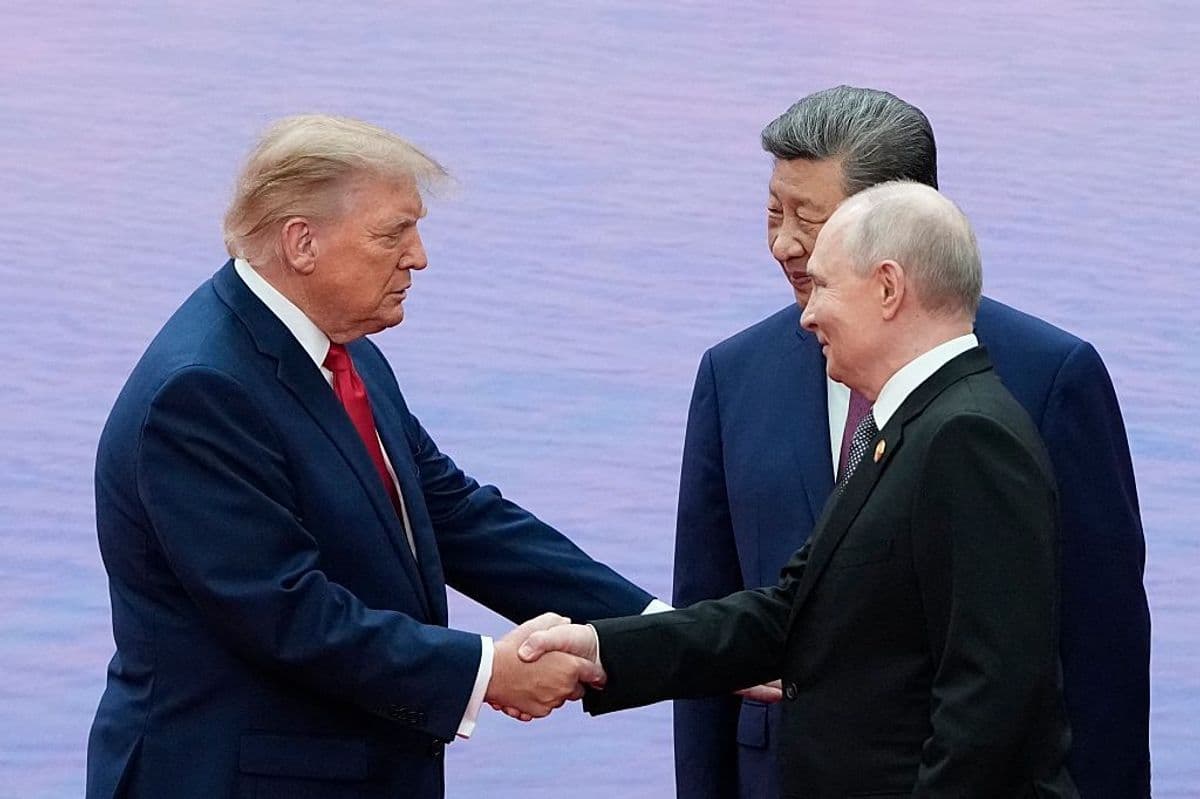
Chinese leader Xi Jinping, Russian President Vladimir Putin, and U.S. President Donald Trump are set to meet in the Chinese city of Shenzhen on Nov. 18 for closely watched trilateral talks.
Two of the three leaders arrive under mounting pressure at home and abroad.
With Russia’s full-scale invasion of Ukraine approaching its fifth anniversary, Putin faces a faltering economy and mounting battlefield losses along a largely stagnant front line.
Trump, meanwhile, is grappling with the fallout from his war with Iran. Restrictions in the Strait of Hormuz have driven up U.S. diesel prices, while bruising midterm election results have handed control of Congress to the opposition.
Xi, by contrast, comes to the table with a markedly different set of pressures — and priorities.
As host, he will have an opportunity to cast himself as a global peacemaker. But the image of a mediator is only part of the story. Beijing has its own strategic and economic interests at stake, both in Shenzhen and far beyond both battlefields.
Common understandings
For Beijing, hosting trilateral talks with Putin and Trump is not without risks.
The talks are taking place on the sidelines of the Asia-Pacific Economic Cooperation summit: an event that China does not want to be derailed in favor of a drawn-out focus on Iran or Ukraine.
Trump in particular is known as unpredictable, and could easily use his platform in Shenzhen to make remarks that do not align with Beijing's interests.
Yet turning down the opportunity to host such talks also would have reflected badly on Xi. Both Putin and Trump are keen to use the talks to achieve their own goals back home with an image of strength.

Xi will also seek to benefit in this way, says Temur Umarov, a fellow at the Carnegie Russia Eurasia Center. Refusing to host such an important event would have been a risk to China's reputation.
"China's interest is to showcase that China is a global superpower that participates in all of the important events that are happening on the global arena," says Umarov.
But just because China has a seat at the table, it doesn't mean that Beijing is keen to throw itself into peace negotiations — whether that's between Russia and Ukraine, or the U.S., Israel, and Iran.
Beijing has previously released its own document on Russia’s invasion of Ukraine — titled "China's Position on the Political Settlement of the Ukraine Crisis" — which includes 12 points, among them calls to respect national sovereignty, cease hostilities, resume peace talks and abandon "the Cold War mentality."
It has also issued "six common understandings" with Brazil, encompassing three principles to "de-escalate the conflict: "no expansion of the battlefield, no escalation of fighting, and no fanning up the flames by any party."
But all of these statements and documents are ultimately low-stakes and non-binding.
German President Frank-Walter Steinmeier is among those who have said that Beijing sees Russia’s invasion of Ukraine as a European affair, recounting Xi's view to German television on Nov. 1, having spoken with the Chinese leader on Oct. 30.
"Active mediation requires making difficult compromises. It also requires putting pressure on partners and guaranteeing some of the terms of the settlement, and then it would mean that Beijing would have to bear all of those responsibilities. That is not something that Beijing normally does," says Umarov.
"China will continue to show its active engagement in the peace negotiations, but (by doing) something that doesn't require commitment."
Seeking benefits elsewhere
In the meantime, Beijing will still try to leverage the global situation to its advantage.
Russia’s war in Ukraine has left Moscow isolated from the West and more dependent on its remaining allies and partners. It needs the goods that Chinese companies can provide to aid its war machine, particularly "dual-use" items that contain components that can be cannibalized and repurposed for military use.
China knows that its relationship with Russia is increasingly weighted in Beijing's favor.
"Even prior to the full-scale invasion, Russia’s superpower status has been in decline, while China has been on the rise," says Filip Rudnik, a senior fellow in the Russian department of Poland's Center for Eastern Studies (OSW).
Yet Beijing still values what Moscow can provide.

China buys large amounts of Russian oil and gas at a discounted rate, an agreement that not only benefits Beijing, but also aids Russia in replenishing its struggling budget. Economic cooperation between the two countries could also go much further in the future.
"Russia is a big market being left by the Western companies, which opened a very big space for the Chinese to devour the Russian market," says Rudnik.
Beijing is also happy to support Moscow in its pursuit of a "multipolar world."
"The Chinese and the Russians have closed their ranks when it comes to challenging the global hegemony of the U.S. I would say that it's the core of their relationship right now, that this is the ultimate goal that unites them," Rudnik adds.
All of this means that an end to Russia’s war in Ukraine is not necessarily the best outcome for China's national interests, says Umarov.
If Russia loses the war and collapses, then there'd be a greater chance of a pro-Western power in Moscow — something that would not please Beijing.
Alternatively, if Russia wins a favorable settlement, either at the negotiation table or on the battlefield, a newly ascendant Russia could create an even more fragmented world order. This would also not necessarily be in China's interest.
For now, says Umarov, it may be a continuation of the grinding war of attrition in Ukraine that suits China best of all, even if it creates an unpredictable path that Beijing will need to navigate.
"Moscow's leverage continues to erode, forcing Russia to grant deeper economic concessions and accept broader Chinese influence in many different spheres. And this is something that would be acceptable for China," Umarov says.
None of the experts expect a breakthrough in Shenzhen.