What Russia's military buildup during Oleshky ceasefire could mean for Kherson Oblast
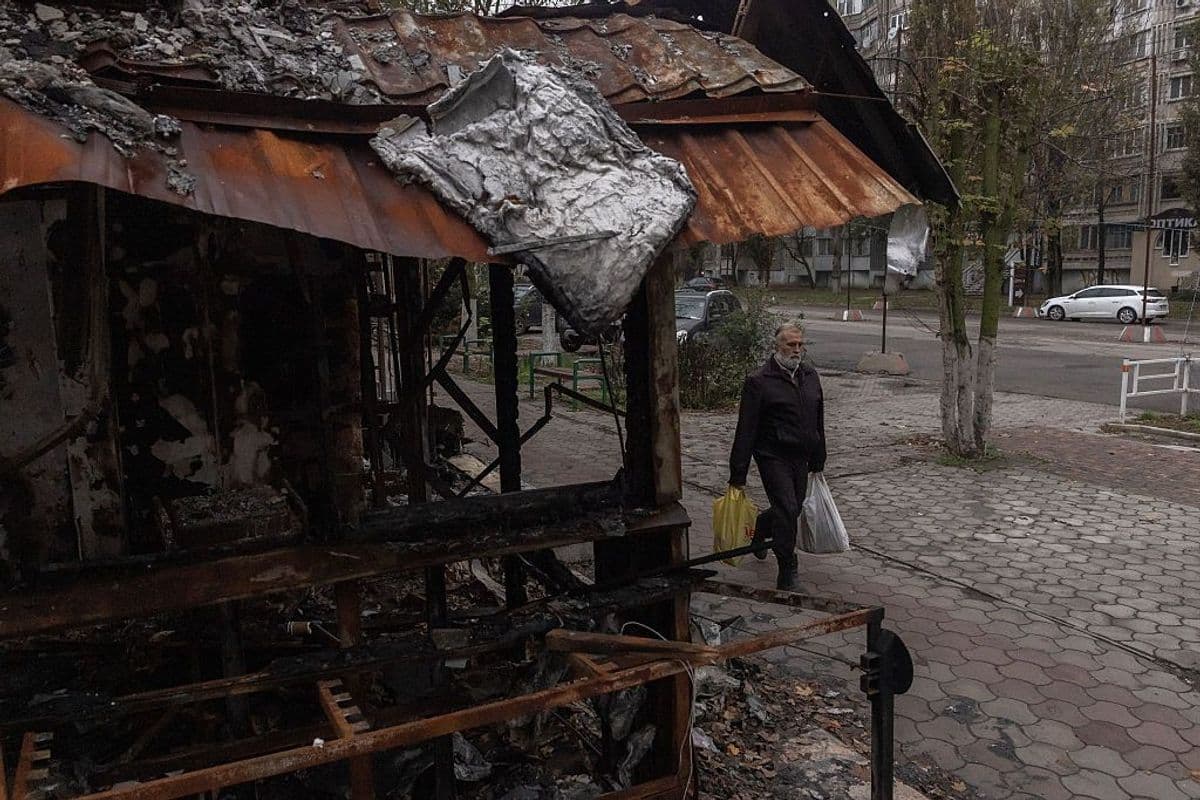
A man carrying bags walks past a building destroyed in a previous Russian airstrike during a temporary ceasefire in Kherson, Ukraine, on Oct. 31, 2026. (Roman Pilipey / AFP via Getty Images)
 on Google
After several days of quiet, the familiar buzzing of FPV drones and near-constant rumble of artillery fire have returned to Kherson. The sounds quickly drowned out the sense of security that had settled in during a ceasefire, replacing it with fear and uncertainty.
For five days, from Oct. 27 to Nov. 1, the ceasefire in Kherson Oblast, intended to evacuate civilians from the Russian-occupied town of Oleshky, gave Kherson residents a short reprieve from constant Russian strikes. Separated from Russian-occupied territory by the Dnipro River, the regional capital had not seen such freedom of movement since 2022.
Russian forces, meanwhile, took advantage of the pause to prepare for future military operations in violation of an agreement banning large-scale troop and equipment movements, Ukraine's military said.
"We were betting on (Russians) trying to bring in (a lot of military supplies). And our assumptions turned out to be correct," Yevhen Voronetskyi, head of the 34th Marine Brigade's communications department, told the Kyiv Independent.
"During the regime of silence, the rotation of Russian units, strengthening of positions, expansion of anti-drone means on the roads, and the increase in logistics, in particular the delivery of ammunition, were recorded."

On Nov. 1, Sky News published footage, captured by the 34th Marine Brigade's drones, showing Russian forces deploying heavy equipment and bringing in ammunition and other supplies to their positions. Some of their vehicles bore the red crosses typically associated with humanitarian missions.
Russian forces have repeatedly used ceasefires to strengthen their positions ahead of further advances into Ukraine. The buildup raises the question of a potential Russian push across the Dnipro River, although an analyst and military personnel who spoke to the Kyiv Independent doubt that a large-scale offensive is imminent.
read also
No lasting peace
Ukraine's human rights ombudsman Dmytro Lubinets said on Nov. 2 that neither side had reported any violations of the ceasefire, including the movement of heavy equipment. The Ukrainian military, however, reported otherwise.
Both the 30th Marine Corps and the 34th Marine Brigade, which operate in southern Ukraine, told the Kyiv Independent that Russian troop movements had been recorded during the ceasefire. Ukraine's General Staff also confirmed on its social media that Russian forces had violated the truce.
"During the regime of silence, the rotation of Russian units, strengthening of positions, expansion of anti-drone means on the roads, and the increase in logistics, in particular the delivery of ammunition, were recorded," the General Staff said.

Pavlo Drohal, press officer for the 30th Marine Corps, said Russian forces had used drones to remotely lay mines ahead of the ceasefire. One such explosive device detonated in Kherson, killing Volodymyr Obertas, a press officer with the 34th Marine Brigade who was originally from Oleshky.
Russian forces often remotely mine road intersections and areas where people gather, particularly in Kherson and neighboring settlements, Drohal told the Kyiv Independent.
"Civilians need to be very attentive to further developments and, in general, take into account that Kherson is right on the contact line and that the situation there is indeed difficult," he added.
Russian forces also violated the ceasefire agreement by flying reconnaissance drones over the western bank of the Dnipro River, Voronetskyi said.
The 34th Marine Brigade also reported a broader buildup of Russian forces in the area, according to Radio Free Europe/Radio Liberty (RFE/RL). During the ceasefire, Russia reportedly brought an additional 1,000 soldiers into the area and advanced 20 kilometers (12 miles) closer to the line of contact, reclaiming positions from which Ukrainian forces had repeatedly driven them out.
"The most important question now is whether the buildup of Russian forces on the left bank is a preparation for a sustained offensive operation, rather than simply an attempt to increase pressure on Kherson."
Predicting what Russian forces may be planning is difficult, Drohal said. It could include operations that would pose a serious challenge for Ukrainian forces, such as amphibious assaults and attempts to retake Kherson, which spent nearly nine months under Russian occupation in 2022.
What are Russia's possible next moves?
The Dnipro River cuts through Kherson Oblast, making offensive operations in the area particularly challenging for both Russian and Ukrainian forces. The river is wide, with many channels, shallow stretches, wetlands, and waterways that vary in navigability. Numerous islands further obfuscate the riverscape.
Crossing a river in a conventional military operation usually entails overcoming a single water barrier and establishing a bridgehead on the far bank. In Kherson Oblast, troops face not one river crossing but a series of them, each stretch of water another obstacle to an advance.
The islands are key points of contention. Both sides want them to monitor opposing positions and troop movements. While most islands are too small for large groups of soldiers, they can serve as temporary positions for military units.

Despite these challenges, Russian forces attempted to land on the Ukrainian-controlled western bank of the Dnipro River in Kherson Oblast twice before the ceasefire, using the first spell of bad weather — including dense fog and heavy rain — to their advantage, Voronetskyi told the Kyiv Independent.
One attempt was publicly confirmed on Oct. 22, when Russian troops from the "Dnepr" Group of Forces landed in Kherson's Korabel District using four boats, each carrying two soldiers. Ukraine's Southern Group of Forces said the operation was unsuccessful; Ukrainian forces destroyed all boats and captured three Russian soldiers.
Voronetskyi said Russian troops conducting such operations may have to navigate without knowing where exactly they will reach the Dnipro's western bank. Despite the risks and uncertainty, Russia will likely continue to attempt landings, he added.
Viktor Kevliuk, a reserve colonel and analyst at the Center for Defense Strategies, told the Kyiv Independent that as Russian operations in the Zaporizhzhia sector of the front line have failed to produce major gains, Russia's Dnepr grouping is considering stepping up offensive operations on the Dnipro's western bank.
Kevliuk also pointed to Russian Defense Minister Andrei Belousov's recent inspection visit to the Dnepr grouping in late October as another sign of such plans.

Offensive operations could involve intensifying attacks on Kherson, but also attempting to establish a bridgehead, Kevliuk said.
The success of such an operation would depend less on whether Russian forces manage to cross the river than on the Dnepr grouping having sufficient reserves to sustain the advance, according to the analyst.
"Even if the enemy manages to land several hundred troops on the western bank, that would not yet mean that a ful-fledged bridgehead has been established," Kevliuk said.
"A bridgehead must be capable of receiving reinforcements, ensuring supplies and fire support, evacuating the wounded, repelling counterattacks, and enabling the further deployment of troops. These are the things that turn a tactical landing into a complex operational task."
Ukraine's ability to maintain control over the islands and surrounding waterways, meanwhile, would be crucial to stopping such an attack, the analyst said.
Poor weather can also hamper the operations of reconnaissance drones and amphibious units by obscuring navigation and orientation, complicating the delivery of supplies, he added.
Since the ceasefire ended, Russian forces have stepped up attacks on the western bank of the Dnipro River and continued attempting short-term raids in the area.
In the first week following the end of the ceasefire, Russian attacks killed one person and injured 26 others in Kherson Oblast, according to the local military administration.
But Kevliuk and the military personnel who spoke to the Kyiv Independent doubt that Russia will launch a large-scale offensive on Kherson in the near future.
"The most important question now is whether the buildup of Russian forces on the left bank is a preparation for a sustained offensive operation, rather than simply an attempt to increase pressure on Kherson," Kevliuk said.