One Ukrainian soldier's bitter bargain for freedom: Ukraine’s convicts at war
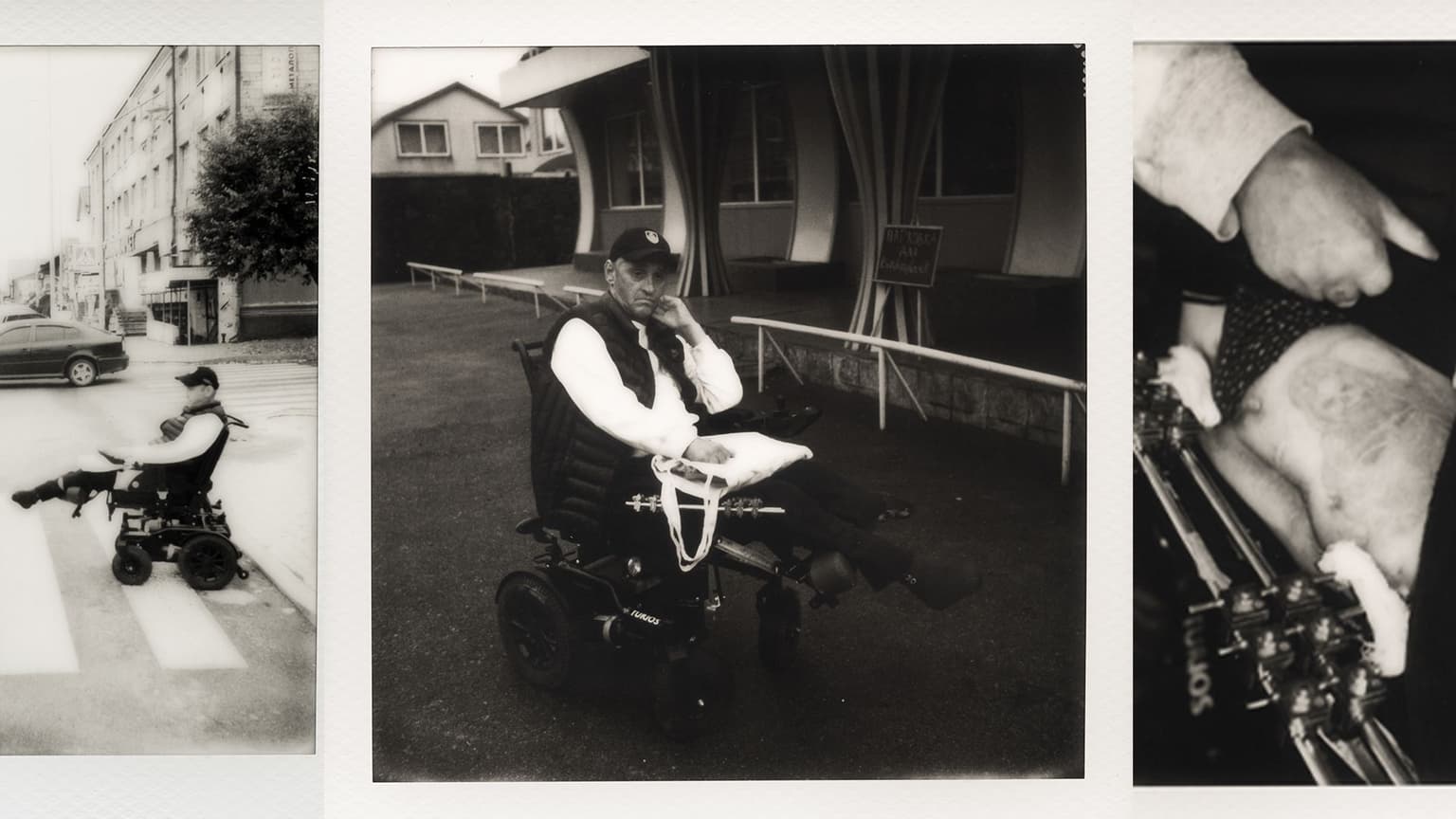
Stanislav Melanych, 52, a serviceman with the Shkval unit of Ukraine’s 59th Brigade, sits in his electric wheelchair, smoking a cigarette and wearing a cap with his unit’s insignia, in Vinnytsia Oblast, Ukraine, on Oct. 18, 2026. (George Ivanchenko / The Kyiv Independent)
 on Google
Sjava reaches into his pocket for his phone using what remains of his hands. He lost all but one thumb during a mission on the front lines of the war in Ukraine.
His friend Francouz is video calling him, and as Sjava answers, a voice from the other side of the screen barks a swashbuckling command: "Why don’t you stand up when you speak with me?!"
Sjava convulses with laughter in his electric wheelchair, careful to keep what remains of his legs still. One is missing below the knee. His other thigh is held together by a metal brace, and half of his foot is missing.
Sjava — who requested the Kyiv Independent not publish his full name for security reasons — is recovering at a military hospital in Nemyriv. He met "Francouz," a callsign which means "Frenchman" in Ukrainian, last winter, when both enlisted in the 59th Shval brigade, one of several units in Ukraine open to convicts who volunteer in exchange for conditional release.
The deal seems simple: Serve until the end of the war and walk free. But convicts mostly serve as infantry in some of the most dangerous parts of the war, and nothing guarantees they will live to enjoy that freedom.

"I’m a free man now," he says at a cafe near the hospital in Nemyriv, in a flat tone, as words can scarcely convey what that freedom has cost him.
Sjava first went to prison at 16, in the early 1990s, as the upheaval of the Soviet Union’s collapse left its newly independent republics struggling with poverty and lawlessness.
Over the next 35 years, he spent 22 in prison, serving different sentences for crimes ranging from minor offenses to murder.
At 51, he was offered a way out of prison. A law passed in May 2024 allowed prisoners to seek conditional release in exchange for military service. By the beginning of 2026, more than 12,000 prisoners had joined Ukraine’s Armed Forces under the program, according to Ukraine’s Justice Ministry. Sjava took the offer, leaving prison once more, this time to join a convict unit.
"Everyone understands; it’s not going to be a little stroll in a forest."
But he wanted more than just a way out of prison. It was a desire for dignity and purpose that led him to swap his prison jumpsuit for a military uniform, Sjava said during an initial meeting in January, before he was badly injured and had just begun his service. As for many others in his brigade, war was a chance for him to make a new name for himself.

"Everyone at home knows me as a bandit," he said back then.
He also understood the potential cost of his freedom. "We know where we are going. Everyone understands; it’s not going to be a little stroll in a forest," Sjava said.
"I am optimistic, but also I am ready for the worst. You do what you are supposed to. You don’t pay attention to anything else. And God protects you."
His first assault mission
On Feb. 2, Sjava was ordered to rotate soldiers from a neighboring unit — a mission he described as a "one-way trip." He believes his commander sent him on the dangerous task expecting him not to return.
"They sent me there because I spoke too much," Sjava said.
He says that he had refused to hand over money from his salary for communal expenses, including fuel, food, and cigarettes. Demands for soldiers to contribute their own money toward supplies are not uncommon as resources are scarce on the front line.


The mission didn't even last a day. Sjava remembers moving past burned-out vehicles along a crater-pocked road on the southern part of the front line before his group reached an open area near a bridge where they spotted Russian soldiers.
According to Sjava, after he reported his location over radio, a friendly fire incident occurred.
"They started shooting mortars. I saw an explosion. Then I look down, and I see I have a bone sticking out of my thigh."
"Either let me die, or get me out of here."
He could no longer walk. To hide from Russian first-person view drones, he says he took shelter beneath the bodies scattered around him.
"I didn't know what to do,” he says. "I asked God. Either let me die, or get me out of here."
He remembers feeling calmer after praying. He eventually crawled out from beneath the bodies and began dragging himself across the ground. He spent three days out in the freezing cold before a vehicle appeared.
He could not tell which side it belonged to. Fearing it might be Russian, he pulled the pin from a grenade. But his hands were so frozen, he says, that he could not throw it.
The soldiers turned out to be Ukrainian. They reached him with the grenade still in his hand and put the pin back, according to Sjava's version of events.

"When they put the pin back and tried to get the grenade out of my hand, they broke my fingers. They were black," Sjava says. As he recounts this episode as he remembers it, he produces something close to a laugh, exposing a golden tooth.
The other side of the freedom bargain
Metal rods extend from a deep scar in Sjava’s thigh. Surgeons have operated on his leg 23 times, he says.
"They put my leg together piece by piece." Beside the scar is a large tattoo of a reaper, which he got in prison in his twenties.
No relatives have come to see him in the hospital and he says he will go see his mother once he recovers. In their absence, the state has provided the support for his recovery.

Sjava says he has been treated no differently from any other veteran. The state paid for his electric wheelchair, and he continues to receive rehabilitation through the public system. He has been assigned Ukraine’s most severe disability status and says he receives Hr 120,000 (about $2,600) per month while undergoing treatment.
He is also determined to pursue a life beyond his serious injuries now that he is freed from his prison sentence.
"I don’t give up on my spirit," he says. "I really want to live. Our group consisted of 36 people. Maybe five or six survived, including me."

He also hopes to make it to France with Francouz one day, a plan they made together when they first met in basic training after joining the 59th Brigade. Francouz remains on active duty and can't leave Ukraine, but his wife has since moved to France. She has sent medicine and warm sweaters to Sjava since he was injured.
For now, Sjava is waiting to walk again. The previous day, doctors took a plaster cast of his leg to make his prosthesis. He says that as soon as he can start walking, he will go to France.
As for Francouz, Sjava, with his usual sense of dark humor, has a solution:
"I'll cut him into pieces and throw him in a suitcase," he says, giggling warmly.