Inside Washington watch parties, Republicans blame midterm losses on Trump's unkept promises — including Ukraine
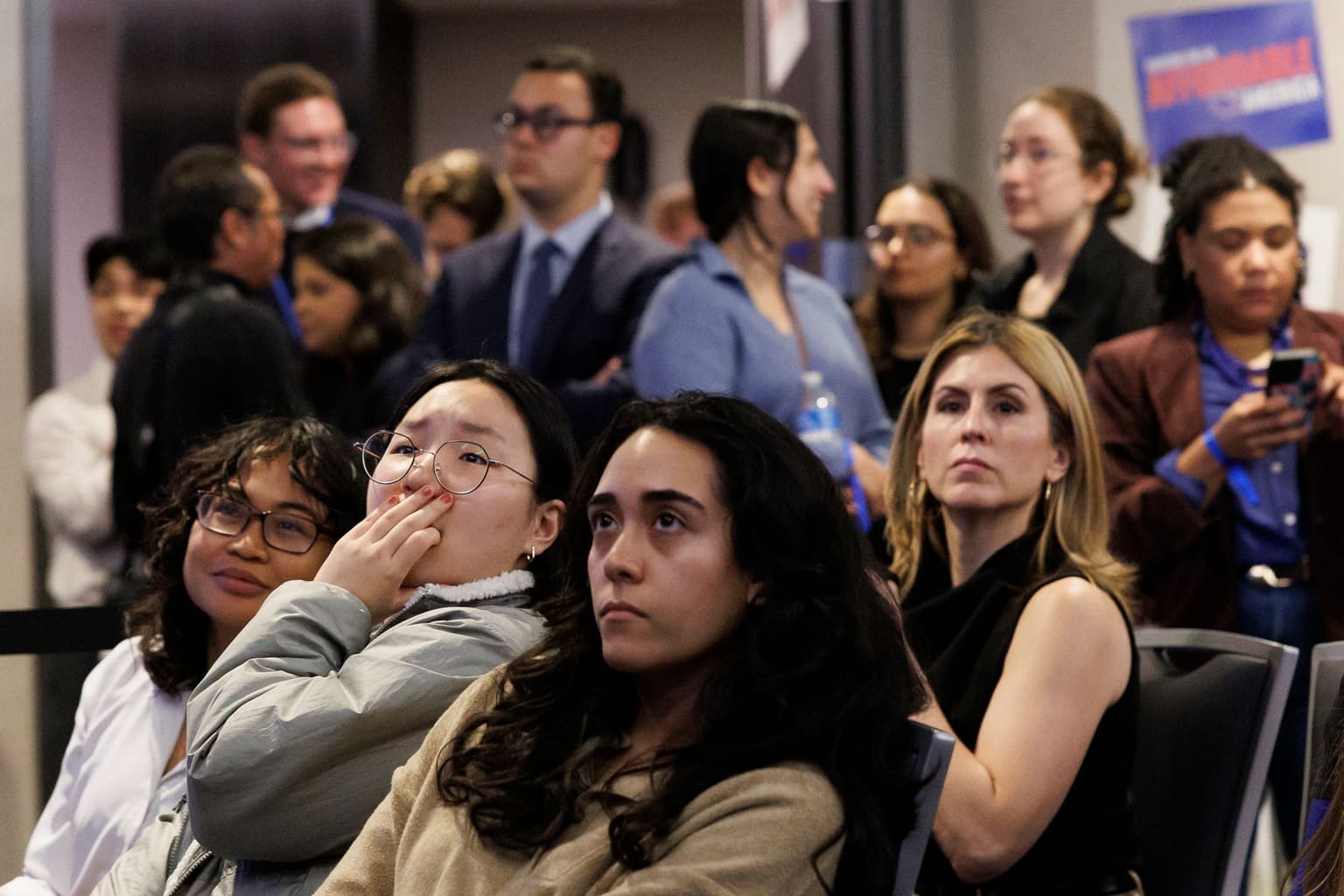
Attendees watch a live election results feed during a midterm election night watch party held by the Democratic Congressional Campaign Committee (DCCC) at the AC Hotel Washington DC Capitol Hill Navy Yard in Washington, D.C., U.S., on Nov. 3, 2026. (Tom Brenner / Getty Images)
 on Google
WASHINGTON, United States — "It is a funeral," a conservative voter from South Carolina said, gesturing toward the crowd inside the Butterworth, a restaurant in the heart of Washington that has long been favored by members and supporters of the Republican Party.
It is where Washington Republicans come to see one another — and to be seen.
On election night, the restaurant had initially been bustling. More than 650 people had registered to attend, and a line of guests stretched out from the front door. The crowd embraced patriotic fashion and MAGA symbolism, sporting red caps, American-flag socks and ties, and costumes inspired by historical American figures.
But as midnight approached, showing Republicans losing control of both the House and the Senate, the festive mood had all but vanished, and the crowd steadily thinned.
The evening had turned into a political Cinderella story: the glamour was gone, and the carriages had turned back into pumpkins.
The young businessman, who asked not to be identified by name, was blunt in his criticism of the president, blaming his party's midterm losses on Donald Trump's failure to deliver on his promises.

In his view, voters in his traditionally conservative state had turned against Republicans, rejecting Darlin, Lindsey Graham's sister, whom Trump had nominated for the seat, in favor of a Democratic candidate.
"She was incompetent. People turned blue," he said.
But his disappointment with Trump went beyond the election.
"He did not deliver on promises," he said, pointing in particular to the president's pledge to end Russia's war in Ukraine within 24 hours of taking office. For the businessman, the issue is personal: He has invested in businesses in Ukraine and has a direct stake in the country's future.
For Roxana Sasani, an Iranian-American born in Tehran who lived there until her teenage years, the war in Iran shaped the midterm vote. While many Americans focused on the conflict's economic fallout, particularly rising energy and grocery prices, Sasani said the U.S. military intervention had pushed many Iranian-Americans toward the Republican Party.
"That war made Iranians be more Republican and vote red," she said, describing what she saw as a significant shift among Iranian-American voters.

Sasani said she had little knowledge of Trump's policies toward Ukraine and did not want to comment without learning more. But she expressed hope that the American president would help bring an end to the fighting.
Having fled Iran in search of freedom and stability, she said she wanted the Ukrainian people to enjoy the same security.
"I want Ukrainians to live in peace without any worries that there is a war or them losing their cities," she said. "I really truly hope that whatever our president is capable of doing so that Ukraine can live in peace."
Ron Ali Davis, one of the few people of color at the Republican gathering, offered a sharply critical assessment of the party's 2026 performance, arguing that Republicans had failed to do the groundwork needed to broaden their appeal.
"The Republican Party needs to diversify their audience," he said, adding that money alone could not make up for what he saw as a disconnect between the party's promises and what voters actually needed.
With Democrats having taken control of both the House and the Senate, he said, "the world will change again." He predicted that President Trump could spend much of the next two years facing legal proceedings, along with people associated with his administration.

"I would assume that we are going to see a lot of Netflix specials over the next couple of years," he added, suggesting that the political fallout could provide material for a string of documentaries.
His own political priorities, he said, were rooted less in foreign policy than in problems facing American families.
A Black man involved in grassroots work with young people and families, he said he knew little about Trump's policies toward Ukraine and struggled to see why Americans should focus on conflicts abroad when so many problems remained unresolved at home.
Broadband access, he said, was among the most pressing concerns, alongside what he described as renewed battles over civil rights, women's rights and marriage equality.
"If I, as a Black man, got to wake up every day and deal with a lot of bullsh*t here, how the hell am I going to worry about some sh*t that ain't even in front of me?" he said. America, he argued, needed to address its own problems before it could be a dependable partner to other countries.
As the night wore on in Washington, Republicans hopped from one watch party to another. Some made the rounds of three or four gatherings in a single evening, enjoying free food and drinks and seemingly endless conversations about the failures of the party and the president elected on a promise to shake up Washington.
But despite the scale of the Republican losses, few seemed eager to talk on the record about what had gone wrong — or to confront the possibility that voters had delivered a broader rebuke to the party and its president.
John Fredericks, a conservative radio host seeking a leadership position in Washington, D.C.'s Republican Party under the slogan "Make D.C. Great Again," hosted a gathering of conservatives at the University Club near the White House.
He dismissed Trump's pledge to end Russia's war against Ukraine within 24 hours, saying the conflict had no foreseeable resolution.

"It's not solvable," Fredericks said when asked about Trump's approach to the war. He predicted the fighting would continue for at least the next two years, arguing that neither Russian President Vladimir Putin nor President Volodymyr Zelensky was in a position to accept a settlement.
"Putin is not going to give up. The Ukrainians are not going to give up. There's no peace in our future," he said.
Fredericks argued that Zelensky would risk losing his presidency if he agreed to a peace deal, while Putin could not tell Russian mothers that "your sons died for nothing."
"This thing is going to go on and on and on. And it's the saddest thing in history," he said.
On the domestic political front, Fredericks dismissed Democratic gains and predicted Republicans would regain control in 2028. He described Democrats as "a clown show," saying they would turn against one another and pursue impeachments without winning over voters.
Henrique, a Venezuelan who now lives in Miami, embraced the patriotic spirit of the gathering, arriving dressed as George Washington, one of the U.S.'s Founding Fathers. His dog, sporting a MAGA hat, completed the look. Henrique voiced support for Trump's intervention in Venezuela and admiration for Ukraine's resistance to Russia's invasion.
An openly gay man who hopes to have children through surrogacy, he said he would like one of his future children to have a Ukrainian biological mother. He was drawn to what he described as the resilience of Ukrainians, shaped by generations of upheaval, from Nazi occupation and Soviet rule to Russia's full-scale invasion.
"That fighting spirit over centuries is amazing. I want that DNA in my next-generation family," he said.

Ukraine, he said, should never have surrendered its Soviet-era nuclear arsenal under the 1994 Budapest Memorandum. Drawing a parallel with Venezuela, which he said has lost roughly a fifth of its historical territory through border disputes and international arbitration.
Henrique, who provided only his first name, said he feared Ukraine could face a similar fate.
Yuval David, a fellow at the Middle East Forum with family roots in the Ukrainian cities of Odesa and Lviv, who advises 40 governmental and non-governmental agencies in the U.S. and Israel, argued that supporting Ukraine was in Washington's strategic interest.
"The Ukraine-Russia war has gone on way too long," David said. "No matter what people might think of Zelensky, the point is, Russia is an enemy of the United States. Ukraine is not an enemy of the United States."
He said a stronger Ukraine would serve U.S. interests, while arguing that Washington had fallen short in its military support. David attributed the limits on assistance partly to political infighting in Washington, including disagreements over the allocation of funding and the amount of military aid provided to Kyiv.
"The United States has helped a lot, but from my perspective, focusing on geopolitical situations, it hasn't helped enough," he said.
As the second year of Trump's second term draws to a close, Democratic gains in the midterm elections have raised questions about the Republican Party's continued loyalty to the MAGA movement and its founding figure — a president who has steered the party at full speed into uncharted waters, with political icebergs looming ahead.
With Democrats poised to intensify scrutiny of the Trump administration, Washington is bracing for two years of turbulence on Capitol Hill. For Ukraine, the shifting balance of power could bring both new opportunities and fresh uncertainty. Some observers believe increased congressional oversight could reshape Washington's approach to Kyiv, even as the future of U.S. support remains uncertain.