Our readers' questions about the war, answered. Vol. 12
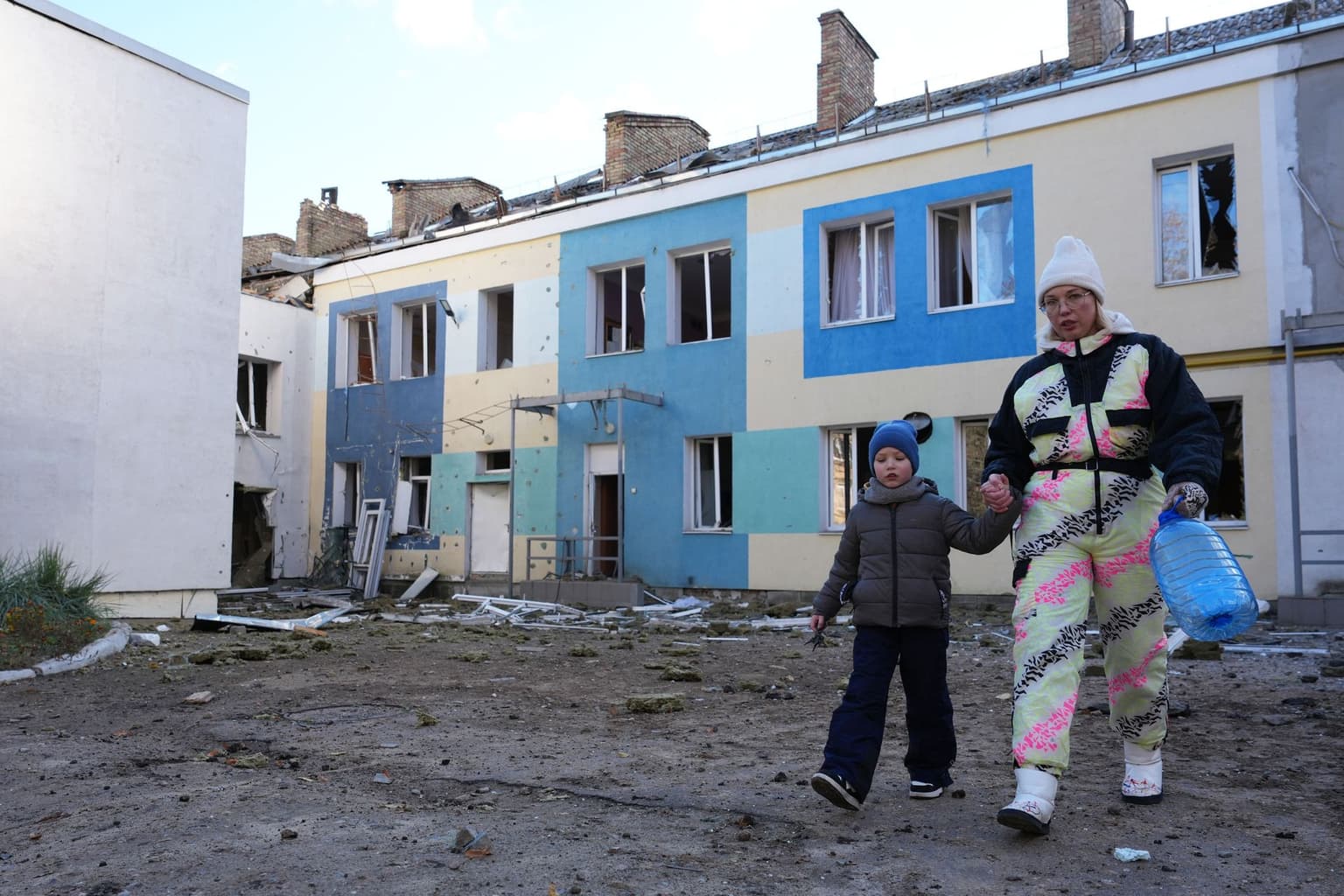
A woman and a child walk past a kindergarten damaged by a Russian missile strike in Kyiv, Ukraine, on Nov. 7, 2026. (Ivan Antypenko/Suspilne Ukraine/Global Images Ukraine via Getty Images)
 on Google
Editor's note: We asked members of the Kyiv Independent community to share their questions about Russia's war on Ukraine. Here's what they asked and how we answered.
Join our community to ask a question in the next round.
Question: The Trump-Putin agreement on diesel exports doesn't seem like good news for Ukraine, but 125,000 barrels a day doesn't seem like a big win for Russia either. Will these funds actually help Russia's economy and its war machine? Is it mostly propaganda ahead of the U.S. midterms, or part of a broader pattern in the relationship between Trump and Putin since 2024?
Answer: While every cent goes toward Russia's war machine, I do not think we can call it a major win for Russia's economy, nor for America's diesel shortage. However, it is a major political win for Putin on the global stage because it normalizes relations with Russia and undermines efforts from Ukraine's allies to wean the West off Russian energy. From my perspective it is largely for propaganda purposes and for Trump scoring a cheap but ultimately dangerous win. It signals Trump's total disdain for Ukraine, while slowly normalizing relations with an aggressive, gangster nation. — Dominic Culverwell, Business Reporter
Question: Could Operation Vivaldi be replicated in future Ukrainian combined-arms offensives? And how has the return of tactical and operational mobility to the battlefield changed the way FPV drones are used?
Answer: Some people whose opinions on the battlefield I greatly respect believe that a return to real maneuver is possible, and that cases like Operation Vivaldi are just the first step toward operations in which real breakthroughs can be achieved, with vehicles punching deeper behind the front line.
I'm not one of those people. The main reason for that is Ukraine's current manpower stocks and the steady, if not always spectacular, expansion of the Russian army's drone component. Overall, we still see that the kill zone continues to widen, deepen, and thicken with time, which means that massing forces and punching through only gets more difficult. What Vivaldi showed us instead, in my opinion, was how you can attack at all under these conditions. This is not the traditional combined arms of tanks, armor, and artillery supported by drones. This is a new type of combined arms, where drones do most of the work, where suppressing enemy drone forces and logistics deep into the rear is the top priority, and where those moving forward on the ground do so slowly and stealthily, pushing, then clearing, then pushing again in very small teams.

Ukraine achieved success in two larger counterattacking operations this year, in Operation Vivaldi, but also in counterattacks in the south led by the Air Assault Forces. The formations that led these operations are some of Ukraine's most elite military groupings, and I have no doubt that they will continue to learn the lessons from these operations to do even better in the future. I believe we will see more offensives. I just do not think they will be based on maneuver. — Francis Farrell, Senior Reporter
Question: Ukraine was well ahead of Russia in the drone field and had more time to develop both the technology and the pilots. How did the current reversal in the drone competition come about, and how did Russia catch up? Is electronic warfare struggling against the new attacks? And is it really impossible to carry out deep strikes without Starlink, if access were ever withdrawn?
Answer: Ukraine is still ahead in many areas of the drone war, particularly in the areas of middle-strike, interceptor, heavy-lift/logistics, and ground and seaborne drones. Ukrainian electronic warfare is still effective against a wide variety of Russian munitions, although details are typically kept confidential. The Ukrainian deep-strike campaign does not rely on Starlink or Starshield, so if access were withdrawn, it would have no impact. — Jimmy Rushton, Special Correspondent

Question: Is there any progress in developing defenses against ballistic missiles, glide bombs, and Russia's newest jet-powered drones?
Answer: These are different problems that require different solutions. The main defense against ballistic missiles is PAC-3 Patriot interceptors, with electronic warfare and jamming playing a secondary role. Destroying Russian production and the missiles' mobile launchers are also important measures.
There is little defense against glide bombs, apart from electronic warfare and destroying the launching aircraft.
Jet-powered drones can be easily engaged with surface-to-air missiles and jets, but are typically launched in numbers that will overwhelm such methods. Interceptor drones are likely the only sustainable solution, and a new generation of such drones is currently under development. — Jimmy Rushton, Special Correspondent
Question: As Ukraine is the last frontier between Russia and Europe, what is Europe realistically ready and capable of actually doing to support Ukraine in concrete ways? And for those of us in EU countries, how can we help Ukraine on its path to membership? Is that still what Ukrainians want?
Answer: Since the U.S. halted nearly all of its military aid to Ukraine, Europe is currently the leading contributor to Ukraine in terms of both defense and economic support by far. It is mainly European NATO allies who buy defense packages for Ukraine under the PURL initiative, and Ukraine currently receives EU funds under a 90 billion euro ($100.73 billion) loan that helps meet its needs, from drone production to the day-to-day running of the state.
European countries are also helping co-produce drones for Ukraine and provide artillery, air defenses, missiles, small arms, intelligence support, and more.
"If you want to help that effort, vote for parties that want to see Ukraine in the EU, let your local MP or MEP know this is something that matters to you, and talk to your friends and family about what is happening in Ukraine and why you think it should be a member of the European family."

Of course, Europe could do more. European governments are reluctant to provide more Patriot interceptors, which would greatly help Ukraine weather Russian attacks over the winter. Many countries, including larger economies such as Italy and France, are also reluctant to increase financial support due to their own budget constraints. What would help most with this issue would be if the EU moved more decisively to use immobilized Russian assets to help Ukraine. Belgium, where most of the assets are held, is currently blocking any movement here, as it first wants guarantees from other European countries that it will not bear the risk alone.
And yes, Ukraine is still very much interested in EU membership and, since Orban's defeat in Hungary's parliamentary elections, is making progress.
If you want to help that effort, vote for parties that want to see Ukraine in the EU, let your local MP or MEP know this is something that matters to you, and talk to your friends and family about what is happening in Ukraine and why you think it should be a member of the European family. — Martin Fornusek, Assistant Editor
Question: How are Ukrainians preparing to get through the winter, and what can those of us outside Ukraine do to help? Is relocation from Kyiv to countryside villages a good idea for the winter months, and what would a large-scale relocation mean for the city?
Answer: Ukrainian people are prepared, but I cannot say that the government has prepared the country enough. Throughout this year, I have been speaking to energy officials and advisers about winter preparations, and all of them are worried. One official told me that she was "scared for this winter."

Many people are considering relocation, not just to villages, but to western regions where the situation will be better because they have more energy generation facilities and can easily import power from the EU. A large-scale relocation from Kyiv will have economic consequences due to fewer people working and buying in the city. But with fewer people consuming power, it might help take pressure off the energy grid, so power outages may not be as severe.
For those of you not in Ukraine who want to help, fundraising to buy equipment such as generators is one great possibility. There are a lot of NGOs working to help prepare the country for winter. — Dominic Culverwell, Business Reporter
Question: How much has normal learning been disrupted? How many schools are actually built underground with enough room to actually be a classroom?
Answer: Learning in Ukraine has not just been affected now, but has suffered toll after toll since Feb. 24, 2022. As Russian attacks intensified over the past months, learning has been even further disrupted.
The difference lies in how Russian strikes have targeted each region and what has been done to accommodate teachers and their students.
"There's basically no learning these days. We keep connecting and disconnecting a million times throughout the day."
In Kyiv, schools face unprecedented disruption as daytime attacks repeatedly trigger air raid alerts. On Sept. 30, Kyiv was under a continuous air raid alert for 20 hours and 44 minutes, making it one of the longest sustained aerial attack warnings in the capital since the start of Russia's full-scale invasion.
The Ministry of Education and Science asked schools to prioritize in-person attendance for first through fifth grades, while the rest of the grades switch to online learning. All this depends on the institution's shelter capacity. However, learning in an underground shelter is far from ideal. Many are only equipped with benches and chairs, and schools with some desks and a board are considered lucky.

A teacher of Ukrainian language and literature for seventh, eighth, and ninth graders told the Kyiv Independent that, at best, a "normal" school day goes without an air raid alert for 1.5 to 3 hours.
She added that students are experiencing educational setbacks "under conditions of constant stress, panic attacks, and threats to our lives."
Older students connect online, but as soon as the air alert sounds, regardless of its severity, the teacher halts the lesson and urges students to seek shelter. "There's basically no learning these days. We keep connecting and disconnecting a million times throughout the day," an eighth grader told the Kyiv Independent.
According to the Kyiv City State Administration, about 94% of educational institutions in the capital are equipped with basic shelters on-site. Over ten schools have switched entirely to online learning. Overall, about 82% of Ukrainian schools have shelters as of the start of this academic year, the Ministry of Education and Science said.

The situation closer to the front line, for example in Zaporizhzhia, is far from normal. Ukraine's first completely underground kindergarten opened there, with a capacity of 140 people, including 115 children. A similar establishment opened in Kharkiv Oblast, where 260 children can learn safely.
With the new wave of constant Russian attacks throughout the day and night, Ukraine's education system is suffering massively, but we cannot yet assess the scale of their impact.
We have reported on how first graders started their first day of school. — Yevgeniya Doluda, Reporter
Question: Why does the Ukrainian government continue to work with Trump's envoys in the peace negotiations? Their approach seems, at best, ineffective; at worst, biased.
Answer: It is important for Ukraine to keep the U.S. on its good side. The U.S. continues to be vital for intelligence support, particularly for early warning against ballistic missile attacks. SpaceX, a U.S. company, is also providing key services for the Ukrainian military, and the U.S. produces Patriot interceptors. The latest rift between Ukraine and Washington showed how much a disruption in these areas can hurt Ukraine.

Ukraine stands to benefit from engaging in the U.S.-led peace efforts. A ceasefire that would give Ukraine a chance to breathe, rebuild its energy grid, sort out its budget, and rest its troops, or even potentially lead to a broader, just peace deal, is certainly in Kyiv's interest. Refusal to engage in these peace efforts would make it easier for Trump to blame Ukraine for the failing negotiations and provide him with justification to cut off the remaining support. But as we saw over the past few weeks, he does not always need a justification. — Martin Fornusek, Assistant Editor
Question: Apart from membership and donations, what's the single best thing we can do from abroad to help Ukraine?
Answer: The most useful thing you can do is keep Ukraine in the conversation. Share reliable reporting, talk with people around you about what is happening, and point them to organizations working on the ground.
We know that from abroad it is hard to tell which needs are most urgent and which organizations can be trusted. That is why we started "How to Help Ukraine," a newsletter that introduces vetted Ukrainian organizations and shows where support matters most right now. This year alone, our readers helped raise over $50,000 for nine of them, supporting older people, refugees, animals, and soldiers on the front line. The best way is to subscribe, share it with someone who has been asking how to help, and pass on the stories that matter to you. — Anastasiia Chernova, Community Manager