Explainer: What top Zelensky staffer's bail saga tells us about Ukraine's justice system
 on Google
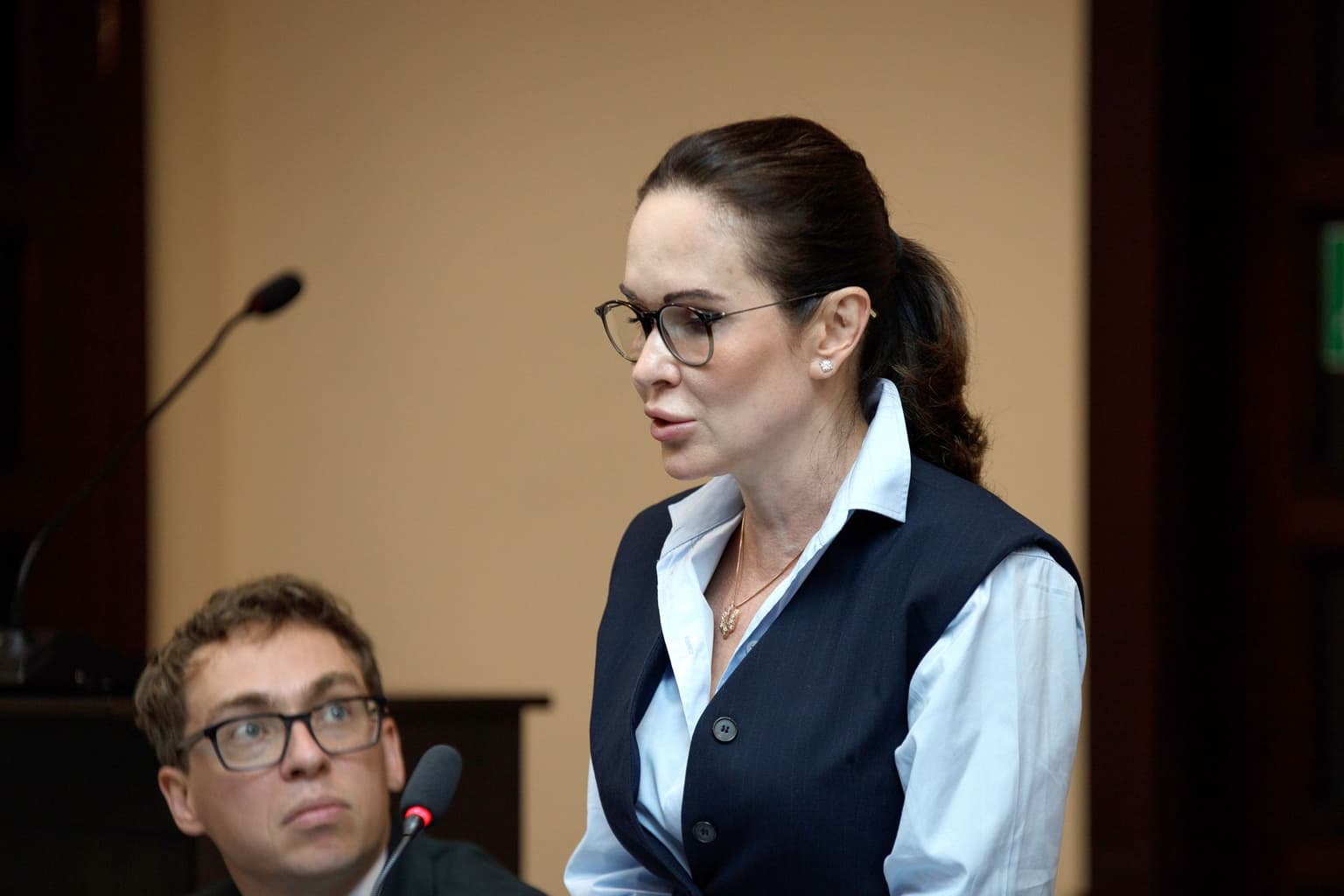
The release from custody of Iryna Mudra, a former deputy head of the President’s Office, last week followed an unusual development.
While Ukrainians had been previously accustomed to corruption suspects easily escaping justice, now the trend was the opposite. Mudra had the money to pay the bail but banks refused to process payments for posting it, fearing that they could be accused of taking part in money laundering.
Furthermore, decreasing political protection for corruption suspects may motivate suspects to testify on other participants of criminal schemes.
One of the crucial questions is whether Mudra's former boss, President Volodymyr Zelensky's Chief of Staff Kyrylo Budanov, is involved in her alleged corruption scheme.
The Kyiv Independent has requested comment from the President's Office and will publish its response once it is received.
Mudra's bail saga
In August, Mudra, lawmaker Maksym Mykytas, and Viktor Dubovyk, head of the legal policy department at the President's Office, were charged with laundering Hr 150 million ($3.4 million) and transferring the funds through Sense Bank to post bail for ex-Energy and Justice Minister Herman Halushchenko.
Halushchenko was charged by the National Anti-Corruption Bureau (NABU) in February as part of last year’s probe into state nuclear energy monopoly Energoatom — the largest corruption investigation of Zelensky’s tenure.
Mudra, Mykytas and lawmaker Vadym Stolar were also charged in August with illegally seizing real estate by hacking the corporate register, forging documents, influencing the Justice Ministry and bribing judges and prosecutors.
On Aug. 25, the High Anti-Corruption Court placed Mudra in custody for two months and set bail at Hr 20 million ($448,000).
However, for a long time banks refused to process payments for Mudra’s bail.
Mudra’s lawyers accused the banks of blocking payments without justification and in violation of the law.
"The accusations against her involved money laundering through bail payments," Tetiana Shevchuk, a lawyer at the Anti-Corruption Action Center, told the Kyiv Independent. "The case attracted a great deal of attention, which made banks cautious about processing those payments."
She said that "this became a sensitive issue because a bank could process a payment today, only for a journalistic investigation to come out tomorrow, prompting the National Bank of Ukraine (NBU) to step in and accuse it of violating financial monitoring rules."
Roman Verbovskyi, another expert at the Anti-Corruption Action Center, argued that "banks simply decided not to process any payments in this case, even if there was documentation showing that the funds were legitimate, because they feared the money might have come from illegal sources."
In September, the High Anti-Corruption Court ordered the National Bank to investigate banks' decisions to block payments for Mudra's bail.
As a result, the bail was paid, and Mudra was released on Oct. 8.
However, the bail payments were not entirely transparent, according to an Oct. 8 investigation by Radio Free Europe/Radio Liberty (RFE/RL)'s Schemes project.
The bail was paid by Mudra herself, her common-law husband, a singer, a private company engaged in wholesale meat trading, a cleaning woman convicted of stealing gaming devices, a person who had previously posted bail in a different corruption case, and a man who had been sued by an energy company over unpaid debts, Schemes reported.
In some cases it was not clear where the individuals and entities got the money or what they have to do with Mudra. Some of them declined to comment on their motives.
"The investigation by Schemes reveals that the source of the money wasn't entirely transparent," Shevchuk said. "So there may have been legitimate grounds for blocking the payments, and the banks may have been justified in doing so."
Masi Nayyem, founder of the law firm Miller, told the Kyiv Independent that they "can only respond to what has actually happened."
"We don't know the people who made the payments," he said. "If they broke the law, everyone responsible should be held accountable."
Miller represents Mudra's interests in court.
Mudra's potential accomplices
The difficulties with Mudra's bail were similar to those faced by ex-Justice and Energy Minister Halushchenko.
The court set Hr 150 million ($3.3 million) bail for him in February, but he struggled to raise the money. He spent several months in a detention facility, and the bail was posted only in June.
According to Shevchuk, keeping Halushchenko out of jail was important for his accomplices because he could have tried to cut a deal with the Anti-Corruption Bureau and testify against them. The same applies to Mudra, she believes.

"When someone is held in pretrial detention, they may become more willing to cooperate with investigators or seek revenge against their accomplices," Shevchuk added. "So getting someone out of pretrial detention is the first priority if you want to ensure they remain loyal."
One of those against whom Mudra could potentially testify is her former boss, President's Office Head Kyrylo Budanov.
A person matching Budanov's description allegedly asked Mudra to launder cash to pay bail for Halushchenko, according to the leaked text of the charges against Mudra published by the media outlet Bihus.info on Sept. 15.
The official then supervised Mudra's actions in the alleged money laundering scheme uncovered by the NABU, according to the text.
The leaked text does not identify Budanov by name. However, the charges identify the person as an official of the President's Office and Mudra's boss, saying that she was trying to curry favor with that person, Bihus.info reported.
Mudra has only one boss at the President's Office — Budanov.
Furthermore, the alleged transcript of Anti-Corruption Bureau's tapes leaked to the media outlet Hromadske in August, there are multiple references to "Kyrylo," "Kyrylo Oleksiyovich," Mudra's unnamed boss, and a top official at the President's Office. There are also direct references to Budanov's last name in the transcripts.
Budanov's name and patronymic match those mentioned in the tapes shared with Hromadske.
The transcripts also involve Timur Mindich, a Zelensky associate who fled to Israel before being charged in the Energoatom case in 2025. He had informal control over state-owned Sense Bank, according to the NABU tapes.
Apparently looking for political cover while he was abroad, Mindich asked "Kyrylo"— an apparent reference to Budanov — to take control of the bank, according to a June statement by Mudra in the transcripts leaked to Hromadske.
In June, Mykytas also said that Mindich had delivered cash for Halushchenko's bail to "Kyrylo Oleksiyovych" — an apparent reference to Budanov, according to the alleged transcripts.
When asked about alleged references to him in the tapes, Budanov told Hromadske in August: "Let the court sort it out. You know, (my name) comes up in a lot of places."