Once shunned, Poland's Ukraine-bashing firebrand sees political breakthrough
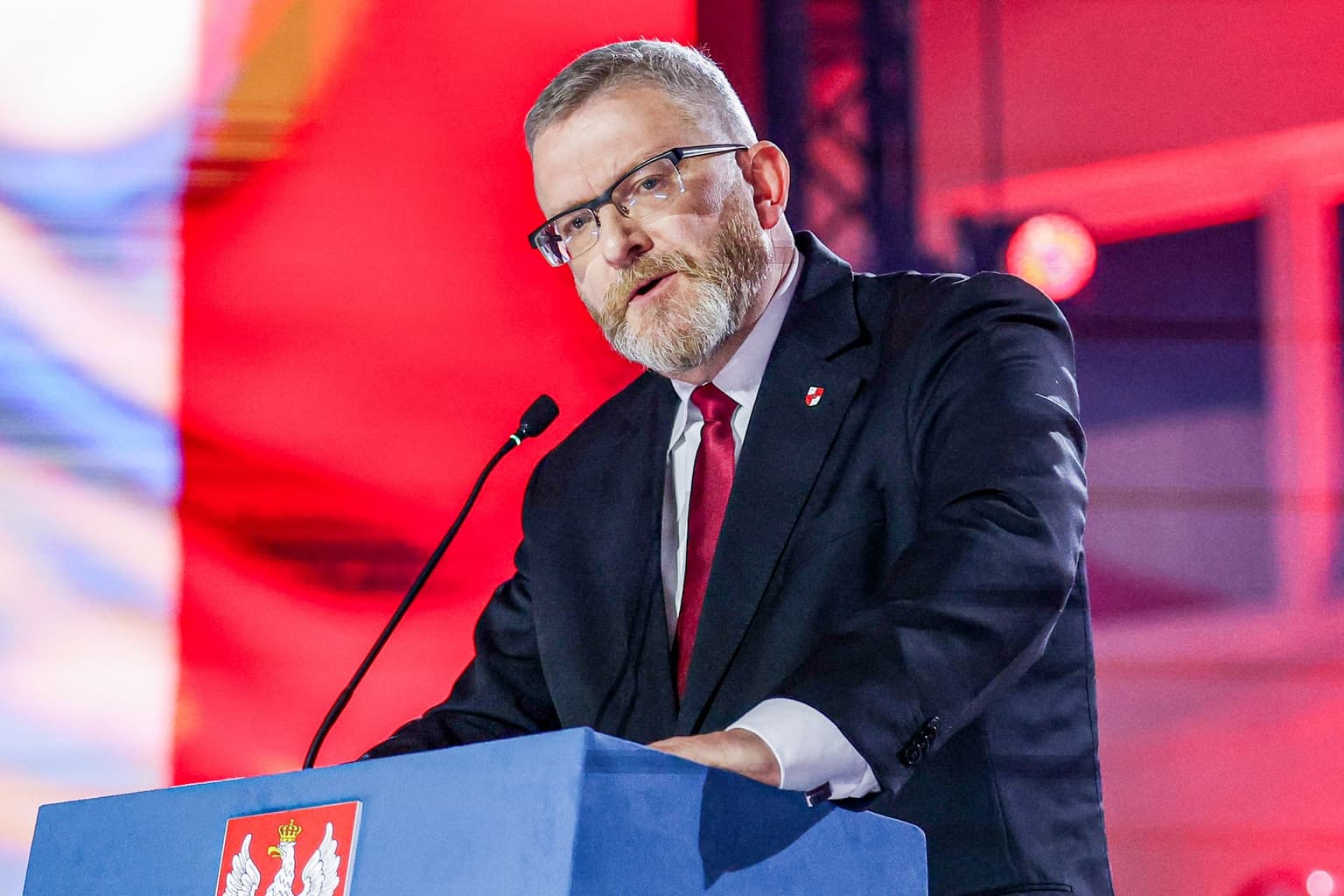
Grzegorz Braun, far-right firebrand, attends a campaign rally in Krakow, Poland, on April 12, 2025. (Grzegorz Wajda / SOPA Images / LightRocket via Getty Images)
 on Google
Once too extreme even for Polish conservatives, far-right firebrand Grzegorz Braun is now being courted by leading right-wing politicians as they seek to unite ahead of the 2027 elections.
Braun, a Moscow-friendly provocateur facing multiple charges for his antisemitic, anti-LGBT, and anti-Ukrainian stunts, leads the Confederation of the Polish Crown (KKP), now polling at around 9%.
With Poland's right-wing opposition deeply fragmented, Polish Crown voters could become an important factor in the conservative camp's efforts to challenge Prime Minister Donald Tusk's centrist governing coalition.
Conservative President Karol Nawrocki appears to be playing a central role in efforts to bring the factions closer together. He has hosted KKP representatives at the Presidential Palace and included them in high-level security discussions.
The rapprochement is already producing results.
In a notable departure from his previous position, Jarosław Kaczyński, leader of the Law and Justice (PiS) party, has suggested that Braun's political camp could be included on a joint right-wing electoral list for the 2027 parliamentary race.
As Poland's conservative camp increasingly adopts a confrontational approach toward Kyiv, Braun's growing political influence could further complicate relations with Ukraine and push Warsaw toward an even more adversarial position on its eastern neighbor.
Braun's radical agenda
The trend of the Polish right-wing scene hardening on Ukraine is undeniable.
Nawrocki has taken a more confrontational stance toward Kyiv than his predecessor, who was also a conservative, and was the main driver of a diplomatic row earlier this year over the legacy of the Ukrainian Insurgent Army (UPA).
Kaczynski has tapped the hardliner Przemyslaw Czarnek as the PiS prime minister candidate, snubbing the previous officeholder, moderate Mateusz Morawiecki, who has since moved to launch his own party.
Meanwhile, the far-right Confederation Liberty and Independence, a Ukraine-skeptic coalition, is narrowing the gap with PiS, polling third at around 14%.
But even in this crowd, Braun stands out.

While PiS and Nawrocki agree that support for Ukraine is in Poland's national security interest, the KKP runs on a complete halt to all military and financial aid.
Braun has also railed against Ukrainian refugees — less than 1 million currently live in Poland — and what he calls the "Ukrainization of Poland."
His party's five-point "Ukraine Plan" includes "immediate repairs, inspection, and maintenance" at the Rzeszow airport, which would effectively disrupt a key transport hub for military aid flowing to Ukraine.
And while denying the existence of Auschwitz gas chambers and using a fire extinguisher to put out Hanukkah menorah candles in the Polish parliament, he lambasted the Ukrainian government as a "neo-Nazi regime."
Braun made headlines in September by vandalizing a monument to the Ukrainian Insurgent Army (UPA) in eastern Poland, even as Kyiv and Warsaw signaled they are finally moving past the dispute.
And Braun goes against the Polish mainstream on other key issues — namely, Warsaw's relations with Washington and Moscow.
The far-right leader has called for the resumption of Russian gas supplies to Europe via the now-defunct Nord Stream pipelines, a position widely condemned across Poland.
"I love the smell of Russian gas in the morning," Braun said at a conference with the Alternative for Germany (AfD) party, in a twist on a famous line from the film Apocalypse Now.
And while the Presidential Palace pursues closer ties with the Trump administration, Braun has publicly backed Tehran's leadership after the U.S.-Israeli strikes.
Nawrocki opens door to Braun
Despite these ideological differences, Nawrocki has been seeking to bring Braun into the fold.
The Polish president hosted Braun at the Presidential Palace on Oct. 31 for consultations amid the Constitutional Tribunal crisis.
While Nawrocki also held similar talks with other opposition leaders and even some of the governing parties, critics blasted the KKP's presence as a tactic to "normalize" Braun in the eyes of the public.
Just a few days later, Wlodzimierz Skalik from Braun's party took part in a meeting of the National Security Council at Nawrocki's invitation — yet again despite the government's protests.
"We can't pretend that Grzegorz Braun and Grzegorz Braun's voters don't exist in Poland," Nawrocki defended his outreach to the KKP leader, stressing he "radically disagrees" with him on several issues.

Yet the president downplayed Braun's pro-Russian leanings, pointing out that it was Tusk who was embraced by Russian President Vladimir Putin at the site of the Smolensk air disaster in 2010.
Behind the scenes, Nawrocki has reportedly been negotiating an alliance for next year's Senate elections, spanning the entire right — PiS, the Confederation, Morawiecki's Development Plus, and Braun.
The so-called "Senate Pact" would prevent right-wing parties from splitting the vote in a single-member, first-past-the-post election for the upper chamber of the Polish parliament.
"Undoubtedly, this is driven by calculations regarding next year's elections," says Michal Lebduska, a research fellow at the Prague-based Association for International Affairs (AMO) think tank.
"Nawrocki has repeatedly stated that Donald Tusk's government is the worst in Poland's history and must be removed from power at any cost — a goal to which he intends to subordinate absolutely everything," he told the Kyiv Independent.
The president "has no other political objective than getting rid of Donald Tusk," adds Wojciech Przybylski, an editor at Visegrad Insight and president of Res Publica Nowa.
Splintered right
The challenge to Nawrocki's alliance-making is the fragmentation of the Polish right and the long-standing distrust many have toward Braun.
The Confederation — which kicked Braun out in 2025 — has kept the door open to working with him in the future.
But Kaczynski, long used to holding a grip over the right, had been vocal about his opposition to such an alliance. He previously warned it would endanger Poland's security and accused the far-right leader of "crossing civilization bounds."
That reluctance seems to be fading.
Braun's selfie with a smiling Kaczynski, taken at the Constitutional Tribunal on the evening of Oct. 30, sparked online discussion about the current state of the relationship between the two politicians.
And during Poland's Independence March on Nov. 11, Kaczynski called for a united list not only for the Senate elections but also for the more powerful lower house, the Sejm.

And for that, "representatives of the three Confederations must be convinced," the PiS leader said, seemingly referring to the two parties making up the Confederation and to Braun's KKP.
"He sees that the Crown (KKP) is still strong in the polls and its results are not going down, so he tries his well-known tactic," says Michal Piedziuk, a political analyst at the Polityka Insight analytical center.
This tactic rests on casting Kaczynski himself as the "uniting man." If a party refuses his offer, they are accused of breaking the right's unity and aiding Tusk, he explains.
Przybylski also describes Kaczynski's strategy as purely instrumental.
"Kaczynski will attempt to tap the voter base of (the Confederation and the KKP), but then if he has no other choice, he will have no problems going into a post-election coalition with these parties," Przybylski told the Kyiv Independent.
He "just needs to be sure that he dominates the right wing and nothing happens without his agreement."
Still, not everyone is convinced about the benefits of an alliance with Braun.

Morawiecki's Development Plus, currently polling around the 5% parliamentary threshold, has categorically ruled out governing with Braun. Morawiecki himself warned about the "Braunization" of Polish politics, saying it plays into Tusk's hands.
Lebduska supports this thesis, noting that Tusk has already begun playing the "Braun card."
"(Braun's) normalization of relations with Nawrocki, but also, for example, his Friday photo with Jaroslaw Kaczynski is welcome news for the government in this sense," he said.
Elections remain a year away, and the voters' support and political alliances can yet shift. But Braun's steady departure from political isolation is nevertheless a poor sign for Ukraine.
"It would certainly mean further radicalization of the Polish political scene and society," Lebduska comments on the possibility of Braun's party gaining a stronger voice on the right, or even participating in the next government.
"This also applies to the relationship with Ukraine, where it would almost certainly push Polish policy toward the extreme and quite possibly lead to a significant deterioration in Polish-Ukrainian relations."
Note from the author:
Hi, this is Martin Fornusek.
I hope you enjoyed this article. In our team, we believe fact-based and truthful reporting should be available to all — that's why we don't use any paywall.
If you'd like to help us provide you with more in-depth coverage of Ukraine's struggle against Russian aggression, European politics, and other topics, please consider joining the Kyiv Independent community.