Luxembourg's excuse for de-listing Russian oligarch Mikhail Fridman fails to convince
 on Google
LUXEMBOURG — Luxembourg's prime minister defended his government's September push to delist Mikhail Fridman from EU sanctions in the country's parliament on Oct. 12, primarily by showing a lack of awareness of EU rules.
In September, the EU took the controversial decision to delist two Russian oligarchs, Mikhail Fridman and Alisher Usmanov, after a threat by France, Luxembourg, and Slovakia to otherwise let all 3,000 of the bloc's Russia sanctions expire.
The sanctions were due for renewal, and that required unanimity to proceed, allowing the three countries to plausibly make this threat.
In Luxembourg's foreign affairs committee, whose meetings are not made publicly accessible, Prime Minister Luc Frieden justified the move in terms of national interest, two lawmakers, Franz Fayot from the social democrats and Sam Tanson from the green party, told the Kyiv Independent.
Frieden said that the national interest was to try and make an arbitration case initiated by Fridman for $16 billion go away, "given the exceptionally high amount of his claim relative to Luxembourg's national budget," Tanson explained.
With Slovakia pushing for the delisting of Usmanov and Fridman, and France doubling down specifically over Usmanov, Frieden explained to lawmakers that he made the "opportunistic" calculation that getting Fridman delisted now might cause him to drop the arbitration and thus benefit Luxembourg in the long run, Fayot said.
However, as Fayot and Tanson explained and Luxembourg's leading newspaper the Luxemburger Wort also reported, there was no contact between the Luxembourgish government with Fridman or his legal team, and so far, that arbitration proceeding has not been withdrawn.
"Luxembourg appears willing to weaken the EU sanctions regime in response to a potentially enormous financial liability without having established that delisting would eliminate it," Tanson said.
The move might even have weakened Luxembourg's case in any eventual arbitration proceeding, Fayot added.
This could be interpreted as an "admission that Luxembourg had a say ... contrary to what was pretended," Fayot said.
Frieden's fears also do not hold ground, given the EU clarifying with every sanctions package that countries do not have to abide by any legal ruling to compensate sanctioned Russian companies or individuals if sanctions are the reason a deal or contract could not be carried out.
A European Commission spokesperson told the Kyiv Independent that the EU's sanctions regulations include a "no-claims clause" to that effect, adding that the latest sanctions packages included a range of additional safeguards to allow those who uphold sanctions to recover damages incurred in doing so.
However, that did not stop Frieden from saying there was "no solidarity at EU level for any damage," Fayot said.
Tanson told the Kyiv Independent that the solidarity question was not discussed in detail, but that it appears to be "the government's general position ... that Luxembourg would have to bear the financial burden alone if it were ordered to pay compensation."
Tanson explicitly asked Frieden about EU rules that would protect Luxembourg from having to compensate Fridman after a future court ruling, to which he replied "he was not aware of such a rule," an exchange also confirmed by Fayot.
The Kyiv Independent asked Prime Minister Frieden's head of communications about these comments and asked for a reaction but had not received any response at the time of publication.
The Luxemburger Wort also reported that Luxembourg's Bilateral Investment Treaty (BIT) with Russia was cited as a basis for having to respect the ruling of an arbitration in Fridman's favor.
In comments made separately to the Luxemburger Wort, Tanson said she asked if it would not make sense to terminate the treaty, but that Foreign Minister Xavier Bettel opposes this.
In the EU, there have been some conversations about a coordinated ending of the bloc's BITs with Russia, of which 17 still exist, but even so the comments made by the EU about an obligation to not comply with legal rulings that undermine sanctions also extends to these treaties.
Instead, Fayot told the Kyiv Independent that he fears Luxembourg has "set a dangerous precedent," as other Russian oligarchs may push to get the same treatment.
The move "weakens the position of smaller countries," and risks creating a "regulatory chill" Fayot warned.
"If a single (small) member state can be put under sufficient financial pressure through judicial or arbitration proceedings to push for an individual's delisting, this risks undermining the entire sanctions system," Tanson said.
Tanson added that the sanctions delistings send the "wrong signal to both Russia and Ukraine."
For her, the move tells Moscow that EU unity is fragile, and for Ukraine, "it raises serious questions about the reliability of European support."
Fayot also said "he's sure the Ukrainians aren't crazy about this," a fact confirmed shortly after the committee meeting.
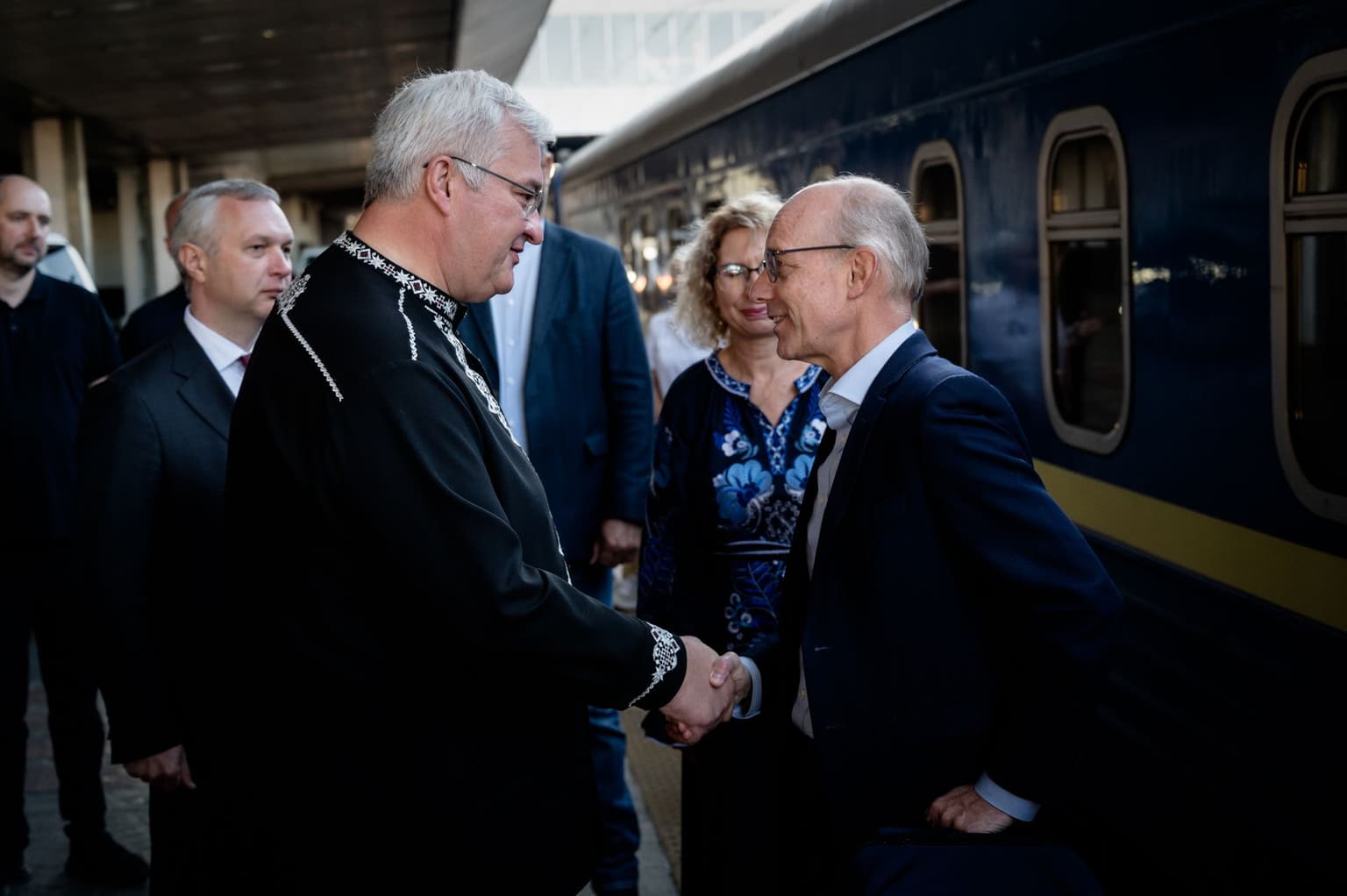
That same morning, Foreign Minister Andrii Sybiha met with Prime Minister Frieden, then immediately headed for a meeting of EU foreign ministers, where he told journalists "our position is that the delisting of the two Russian oligarchs was a wrong step, it was a wrong decision."
"That's why we will propose to impose sanctions on an additional 10 Russian oligarchs. It was a wrong step," Sybiha repeated.