Who are Usmanov and Fridman, the Russian oligarchs France helped remove from the EU sanctions list?
 on Google
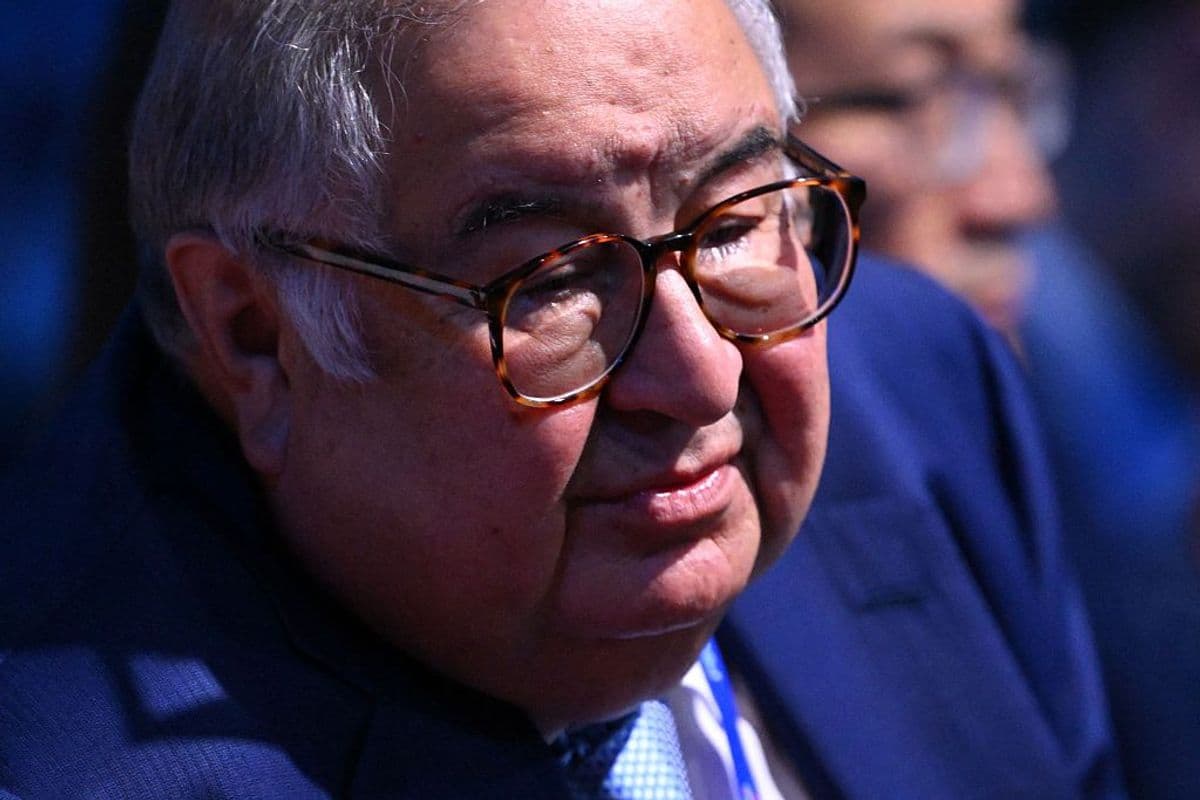
The European Union is expected to lift sanctions on two high-profile Russian oligarchs — Alisher Usmanov and Mikhail Fridman.
The ruling will come after days of intense negotiations that could have seen the entire package of EU sanctions, imposed since 2022, go to waste.
The push was spearheaded by Slovakia, yet it was France that held the new round of sanctions extensions hostage. The Financial Times previously reported that Paris wants to delist Usmanov because Azerbaijan has made it a condition to release two French prisoners.
The Kyiv Independent explains who Usmanov and Fridman are, and why Russia has fought, and won, the battle for their delisting.
Usmanov — Putin's wallet
Usmanov was born in 1953 in Uzbekistan.
In 1980, Usmanov was sentenced to eight years in jail on charges of receiving a bribe. In 2000, the Supreme Court of Uzbekistan ruled that the case against him was fabricated and no crime had been committed.
The oligarch was sanctioned by the EU, the U.K., and the U.S. in 2022.
"Alisher Usmanov is a pro-Kremlin leading businessperson," the EU said. "…Usmanov has particularly close ties to (Russian President) Vladimir Putin. He has been referred to as one of Vladimir Putin's favorite leading businesspersons."
The EU also said that Usmanov was "entrusted with servicing financial flows but whose positions depend on the will of the president" and "has reportedly fronted for… Putin and solved his business problems."
Meanwhile, former Russian President Dmitry Medvedev "benefited from the personal use of luxurious residences controlled by Usmanov," according to the EU.
Usmanov, who had been president of the International Fencing Federation since 2008, also stepped down from the post amid Russia's full-scale invasion in 2022.

He was re-elected president again in 2024 but suspended himself from the job the same year, saying that he did not want the federation to be sanctioned.
Usmanov was ranked by Forbes as Russia's richest person from 2012 to 2014. As of 2026, he is Russia's 10th richest person with a net worth of $14.5 billion, according to Forbes.
Usmanov controls Metalloinvest, one of Russia's largest mining and steel conglomerates.
The EU has identified Metalloinvest as a major source of revenue for the Russian state.
A Ukrainian court has found that Metalloinvest subsidiaries supplied iron-ore products to Russian industrial companies linked to Uralvagonzavod, a producer of battle tanks for Russia's Defense Ministry, according to Vladyslav Vlasiuk, Ukraine's sanctions commissioner.
Usmanov also co-owns the Udokan mine in Zabaikalsky Krai — Russia's largest and the world's third largest copper field.
Another major asset controlled by Usmanov is Megafon, one of Russia's largest mobile operators.
Additionally, Usmanov has invested heavily in IT companies.
Until 2021, Usmanov controlled VK Group, which owns the Vkontakte and Odnoklassniki social networks and the Mail RU e-mail service.
The acquisition of Vkontakte was controversial.
Usmanov bought Vkontakte in 2014, when its founder, Pavel Durov, left the country amid pressure by the Kremlin. Usmanov effectively took over Russia's largest social media platform, turning it into a government-controlled institution.
Another controversy concerns Usmanov's media assets.
In 2006, Usmanov bought Kommersant, one of Russia's leading business newspapers. As a result, the newspaper's editorial policy was brought under Kremlin control.
Another link to the Russian government is Citadel, a company that supplied Russian security services with telecommunications monitoring and surveillance technology. Usmanov held a stake in the firm until 2022.
He has also benefited from ties to Russian state-controlled giant Gazprom. From 2000 to 2014, Usmanov served as CEO of Gazprominvestholding, a subsidiary of Gazprom.
In the 2000s, Usmanov held 2.6% in Gazprom and 1% in Russia's largest bank, state-controlled Sberbank.
His reach extended abroad as well.
Usmanov invested in the U.S. social networking service Facebook through DST Global from 2009, but the fund sold its stake in 2012-2013.
In 2013-2014, he also owned $100 million worth of shares in the U.S. IT company Apple.
Until 2018, Usmanov co-owned London's Arsenal Football Club.
Similarly to many Russian businesspeople, Usmanov has invested in luxurious real estate in the U.K. He used to own Sutton Place, a 16th-century Tudor estate in Surrey, and Beechwood House in London.
Fridman — Ukrainian-born Russian oligarch
The other oligarch soon to be delisted is Fridman, a citizen of Russia and Israel. He is the founder of the Alfa Group investment conglomerate, with key interests in energy and banking.
He was born in 1964 in the Ukrainian city of Lviv and later moved to Moscow.
In the 1990s, Fridman was considered to be one of Russia's most influential businesspeople — a group of seven oligarchs, known as semibankirshchina, that bankrolled President Boris Yeltsin's 1996 re-election campaign.

In 2022-2023, Fridman was sanctioned by the European Union, the U.K., and the U.S. due to Russia's full-scale invasion of Ukraine.
"He has managed to cultivate strong ties with the administration of (Russian President) Vladimir Putin, and has been referred to as a top Russian financier and enabler of Putin's inner circle," the EU said then. "He managed to acquire state assets through government connections. He exchanged favors with (Russian President) Vladimir Putin in return for political support to his business and financial gains."
The EU also said that Putin "rewarded Alfa Group Consortium's loyalty to the Russian authorities by providing political help to Alfa Group Consortium's foreign investment plans."
Alfa AlfaStrakhovanie, a subsidiary of Fridman's Alfa Group, provides insurance to the vehicles of Russia's National Guard (Rosgvardia), whose units operate in Ukraine's Russian-occupied regions, according to the EU.
X5 Retail Group, another subsidiary of Alfa Group, cooperates with Voentorg, which provides catering and laundry services, as well as military uniforms, to Russia's armed forces, the EU said. The group also sells T-shirts bearing the "Z" military symbol used by Russian propagandists to promote Russia's war of aggression against Ukraine.

The EU's Court of Justice has ruled that the 2022 sanctions against Fridman were unjustified. The ruling did not apply to updated sanctions against Fridman imposed in subsequent years, which remain in force.
In 2023, Ukraine's Security Service (SBU) also charged Fridman with financing Russia's war against Ukraine. It said that, since the start of the full-scale invasion, Fridman had directed about 2 billion rubles through Alfa Group assets to Russian defense plants, supplied Russian troops with food, clothing, and other goods, organized material support for Russian forces, and used his insurance businesses to insure military equipment and Russian soldiers.
In 2005, Fridman was tied for the title of Russia's richest businessman with Vladimir Lisin, according to Forbes. As of 2026, he is Russia's ninth richest businessman with a net worth of $16.5 billion, Forbes reported.
He controlled Alfa Bank, one of Russia's largest banks, until 2024.
Fridman's Alfa Group co-owns Dubai-based telecommunications group VEON, formerly known as VimpelCom. The group controlled VimpelCom, one of Russia's largest mobile operators, until 2023 and still controls Ukrainian mobile operator Kyivstar.
Alfa Group also controls X5 Retail Group, one of Russia's biggest retailers, and co-owned oil company TNK-BP, a joint venture with British oil company BP, until 2013.
Like Usmanov, Fridman has also invested in high-end properties in the U.K.
Despite the sanctions, Fridman still owns Athlone House, a mansion in London.