100 years ago, Kyiv's young writers sought artistic freedom. Stalin's purges cut their experiment short
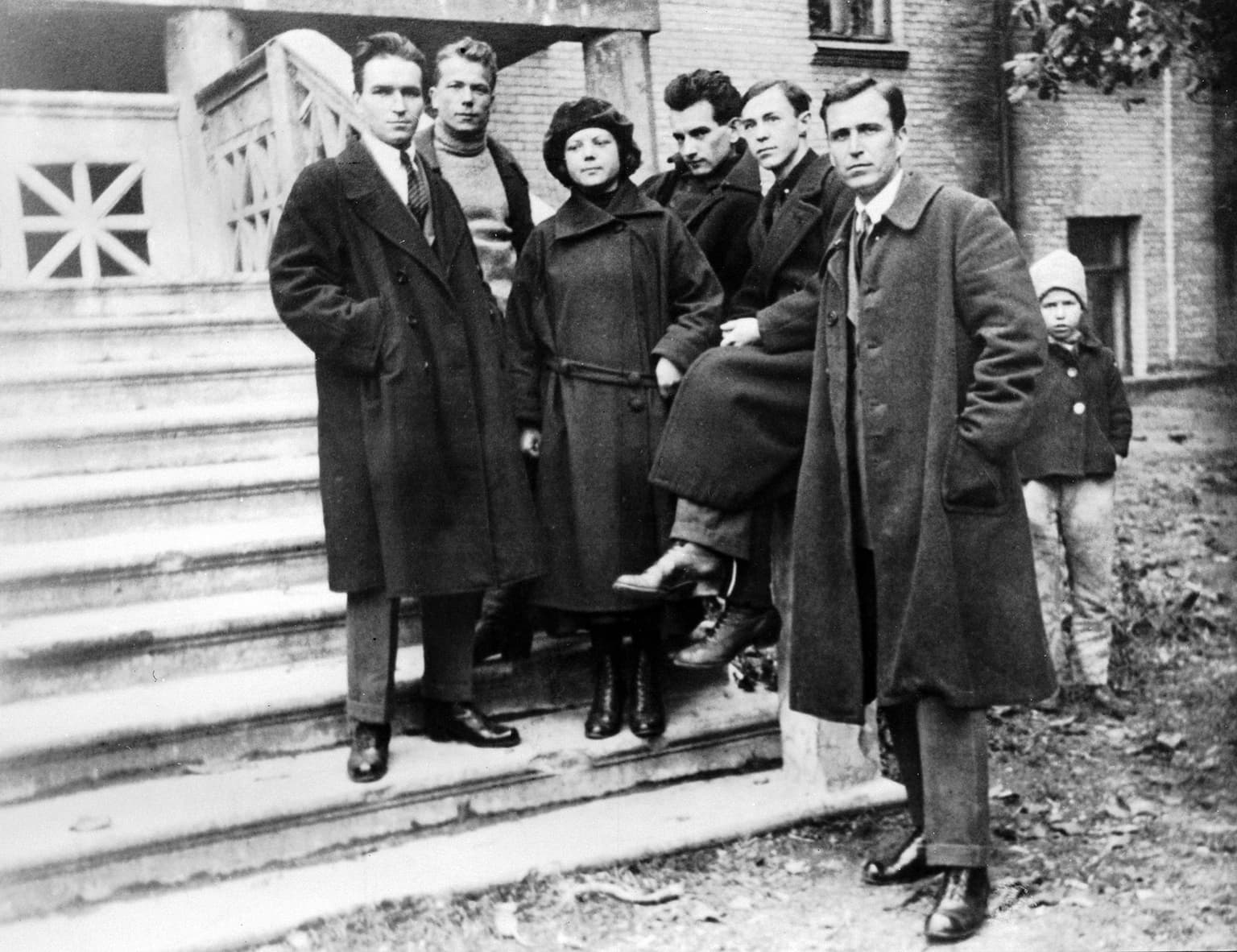
Members of the Maisternia Revoliutsiinoho Slova (MARS), or Workshop of the Revolutionary Word (L-R) Antonenko-Davydovych, Kosynka, Halych, Pluzhnyk, Pidmohylnyi, and Osmachka, at 49 Volodymyrska St. in Kyiv, Ukraine, in 1925. All except Antonenko-Davydovych and Osmachka were executed in the 1930s. (Wikimedia)
 on Google
A century ago, some of Kyiv's most talented young writers had the idea to push back against the pretension and mediocrity they worried were taking root in literary circles.
Yet, with the start of mass repression that began under Soviet leader Joseph Stalin shortly after, many of those writers never had the chance to discover what such a project could have become.
The Maisternia Revoliutsiinoho Slova (MARS), or Workshop of the Revolutionary Word, was founded in Kyiv on Nov. 7, 1926, by some of Ukraine's most prominent young authors, including Valerian Pidmohylnyi, Yevhen Pluzhnyk, and Hryhorii Kosynka.
It emerged from the dissolution of another literary group called "Lanka" — meaning "link" in Ukrainian — and announced itself to the public through a press release listing 10 founding members. A little over a year later, MARS dissolved itself.
The group's brief history, the brutal repression its members faced, and conflicting accounts of its membership and aims have contributed to ongoing debate over its place in Ukrainian literary history.
"The significance of the group is the sum of the significance of its individual members."
"They had no platform, no bylaws, and no manifesto," literary scholar Yaryna Tsymbal told the Kyiv Independent. "They simply felt that, under the circumstances, it was better to exist as a group rather than each writer operating independently."
During the Soviet period, cultural production was expected to align with state policies. Literature and the arts were meant to promote the Bolshevik Revolution, reinforce Communist Party ideals, and shape public consciousness in line with official state doctrine.
By contrast, the writers of MARS wanted to produce literature that did not conform to officially mandated frameworks. Rather than reducing literature to a political tool, they championed its role as a lens for exploring the human condition through their own works.
Pidmohylnyi's 1928 novel "The City" is one of the most striking examples of this. Its protagonist, Stepan Radchenko, leaves his rural village for Kyiv, but the novel does not portray his arrival in the city as a straightforward triumph of Soviet modernization.

The novel is less concerned with turning a peasant into a model Soviet citizen than with following the nonlinear — sometimes even morally ambiguous — ways in which a person comes to understand himself and his place in the world.
read also
MARS did not necessarily see itself as a political challenge to Soviet authority. But in a system increasingly determined to bring cultural production under ideological control, even the desire for artistic independence could attract suspicion.
Groups like MARS and the Kharkiv-based VAPLITE (Free Academy of Proletarian Literature) provided writers with a chance to meet and share ideas outside the Communist Party's direct control. As a result, they were closely monitored by the Soviet secret police, which sought to determine loyalties within the literary community and root out any potential dissent.
As Tsymbal wrote in a 2021 article for "Local History," an informant codenamed "Polishchuk" regularly reported to the secret police on what transpired among MARS members during their meetings.
"There are no organizations anywhere in Ukraine comparable to MARS, and therefore MARS is not allied with anyone," the informant told the secret police, according to archival documents cited by Tsymbal.
"Polishchuk" reported that MARS was closest to VAPLITE in its literary theories and tactics. At the same time, the informant also claimed that the Kyiv group did not share the views of what they perceived as VAPLITE's more right-wing faction, which supposedly included the group's founder, Mykola Khvylovy.

A leading figure in Ukraine's literary debates of the 1920s, Khvylovy famously argued that Ukrainian culture was more aligned with Europe than Moscow, challenging the assumption that Ukrainian literature was somehow subordinate to Russian cultural influence.
Stalin himself had identified Khvylovy as a political "problem." In 1933, overcome by the scale of the persecution of Ukrainian writers, Khvylovy committed suicide.
"There is little doubt that such comparisons only harmed (the members of) MARS," Tsymbal wrote, "given the very real danger of being accused of 'Khvylovism.'"
Like VAPLITE, MARS eventually dissolved due to internal disagreements and mounting pressure on those involved in intellectual life in Soviet Ukraine.
Several of MARS's founding members were later executed or died during the Stalinist purges of the 1930s. Pidmohylnyi was among hundreds executed in 1937 at Sandarmokh, near the Finnish-Russian border. Kosynka and Dmytro Falkivskyi were shot in Kyiv in 1934. Pluzhnyk, initially sentenced to death that same year, had his sentence commuted to 10 years in a labor camp, where he died in 1936.
Others also fell victim to the purges. Volodymyr Yaroshenko was shot in Kyiv in 1937, while Borys Teneta died by suicide in 1935 while in detention.
Given MARS's short-lived existence, it is difficult to point to collective achievements that would independently secure its place in Ukrainian literary history.
Yet the group's brief existence also offers a glimpse of the artistic approaches Ukrainian literature might have explored had its writers been allowed to write freely, rather than under the increasingly suffocating conditions of Soviet rule.
"The significance of the group is the sum of the significance of its individual members," Tsymbal said.
"Each of these writers was already a formidable creative force and an established figure in their own right, and remained so afterward."