Stay or flee? Kyiv mothers torn on how to keep children safe as Russian attacks step up
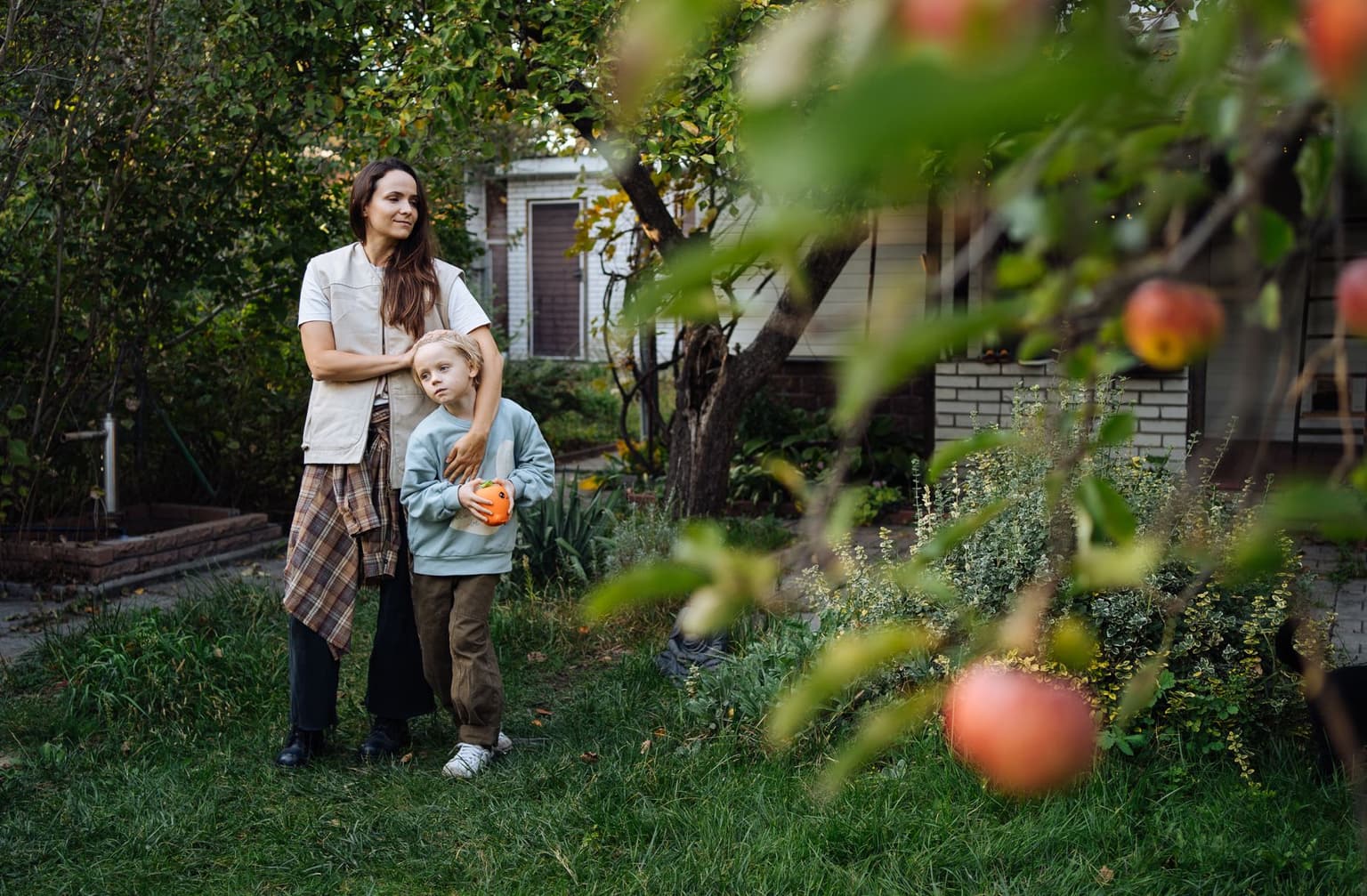
Nina Shkurba, a writer and mother, with her son Veniamin in the Osokorky neighborhood of Kyiv, Ukraine, on Oct. 4, 2026. (Khrystyna Kulakovska / The Kyiv Independent)
 on Google
Anna Lodyhina, a mother of a 5-year-old, spent many nights on the cold floor of Kyiv's metro, driven there — like many others — by relentless Russian attacks. As her child slept, she watched over him, exhausted by the constant threat and lack of sleep.
This is just a glimpse of what Ukrainian mothers have been facing daily as Russia intensified its drone and missile campaign against Kyiv over the summer and early autumn.
Mothers are now confronted with the same question they faced almost five years ago — to stay or to leave.
Many left for abroad at the onset of Russia's full-scale invasion in 2022, but returned to give their children the possibility of a childhood in their native Ukraine. But now, as Kyiv increasingly resembles cities closer to the front line, relocation has become a necessity for some.
'I never dreamed of emigration'
Lodyhina, a journalist and art researcher who moved to Warsaw in March 2022 with her then-1-year-old son, said she never imagined leaving Kyiv before Russia's full-scale invasion.
"I never dreamed of emigration," she said. After two years, they returned to Kyiv.
But as Russian attacks intensified earlier this year, Lodyhina once again faced the question of whether to leave Kyiv. Living in a building without a shelter, she and her son were often forced to take refuge in the metro and sleep on its cold concrete floor amid mass strikes.
"The child slept, but I stayed awake the entire night in the metro," adds Lodyhina. With a constant lack of sleep, her health started to deteriorate, affecting her ability to focus.
She told the Kyiv Independent that she had been actively involved in volunteer work to support Ukraine's Armed Forces, but lamented that much of it stopped once the attacks intensified.
By the start of September, she had had enough. Lodyhina and her son moved to Lviv in western Ukraine to escape the never-ending terror.
"For the past three weeks, we have slept calmly. We can't get enough of it."

"For the past three weeks, we have slept calmly. We can't get enough of it; we go to bed early and still wake up late the next morning."
Despite a relative sense of tranquility in the weeks of September, reminders of war pierce any illusion of peace. While picking up her son from kindergarten, Lodyhina overheard him say he had never known life without war. His friend agreed with childlike excitement.
read also
Her son knows the daily moment of silence — the nationwide pause at 9 a.m. to commemorate the fallen — and how to greet soldiers, she says.
As Russia continues changing its tactics, it is uncertain how long families will have to stay away from their homes in Kyiv. With winter approaching, many are also afraid of attacks on critical infrastructure that can leave the capital without heat, electricity, and water for days on end.
Lodyhina's winter preparations have been ongoing for a while now. In her new Lviv apartment, she made sure to check all the radiators and gas systems and bought a portable generator.
"I feel privileged to have a chance to relocate within the country," Lodyhina added. However, she told the Kyiv Independent that she never rules out the possibility of having to move abroad again if security and living conditions worsen in western Ukraine as well.
By October, this question is no longer theoretical, as drone attacks and air raid alerts grow more frequent in Lviv as well. Even western Ukraine is becoming less of a refuge from Russian aggression.

Children first
The turning point for Anna Ablitsova, 33, was a strike just a street away from her home. She recalls being in the kitchen while her 4-year-old son, Mykyta, was playing in the other room.
"He got really scared, started crying, ran, and put his arms around me. I got very nervous," Ablitsova told the Kyiv Independent. She notes that previous strikes, even nightly mass attacks, never affected her son this much.

When Mykyta started kindergarten, Ablitsova realized he was spending almost the entire day in an underground shelter.
"All these stories he tells me are about how (the children) were in shelters, and the teacher says, 'air raid alert, let's go to shelter,' and what kind of missile is flying their way," she says while wondering what sort of long-term repercussions such conditions will have on her son's mental health.
In August, Ablitsova and her husband began considering relocating from Kyiv amid increasingly frequent air raid alerts and drone attacks. The couple settled on Lutsk, a western city they had temporarily stayed in at the onset of Russia's full-scale invasion.
Lutsk is a five-hour drive from Kyiv, where Ablitsova and her husband work, where their family resides, and where a big part of their life remains. However, after experiencing just over a week of relative peace in Lutsk, it may prove hard to return to Kyiv.

"Now I'm a little afraid when we need to go to Kyiv. We promised to come for a birthday, but I haven't been there for a week and a half. Everything changes so quickly, and just a week ago, I lived there."
Despite having to move everything to Lutsk, at least for the next six months, Ablitsova is happy to see Mykyta no longer spending hours in the kindergarten shelter, speaking Ukrainian, and not sleeping in the hallway.
"Everyone here speaks Ukrainian. I have my child in the environment that I want him to be in, where he doesn't bring home some stupid Russian words from the kindergarten," adds Ablitsova, whose family was Russian-speaking but switched to Ukrainian on the very first day of Russia’s full-scale invasion.
But as in Lviv, the security situation in Lutsk is changing too. Weeks after the Kyiv Independent talked with Ablitsova, a Russian drone attack struck the city on Oct. 14, killing six civilians.
Adjusting to Kyiv's new reality
Leaving Kyiv amid relentless Russian attacks is not something every mother wants — or can — do.
Although many have decided to move to a safer place in Ukraine or abroad, some remain hopeful that the current difficulties will end.
"Safety is not the absence of a threat," Nina Shkurba, a 38-year-old writer, summarizes an idea developed by American psychotherapist Peter Levine.
Shkurba, along with her 9-year-old son and 16-year-old daughter, knows what it's like to be forced to leave Kyiv due to Russian aggression. Just two days after the start of the full-scale invasion on Feb. 24, 2022, she left Ukraine for the Spanish coastal city of Santander, but returned two and a half years later.
For now, she is determined to stay in Kyiv to keep the family united in their native home.
"I don't have that feeling that I need to run."

During her time in Spain, Shkurba wrote a book on the sense of belonging, which was then published in Ukraine. However, almost the entire printed supply was destroyed in August when a Russian attack struck her publisher. All that is left are the few copies in bookstores, she told the Kyiv Independent.
"I don't have that feeling that I need to run," she said, adding that going to their "dacha" — a seasonal home on the city's outskirts — helps the family recharge and find some peace.
But life in Kyiv is not the same as it was a mere few months ago. "September (was) very difficult in terms of anxiety. This is a new reality that we still have to get used to — that Kyiv feels like a front-line city," says Shkurba.
"My son has been wanting to celebrate at the Blockbuster (shopping mall in Kyiv) all year; he was looking forward to it. But we canceled both our children's celebrations in the shopping centers because of the drone threat."

Shkurba adds that children, especially her teenage daughter, are aware of the worsening security situation.
As a precaution, Shkurba renews her and her children's Spanish documents in case they have to leave Ukraine again. It is not something she is considering now, but being prepared offers a sense of control in what seems like never-ending uncertainty about tomorrow.
No end in sight
No one can say for certain how long Russia's daily drone and missile campaign against Kyiv will continue. For over a month now, the air raid alert has been on for most of the day, with the city recording over 20 hours of alert on Sep. 30.
The city and its families endure, adjusting to the new alert system and avoiding places like shopping malls and train stations. Mothers who stayed in Kyiv or relocated elsewhere are victims of the same Russian terror that aims to paralyze daily life.
Despite feeling a sense of peace in Lviv, Lodyhina refuses to accept what is happening in Ukraine as the new norm.
"This is not our life," she says.