Ukrainian publishers stand strong despite enormous financial losses from Russian attacks
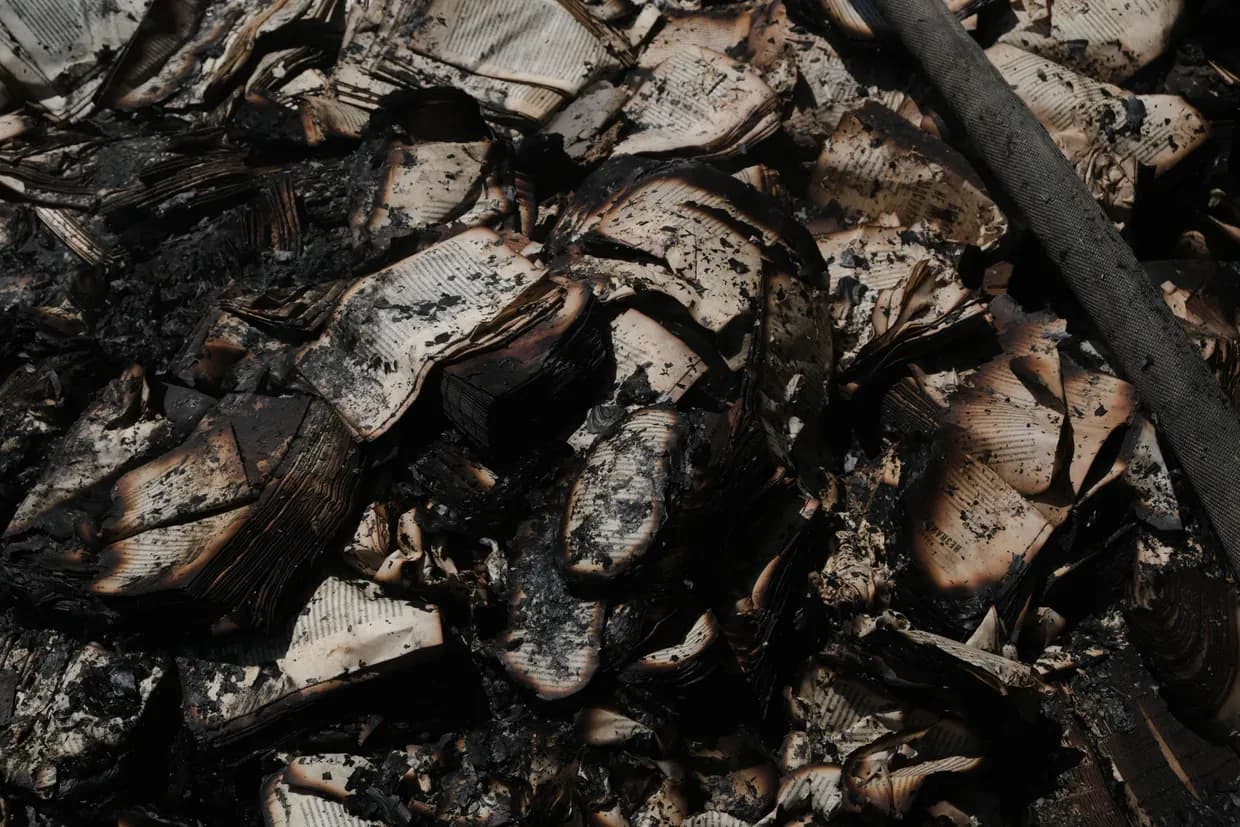
Burned Ukrainian books at the site of a Russian missile attack on a publishing factory in Kharkiv, Ukraine on May 23, 2024. (Francis Farrell/The Kyiv Independent)
 on Google
The moment Svitlana Paveletska, co-founder of Knyholav, received the news that the mass attack on July 19 had wiped out her publishing house's warehouse in Kyiv, she felt an overwhelming wave of grief that was difficult to put into words.
"Every book represents months, and sometimes years, of work by our entire publishing team, including the author, translator, editor, proofreader, designer, and printer," Paveletska told the Kyiv Independent.
Books are not military targets, but according to the Ukrainian Book Institute, Russia has destroyed more than 1.5 million Ukrainian books in July alone.
"These books were created during the full-scale war. We worked through air raid alerts, during power outages, and countless sleepless nights caused by Russian attacks. We never stopped because we believed that Ukrainian books are more important today than ever before."
Knyholav — whose motto is "A nation that reads, always prevails" — has published a diverse range of authors from both Ukraine and abroad, including prominent Ukrainians like writer Irena Karpa, diplomat Dmytro Kuleba, and chef Yevhen Klopotenko.
Nearly 250,000 books from the publishing house's inventory were destroyed in Russia's July 19 attack on the capital.

Knyholav isn't the only Ukrainian publishing house to impacted by the July 19 attack.
Konvi Group, one of Ukraine's largest printing houses, also suffered heavy material losses. According to Victoria Haidai, Konvi's commercial director, at least 16 of their publishing partners were impacted by the destruction.
Additionally, 250,000 printed ninth-grade textbooks in Konvi's inventory, ready to be shipped to schools, were destroyed. Semi-finished publishing materials with a total print run of around 350,000 books — including fourth-grade textbooks — were damaged.
The aftermath of the July 19th attack was far from an isolated incident — as Russia intensifies its strikes across the country, a growing number of publishers are reporting damage or even total destruction, threatening the future of their businesses.
Earlier, on July 2, BookChef experienced one of the most significant losses for any single Ukrainian publisher since the start of the full-scale war, when a Russian strike on Kyiv destroyed 800,000 books from its warehouse inventory — resulting in damages of about Hr 100 million ($2.2 million).
"This is an enormous sum for a business that has operated independently, without grants or outside financial assistance," editor-in-chief of BookChef publishing house, Yevhen Shyrinos, told the Kyiv Independent.
"Our main task now is to rebuild from scratch all the key processes that took decades to establish and develop."
The Ukrainian Book Institute, which is a state institution under the Culture Ministry, has publicly called on the government to support publishers in their time of need.
"By my estimate, (government assistance) would take no more than Hr 150—200 million ($3.5-$4.5 million)," Oleksandra Koval, director of the Ukrainian Book Institute, wrote on Facebook on July 20.
"A nation that reads, always prevails."
The devastation wrought on Ukraine's book industry is just one part of Russia's larger effort to erode Ukrainians' way of life.
"It is an attempt to destroy Ukraine's economy, its major logistics hubs, and its industrial infrastructure," Shyrinos said.
It's also part of Russia's centuries-long attempts to erase Ukrainian culture. Russia's destruction of Ukrainian language books is not just an economic loss, but an attack on Ukraine's very identity.
"When the institutions that create, preserve, and share Ukrainian culture are repeatedly destroyed, it becomes difficult to see these losses as mere coincidence. The result is that people lose access to books, education, and culture," Paveletska said.
That's why publishers like Knyholav and BookChef are determined to persevere, even though it remains unclear how long it will take for their businesses to fully recover. Producing a single book can take anywhere from six to 18 months, during which a number of unexpected setbacks can occur because of Russia's war.

"Recovery is about much more than finding a new warehouse. We also have to reprint hundreds of thousands of books that were destroyed. We'll have to reprint some books practically from scratch. This means significant new costs, new production cycles, and new deadlines," Paveletska said.
"This has created a major financial challenge and forced us to rethink many of our operational and logistics processes. At the same time, we are not giving up on new books, putting our publishing plans on hold, or slowing down our long-term development. We're simply adjusting the production timeline for the final product."
In addition to expanding its e-book selection, Shyrinos said that BookChef is also prioritizing the reprinting of its bestsellers.
"Books with relatively small print runs — fewer than 1,000 copies — will become much more expensive to produce. As a result, new titles will either be published in smaller print runs or receive lower priority in our publishing schedule. Even so, we are doing everything we can to stay on track with our planned publishing program," he said.
Despite the overwhelming challenges faced by Ukrainian publishers after Russian attacks, one of the main sources of encouragement has been the mass outpouring of support from Ukrainians on social media, where they are urging others to help financially — whether by donating or purchasing books directly from publishers' websites.
"We received an overwhelming wave of support from the book community (after the July 19 attack). We received messages from authors, publishers, printing houses, bookstores, bloggers, and readers," Paveletska said.
"In moments like these, you realize that Ukraine's publishing industry is much more than a market. It is a community of people who genuinely support one another."
Note from the author:
Hi, this is Kate Tsurkan, thanks for reading this article. It’s remarkable how much books have become a kind of lifeline for Ukrainians during the war, which makes Russia’s attacks on the country’s publishing industry all the more heinous. I hope you find the determination of these publishers to keep working as inspiring as I did.
If you like reading about this sort of thing, please consider supporting The Kyiv Independent.