Kyiv's bomb shelters are in a dire state. Mayor Klitschko is passing on the blame
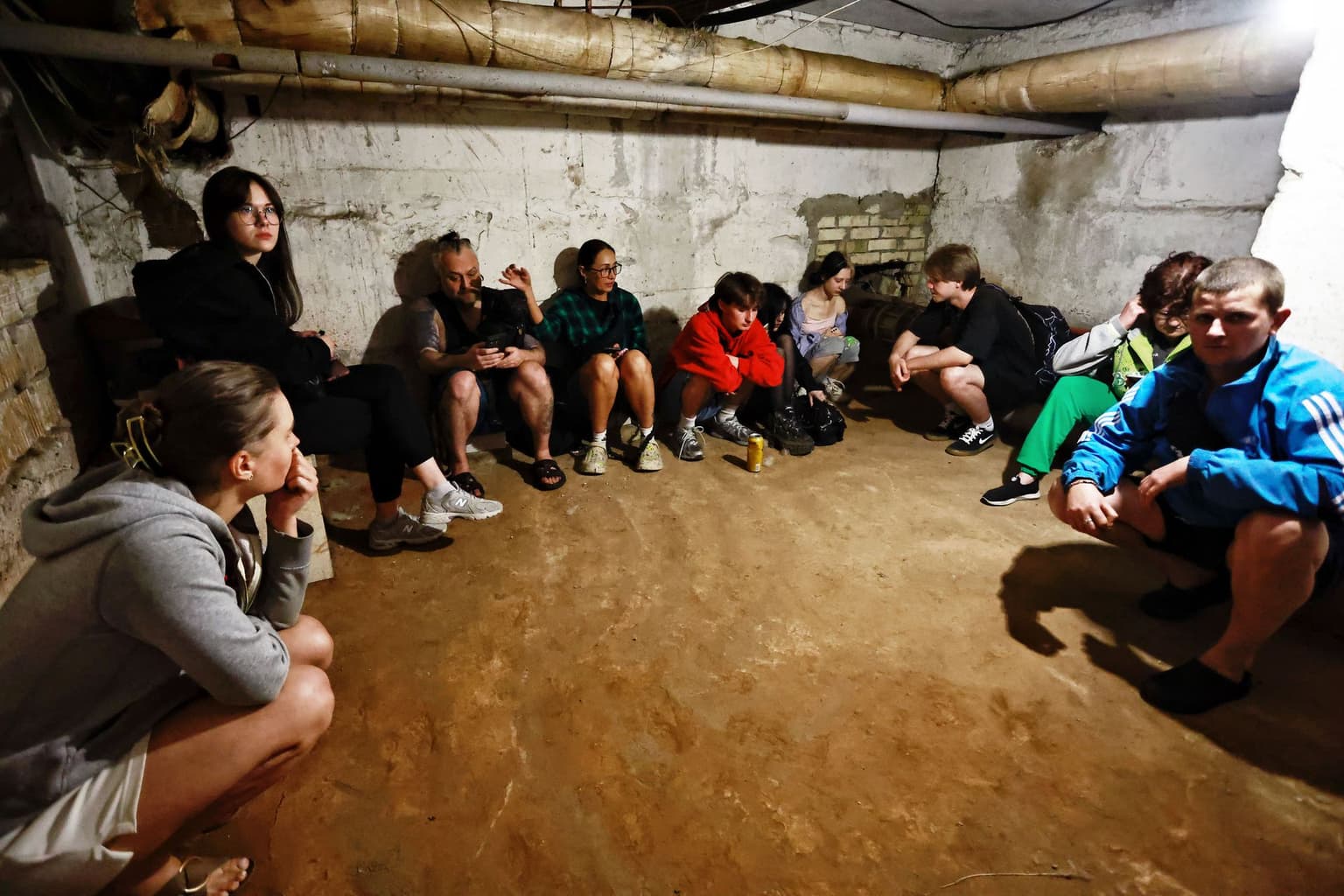
People take shelter in a bomb shelter during a Russian missile and drone attack in Kyiv, Ukraine, on July 4, 2025. (Yan Dobronosov/Global Images Ukraine via Getty Images)
 on Google
On the night of Aug. 1, Olena Rozhniativska and her 18-year-old daughter Kateryna rushed to a bomb shelter as ballistic missiles tore into Kyiv during one of Russia's mass attacks. They were killed before they could hide in an underground shelter, along with five other people in Darnytskyi district that night.
"I didn't even have time to get out of the bedroom before there was already this terrible explosion," recalls Raisa, a 70-year-old Darnytskyi resident who does not want to be identified. "All my windows flew straight into the apartment, frames and everything."
She made it into the corridor before hearing what she described as a terrible scream from the yard below. At first, she thought the building itself was collapsing. When she reached the street, she saw Olena and Kateryna on the road.
"There was fear everywhere," Raisa says. "It was some kind of hell."
From her home, it takes about 10 to 15 minutes to reach the shelter she normally uses, she says.
"That's a long time because ballistic missiles arrive in two minutes," Raisa says.
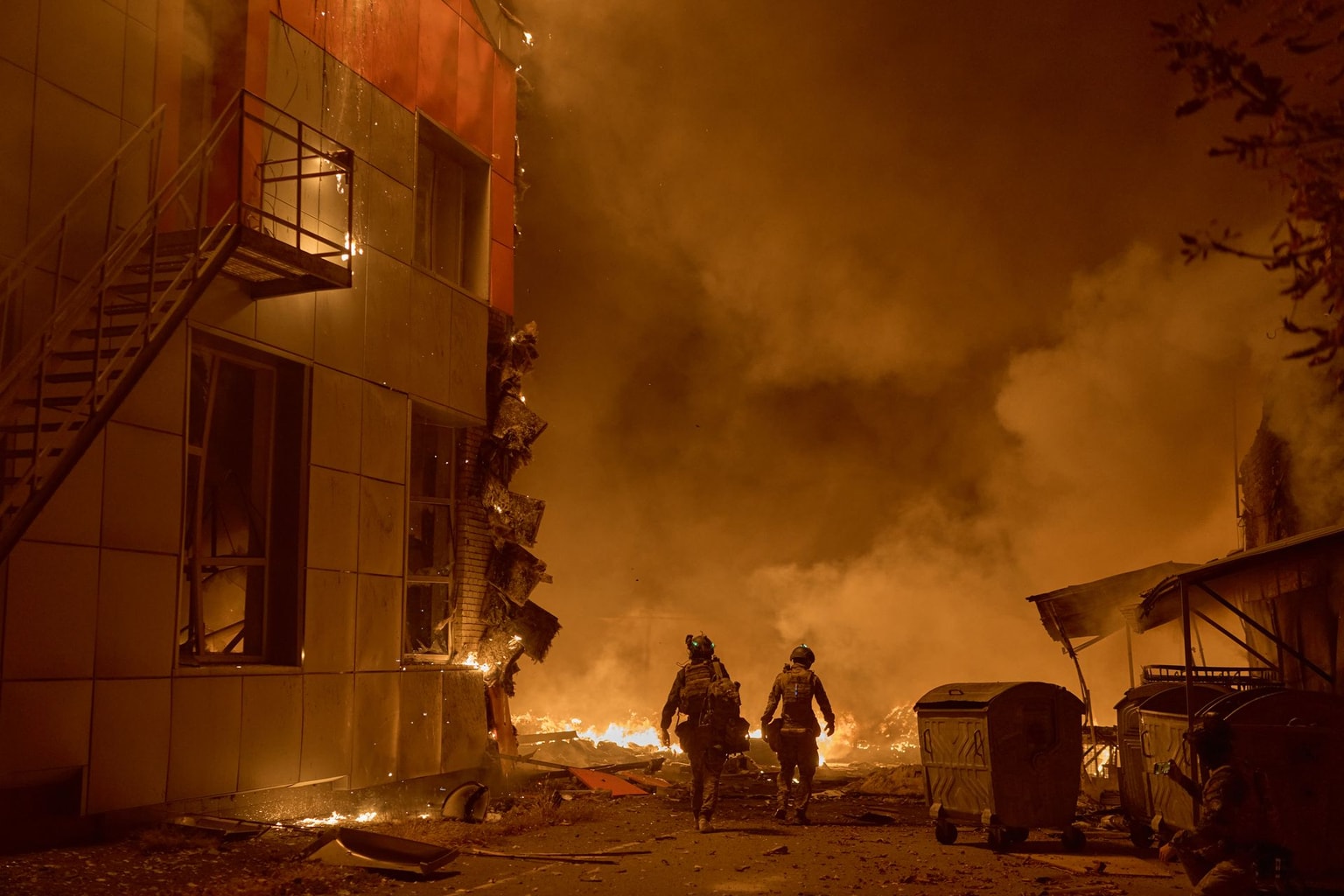
Alongside mass missile attacks, Russia uses swarms of jet-powered strike drones in a new campaign against Kyiv. These drones target gas stations and other civilian infrastructure around the city and keep the capital under air-raid alerts for hours at a time.
For the capital's residents living under constant aerial attacks, access to and availability of shelters is critical. But more than four years into Russia's full-scale invasion, the city's shelter network falls short of their needs.

Kyiv's city government allocates funding for the shelters, but the capital's 10 district state administrations are responsible for carrying out their share of shelter construction and repairs.
The district administrations, however, do not answer directly to the mayor. Their heads are appointed and dismissed by the president on the submission of the Cabinet of Ministers.
Individual owners and balance-holders are also responsible for maintaining some facilities in the network.
"Responsibility lies first and foremost with the mayor of Kyiv, with the Kyiv City Council, which allocates the budget, and with the heads of the districts," says Roman Hryshchuk, a member of Ukraine's parliamentary faction Servant of the People.
Other lawmakers and Kyiv Mayor Vitali Klitschko did not respond to the Kyiv Independent's request for comment at the time of publication.
Not enough shelters
Kyiv's civil-protection shelter network currently includes 4,385 facilities, according to information provided by the Kyiv City State Administration (KMDA) to the Kyiv Independent.
Olha Altunina, then head of the IDP Council under KMDA, estimated in 2025 that around 3.7 million people were living in the capital, based on mobile operator traffic data and figures on internally displaced people. She noted that the last official statistical estimate, from 2014, put Kyiv's population at 2.8 million, making it difficult to precisely establish the city's current population after years of war and displacement.
Nearly nine out of every 10 shelters are classified as "basic shelters," which Ukrainian law does not consider protective civil-defense structures. These are usually basements, semi-basements, and other underground spaces adapted so people can take cover during an attack. They are not purpose-built protective structures and offer a low level of protection.
KMDA puts the network's combined capacity, including inadequate shelters, at around 2.18 million people, less than 60% of Kyiv's estimated population.
A three-month investigation by Slidstvo.Info in late 2025 found that a quarter of facilities on Kyiv's official shelter list are privately owned and accessible only to residents.
When the outlet looked specifically at the city's more protective shelters, it identified just 77 facilities across Kyiv. Together, these can accommodate slightly more than 54,000 people, not even 2% of the city's population.
The reality of Kyiv's shelters
"Essentially, the only truly safe place that can be called a shelter, and that Ukrainians trust, is the Kyiv Metro," says Hryshchuk.
"However, a large number of residents simply cannot reach the metro because there is no station within walking distance," he adds.
During major attacks, families descend into the metro with their children and pets, setting up sleeping mats, folding beds, and tents across station platforms as they prepare to spend hours underground. During a mass missile attack on July 30, more than 56,000 people sheltered in Kyiv's metro stations overnight, according to Kyiv Metro.
Only 46 of the city's 52 stations can be used as shelters.
"And during the heaviest attacks, we see that sometimes there is not even enough space," Hryshchuk says.

"Another problem is the poor condition of shelters," says Bobrova, recalling a recent visit to a residential building near Klovska metro station.
"It is a fairly damp basement, parts of which residents have converted into locked storage units. Some of these storage units block access to ventilation pipes, so it is difficult to breathe inside the shelter," she says.
The Kyiv Independent found similar problems in Darnytskyi district, a district on Kyiv's left bank which Russia has repeatedly struck. In one apartment block, 39-year-old entrepreneur Edvard Rassuzhdai showed the Kyiv Independent the basement that residents use as a shelter, where sewage constantly leaks through the pipes and floods the floor.
"You can imagine the smells here," Rassuzhdai says. "We had to buy a pump with our own money."
The residents can pump out the sewage and dry the basement, but the source of the problem lies outside the building, so they cannot fix it themselves. They appealed to the Darnytskyi district administration, but three months later, the problem remains unresolved, Rassuzhdai says.
In a statement, the Darnytskyi district administration told the Kyiv Independent that responsibility for the leaking pipes lies with the condominium association that manages the building.
The administration added that city funds had previously been used to repair the basement at 23A Urlivska Street for use as a shelter. In 2023, the work included waterproofing, electrical and plumbing repairs, flooring, a toilet, and new doors, while further electrical work for CCTV and access control was carried out in 2026.

The quality of shelters in Kyiv varies considerably among neighborhoods. Differences are especially visible between wealthier residential neighborhoods and older ones.
"Spatial inequality clearly exists," Bobrova says. "First and foremost, it is connected to economic inequality."
People living in newer and more expensive residential complexes tend to have higher incomes, Bobrova says, and have often been able to equip their buildings with comfortable shelters. Those who, for various reasons, have not been able to do so, are at a disadvantage.
Bobrova points out gated complexes such as Comfort Town, where residents may have access to good-quality shelters inside the development, while people living outside the complex cannot access them.
"This is an example of spatial segregation," she says.
Inspectors from the office of Ukraine's Human Rights Ombudsman, Dmytro Lubinets, found shelters listed as available to the public that were either locked or unusable. Other common problems included broken or missing lighting and ventilation, poor sanitary conditions, clutter, and a lack of drinking water and first-aid kits.
In a comment to the Kyiv Independent, KMDA said 397 facilities across the capital currently need work before they meet readiness requirements.
But even a properly equipped shelter is no use to those who cannot reach it in time.
"You cannot stop life every time there is an alert and Shahed drones are flying somewhere," Hryshchuk says. "But if there is an immediate threat, you need somewhere nearby where you can quickly take shelter and wait out the attack."
Lubinets' secretariat told the Kyiv Independent that it receives many complaints about shelters in Kyiv, of which 30% concerned the absence or insufficient number of shelters in a residential area, and 29% concerned inadequate conditions inside them.
The Ombudsman's office also found that shelters being used by residents did not appear on the city's official maps, while 14 facilities were still listed as available even though they did not exist.
Many of the inspected shelters were also not properly accessible to people with disabilities and those with limited mobility.
Why does the problem remain?
Since Russia launched its full-scale invasion, the Kyiv city government says it has repaired nearly 3,000 civil-protection facilities. Yet in that time, only four new facilities have been built.
Two of those are anti-radiation shelters at educational institutions in Darnytskyi district, with a total capacity of 540 people. Two others are dual-purpose facilities in Obolonskyi district, with a combined capacity of 2,195. KMDA says documentation is being completed for six additional newly constructed facilities.
The city has allocated substantial money to the problem. KMDA told the Kyiv Independent that Kyiv's 2026 budget provides Hr 840.2 million ($18.8 million) for the construction of dual-purpose facilities with anti-radiation protection and Hr 173.6 million ($3.9 million) for reconstruction projects.
Another Hr 934.8 million ($20.9 million) is set aside for major repairs, while Hr 12.9 million ($289,000) goes toward current repairs, bringing the four budget lines together to almost Hr 2 billion ($43.9 million).
Even though the sums are substantial, Hryshchuk argues the problem also lies in the distribution of funds.
"We are already seeing cases where construction began and was then abandoned because of insufficient funding, the complexity of the project, or an irresponsible contractor," Hryshchuk says.
"The shelters that are closest to completion need to be finished. The authorities should concentrate funding rather than trying to move 10 different shelters from, say, 40% completion to 60%. They should finish those that are already the most advanced," he adds.
Kyiv Mayor Vitali Klitschko has criticized district administrations over the slow use of shelter funds. In July, he ordered an audit of district spending on shelter construction, repairs, and equipment between 2022 and 2025.
Bobrova is skeptical that fragmented authority is a sufficient explanation for slow progress.
"A similar division of responsibilities does not prevent the KMDA from carrying out expensive projects to upgrade Kyiv's road infrastructure," she notes.
She argues that the city could treat shelters with the same political urgency.
"For example, the KMDA could develop an alternative network of municipal shelters.
This could become one of the mayor's flagship programs," Bobrova says. "Signs reading 'with the support of Kyiv Mayor Vitali Klitschko,' which we often see on various public improvement projects, could fit very nicely on the doors of such shelters."