Reporter's notebook: Inside a Ukrainian power plant caught in cycle of Russian destruction
How a group of Ukrainian power plant workers face another grueling winter of attacks and repairs
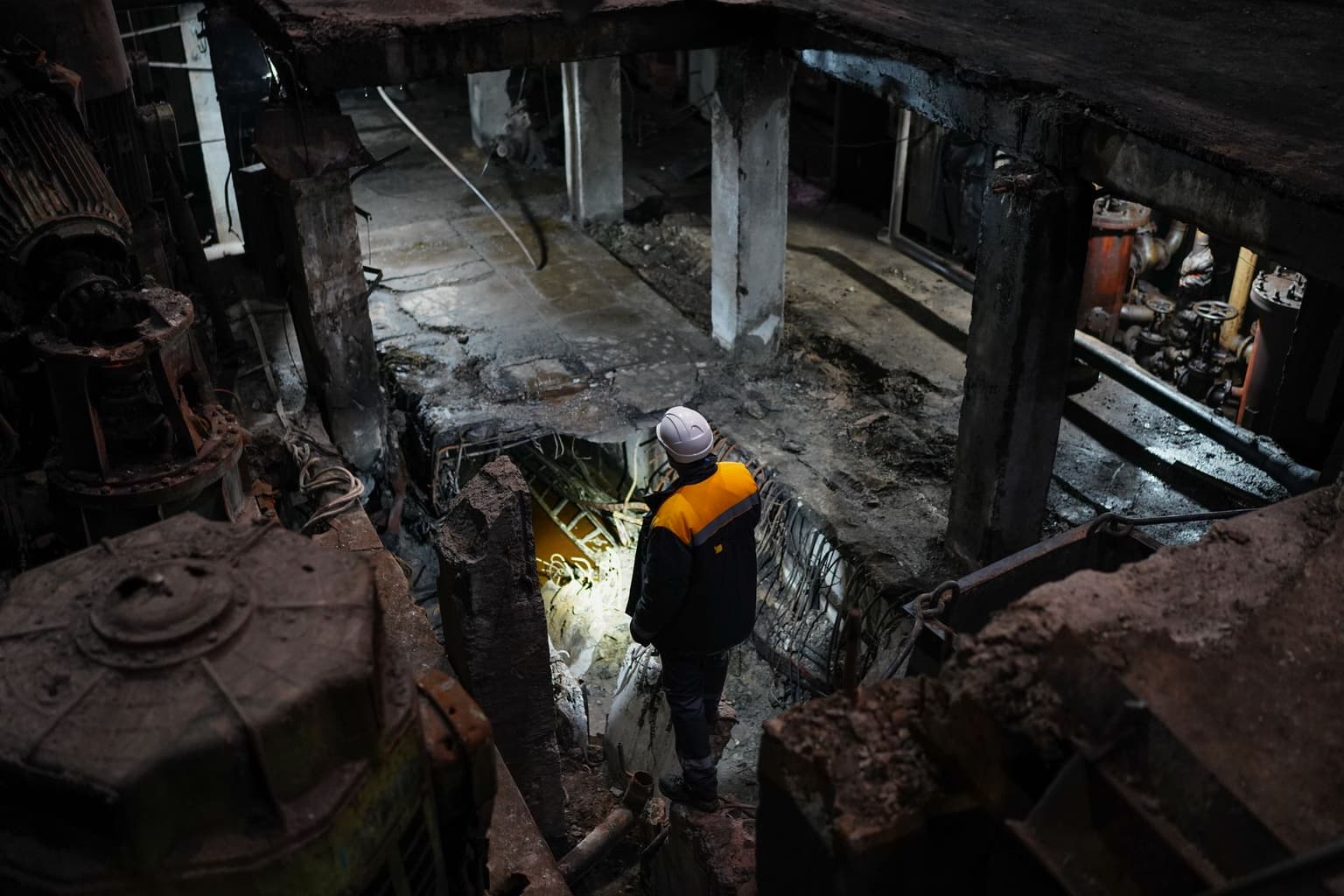
A thermal power plant damaged in a Russian attack is seen at an undisclosed location, Ukraine on Nov. 12, 2026. (Karina Piliuhina / The Kyiv Independent)
 on Google
The piercing air raid siren drowned out the rumbling, hammering, and welding at a war-battered thermal power plant operated by DTEK, Ukraine’s largest private energy company. Like clockwork, the workers put down their tools, vacated the powerhouse, and beelined toward the closest bunker. Some marched, others ran. All wore the same exhausted expression.

Soon, only the siren could be heard outside as an eerie quiet settled over the enormous plant. Down in one of the shelters, however, coal-covered employees wearing thick jackets and hard hats chatted among themselves, watched videos on their phones or stared at an app showing the number of drones in the vicinity. After more than half an hour, the all-clear was given, and the weary workers resurfaced.
While Ukraine spent the last eight months recovering its power plants and energy grid, Russia spent that time building a record number of missiles and drones. A typical workday at the plant now means trekking to and from shelters as Russia launches a steady stream of drones toward the station.
"As soon as the unit comes back online, the Russians will let it operate for a little while, but their efforts will be directed toward destroying it again."

Russia’s mass attacks are more powerful than before, combining jet-powered drones, cruise missiles, and ballistic missiles. Ukraine, meanwhile, still lacks sufficient air defenses to fully protect its plants. In a single attack, Russia can undo months of repairs, dealing a heavy psychological blow to employees.
"Every time we repair a unit and bring it back into operation, we get this feeling of being in Groundhog Day. You realize that as soon as the unit comes back online, the Russians will let it operate for a little while, but their efforts will be directed toward destroying it again," said Dmytro, one of the department heads at the plant.

His last name, like the name of other employees and the location of the thermal power plant, cannot be disclosed for security reasons.
I’d met Dmytro a year earlier on my last visit to the plant. Back then, continuous daytime drone attacks were rare. We didn’t bunker down once. This time, however, we spent well over an hour in the shelter during a six-hour visit. For the workers, putting down their tools means less time to repair critical damage before winter, when households and businesses rely on the plant for power and heat.
"People are working not just 12-hour shifts, but sometimes 24 hours. There are no days off. Everyone hopes that one day the war will end, and they'll be able to take all the days they've worked overtime and go on vacation, one after another."

Gesturing toward a charred transformer recently destroyed in a massive strike, Dmytro said that the workers had repaired it earlier in the year, but now it and other mangled equipment could only be used for scrap. As the strikes intensify and workers burn through critical stocks, they salvage what they can. Even the smallest things, like bolts from circuit breakers, are useful, Dmytro said.
"The main priority in our country is life, light and warmth."
Walking around the rubble while inspecting the plant, DTEK CEO Maxim Timchenko painted a more positive picture of the equipment stockpile situation. New equipment is being produced not only in Ukraine but also in Turkey, he said. This has helped the company overcome one of its main problems last year, when Ukraine struggled to find compatible spare parts because its specifications differ from those of most other European countries.
"That's another lesson we learned over these several winters: We need to build strong stockpiles. So we brought in a significant amount of spare equipment, especially transformers and heavy equipment. And I'm confident that we can recover faster than in previous winters," he said.

Inside the plant’s boiler room, Timchenko lowers himself into a crater several meters deep caused by a recent strike. Led by the plant’s chief, he shines a flashlight on the deformed pipes, cogs and other unidentifiable metal parts, all blackened by the blast. It will take weeks to repair, he says.
With morning frost already coating the grass outside, the workers urgently need to bring the power-generating units back online quickly. Otherwise, the water used to generate the steam that powers the turbines risks freezing. If that happens, the pipes will burst, causing even more damage. Last winter, the boiler room was encrusted with frost after the roof was blown off, but employees powered through the Arctic conditions.
"They [russians] will not break our spirit, and they will not switch off Ukraine"
"We are focused on one thing: to produce electricity and heat. The main priority in our country is life, light and warmth," said a different Dmytro, a senior power unit operator.
After the fourth alarm rang out and we hurried back to the shelter, I also felt like I was trapped in Groundhog Day. Aside from relentlessly oscillating between the plant and bunker, everything was eerily similar to my last visit. The boiler room had been rebuilt since last year, only to be battered again. Transformers lay in ruins, and the sharp smell of burned plastic and metal still lingered.


Although the workers spoke stoically about their duty to keep the plant operating, I wondered how much longer they could keep up with this gruelling cycle of repairs and destruction. The plant is physically running out of people, while those who remain are exhausted, the first Dmytro said.
"Everything is falling apart. It's constantly falling apart," said Vasyl, a technical engineer, down in the shelter.
But somehow, Ukraine has always managed to find a way to survive the winter, largely thanks to employees like the two Dmytros and Vasyl. Even last year, when Russia took 9 gigawatts of power capacity offline during the country’s coldest wartime winter and effectively razed this thermal power plant to the ground, Ukraine didn’t collapse. People found ways to adapt while workers risked their lives to bring power to communities.
"When I saw the destruction in 2023, I also asked myself how many winters we could survive. I thought it was probably the last cycle that we could recover from. But then we survived 2024, 2025, and then 2026 in minus 20 degrees Celsius," Timchenko said.
"Trust me, they will not break our power system, they will not break our spirit, and they will not switch off Ukraine."

Author's note:
Hi, it’s Dominic, thank you for reading this story. We are facing down another bleak winter here in Ukraine. But that won't stop us from reporting the truth, especially with your support! If you are able, please become a member of the Kyiv Independent. It costs the same as one cup of coffee a month.
read also