Amid the rubble of a Ukrainian apartment building, locals have one wish for Putin’s birthday
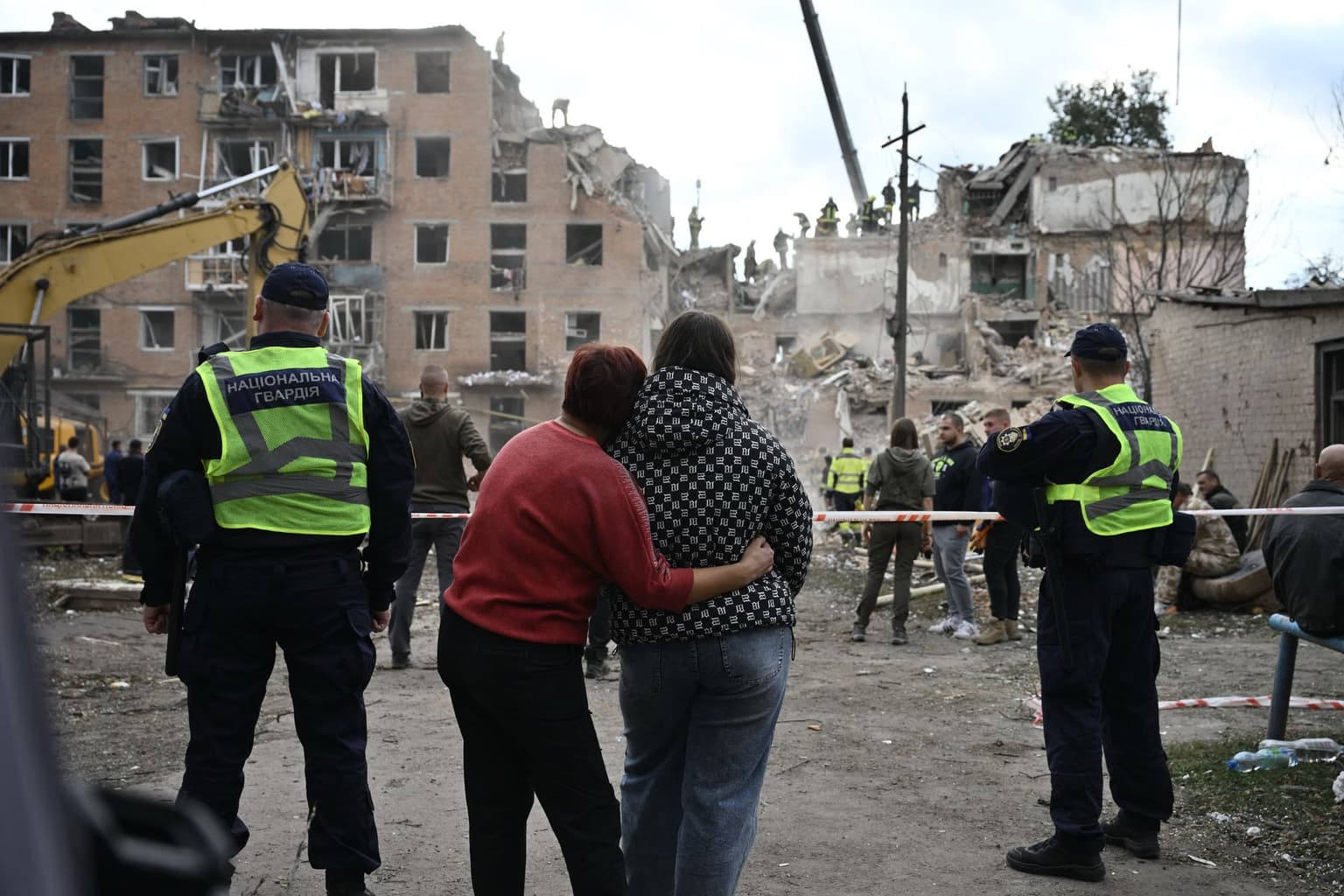
Local residents hug as they look at a multi-floor residential building destroyed following a Russian aerial strike in Pryluky, Chernihiv Oblast, on Oct. 7, 2026. (Genya Savilov / AFP via Getty Images)
 on Google
PRYLUKY, Chernihiv Oblast – Families stand outside the ruins of a five-story apartment building, watching rescuers dig through what remains of their homes.
Some sit wrapped in blankets, staring at the rescue operation, waiting to see who is pulled from the rubble next. Five bodies so far are those of children, three of them only one year old.
They were among at least 20 people killed by a Russian cruise missile that struck a five-story residential building in Pryluky as part of a mass salvo that struck cities across Ukraine overnight on Oct. 7.
A date which also happens to be Russian President Vladimir Putin's birthday.
"As a Christian, you cannot wish death on someone," Olga, a 41-year-old resident of Pryluky, who asked that her surname not be published, tells the Kyiv Independent.
"But I wish that he could feel even the tiniest fraction of what our people and our children are feeling," she says. "I wish he could feel it, and that the people around him could feel what our children are feeling.”
"Let him feel what every person and every child in our country is feeling."
Others don't hold back.
"I hope he drops dead soon," says 75-year-old Volodymyr Ivashchenko.
As the search and rescue operation continues, people rush between buildings with relatives and neighbors, covering shattered windows and salvaging what they can from damaged apartments.

The roar of excavators fills the courtyard as emergency workers lift slabs of concrete from what had been apartments only hours earlier. Rescue workers standing on the exposed floors throw smaller pieces of wreckage below, stripping away ruined walls, furniture, and fragments of the lives that had been inside.
There is little to distinguish the neighborhood from countless other residential districts across Ukraine. Apartment blocks surround courtyards and children's playgrounds. Grocery stores and small businesses line the surrounding streets. Across the road stands the Children and Youth Creativity Center, one of the city's oldest institutions, where generations of children have gone to sing, dance, do gymnastics, and prepare for school.
Now the neighborhood is buried in dust.
Ivashchenko had woken at around 6 a.m. Before the explosions, the first thing he noticed was a humming noise outside.
"I said to my wife, 'Maybe the wind has picked up,'" he recalls.
Then the explosions began.
"The windows flew open, and the whole house shook. It shook very badly," Ivashchenko says.
He remembers several explosions in quick succession and a deafening sound overhead that made him think an aircraft was passing above his roof.
Hours later, his hands and legs are still shaking.
"I feel so sorry for those innocent people, especially those tiny children," he says. "A tiny child, one year old. A young mother who had her whole life ahead of her."
At 75, Ivashchenko says, he had already had the chance to live a long life. The children killed in the building had not.
"It's the 21st century. Is there really no one who can stop this one clown, or whatever you want to call him?" he says.
"How many more deaths can there be? How much more destruction?"

‘Let him feel what every child in our country is feeling’
For Olga, the sight of the destroyed building is inseparable from the children who filled the courtyards around it.
"There are actually so many children in our courtyard," she says.
On the morning of the attack, Olga and her family were asleep. Her children were in one room, she was in another, and her husband was sleeping in the living room.
After the first explosion, they rushed into the corridor and sheltered between two walls. A second explosion followed, and then, several minutes later, another.
When they eventually went outside, the neighboring building where her 7-year-old son regularly played with other children was partly destroyed.
The blast had blown out every window in Olga's apartment facing the courtyard. Her husband had been in the living room when a balcony door was thrown toward him, but he escaped serious injury.
"You can repair everything," she says of the damage to their home. "You can't bring back the lives of the people who lived there."
'Now I don't feel sorry for them anymore'
Tetiana Pinchuk, 69, has lived in the district since 1974. She had taken her dog outside early that morning and returned home to rest when the explosions began.
"There were several explosions. Bang, bang, bang," she said.
Every window in her apartment was blown out.
"All of them, literally every one," Pinchuk says.
Doors inside the apartment were damaged as well, including those leading to the kitchen and bedroom. Pinchuk was unhurt, but hours later, her dog was still terrified.
Looking at the damage around her, she keeps returning to the same question.
"I just can't understand why you would bomb ordinary people. Why?" she says.

It is not the first time she has seen strikes damage her part of Pryluky. She recalls previous attacks near the local Epicentr home-improvement store, the Nova Poshta delivery company, and elsewhere in the district.
"But none of the previous attacks were like this morning," she says.
When asked what she wished for Putin's birthday, Pinchuk does not hesitate.
"I wish his entire family would die."
Earlier in the war, she says, she had opposed strikes on homes inside Russia because she believed ordinary people should not be held responsible for the actions of their government.
"I thought you should only hit what needs to be hit, because I felt sorry for ordinary people," she says.
"Now I don't feel sorry for them anymore."
Pryluky, like many cities across Ukraine, has become home to families displaced from front-line regions. Pinchuk said some of those families had children who were playing in these same courtyards after already fleeing the war once.
"I wasn't born here, but I consider it my hometown," she says. "That's why this hurts so much."
Fifty-eight-year-old Ludmila was preparing for work at around 6:30 a.m. when she heard the explosions. Her mother lives directly opposite her, and Ludmila immediately began calling her before contacting her husband, who works in Kyiv.
"My old classmate was killed, her daughter, and her daughter's child," Ludmila says.
She tries to describe some of the others she knew who died, but can't get the words out. Instead, she looks back toward the destroyed building.
"Seeing the bodies, especially the bodies of children," she sighs. "That's very hard."