Kyiv reels after Russia unleashes massive missile, drone attack on Ukraine, killing at least 23
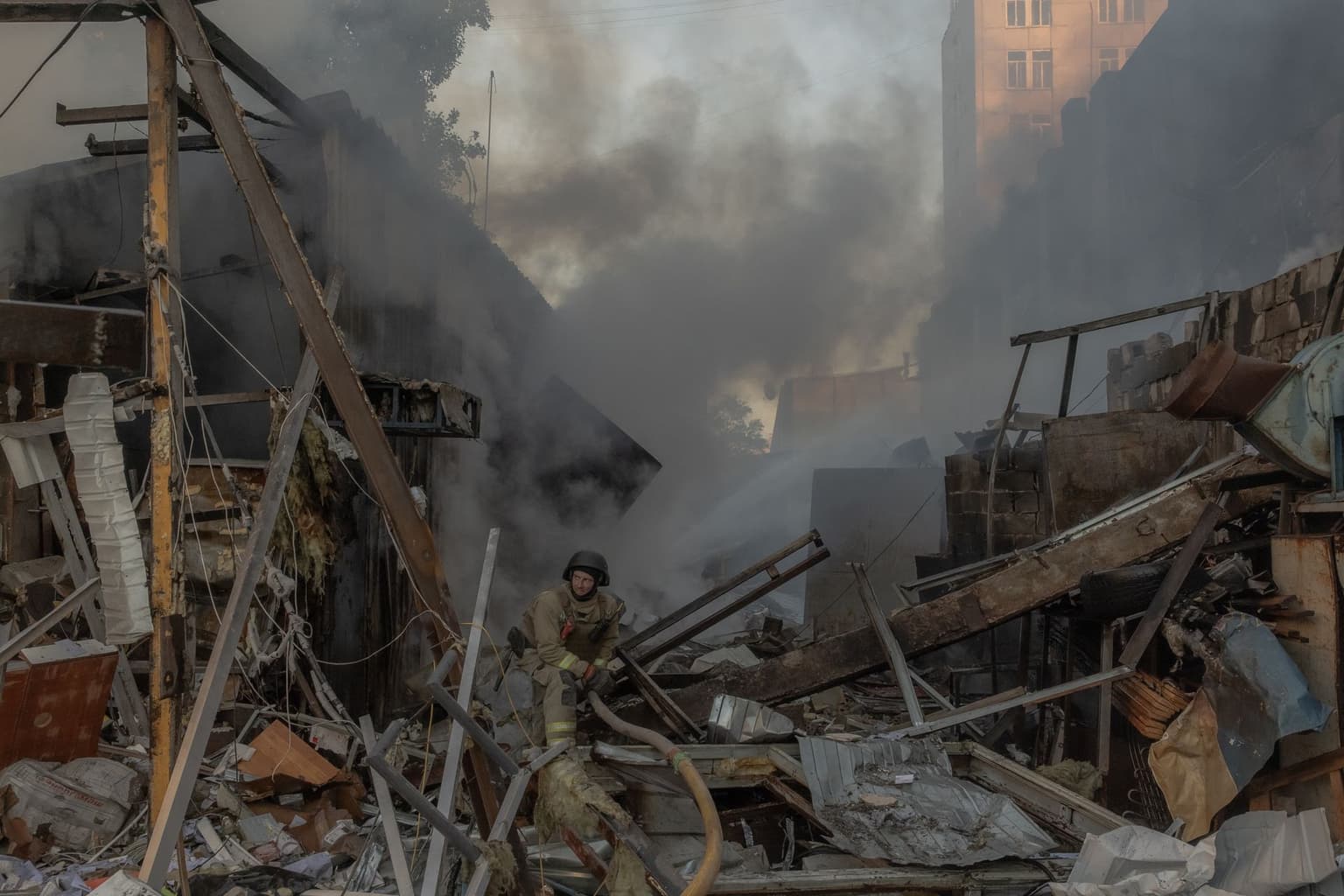
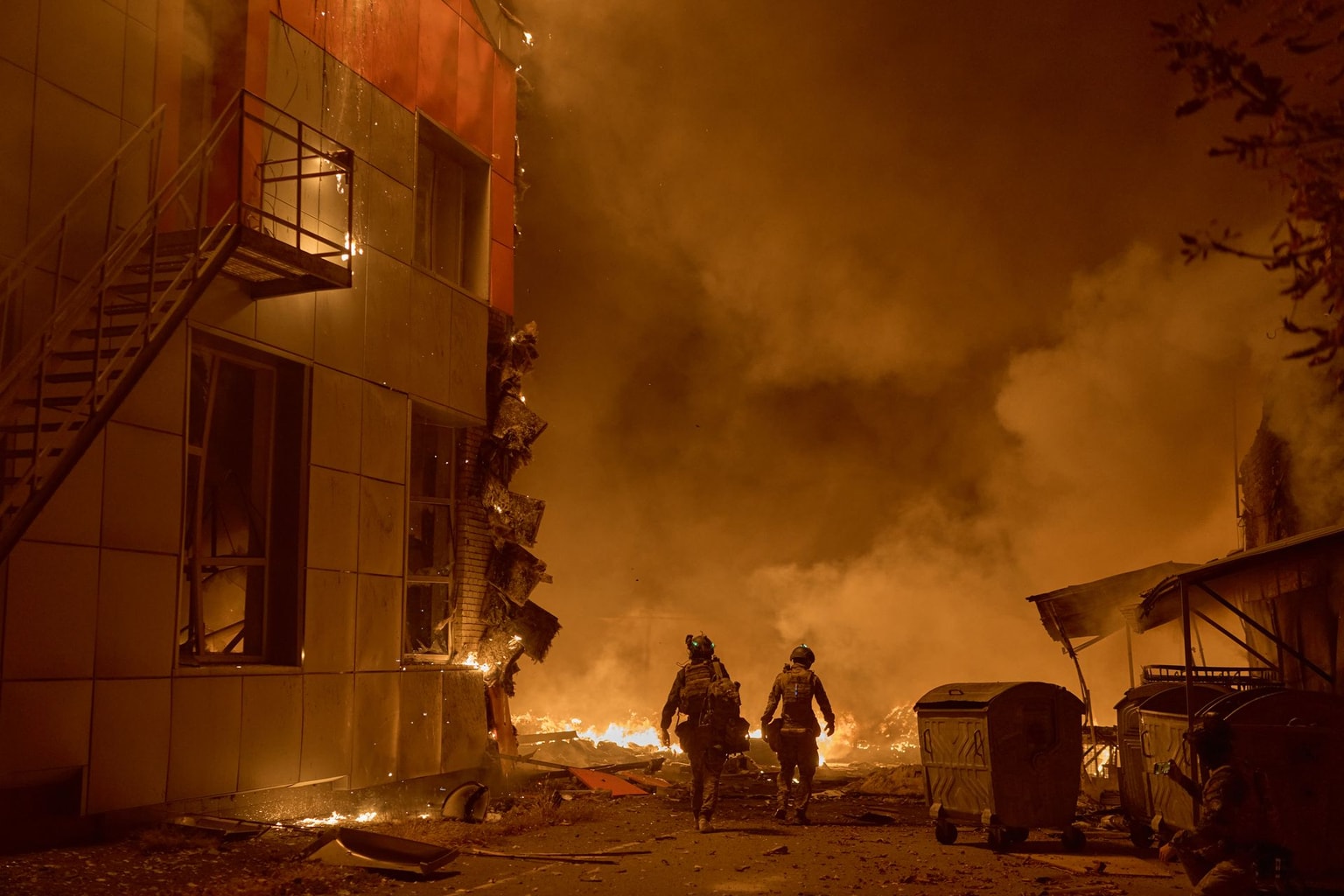
A firefighter works at the site next to a multi-storey residential building damaged following massive Russian missile and drone strikes in Kyiv, Ukraine, on June 2, 2026. (Roman Pilipey / AFP via Getty Images)
 on Google
Russia launched one of the largest aerial attacks of the full-scale war overnight on June 2, targeting multiple Ukrainian cities, including Kyiv, with missiles and drones. Across the country, at least 23 people, including two children, have been killed and 130 others injured, officials said.
President Volodymyr Zelensky said that Kyiv bore the brunt of the attack. At least seven people were killed and 90 others were injured in the capital, according to Kyiv Mayor Vitalii Klitschko. Fifty-one people remained hospitalized, including two children.
Dnipro also suffered heavy casualties. Sixteen people, including two children and a first responder, were killed, and 42 others were injured in the central-eastern Ukrainian city, officials said. One of the children pulled out from the rubble of a partially destroyed four-story apartment building was born in 2023, and another was an eight-year-old boy, according to Dnipropetrovsk Oblast Governor Oleksandr Hanzha.
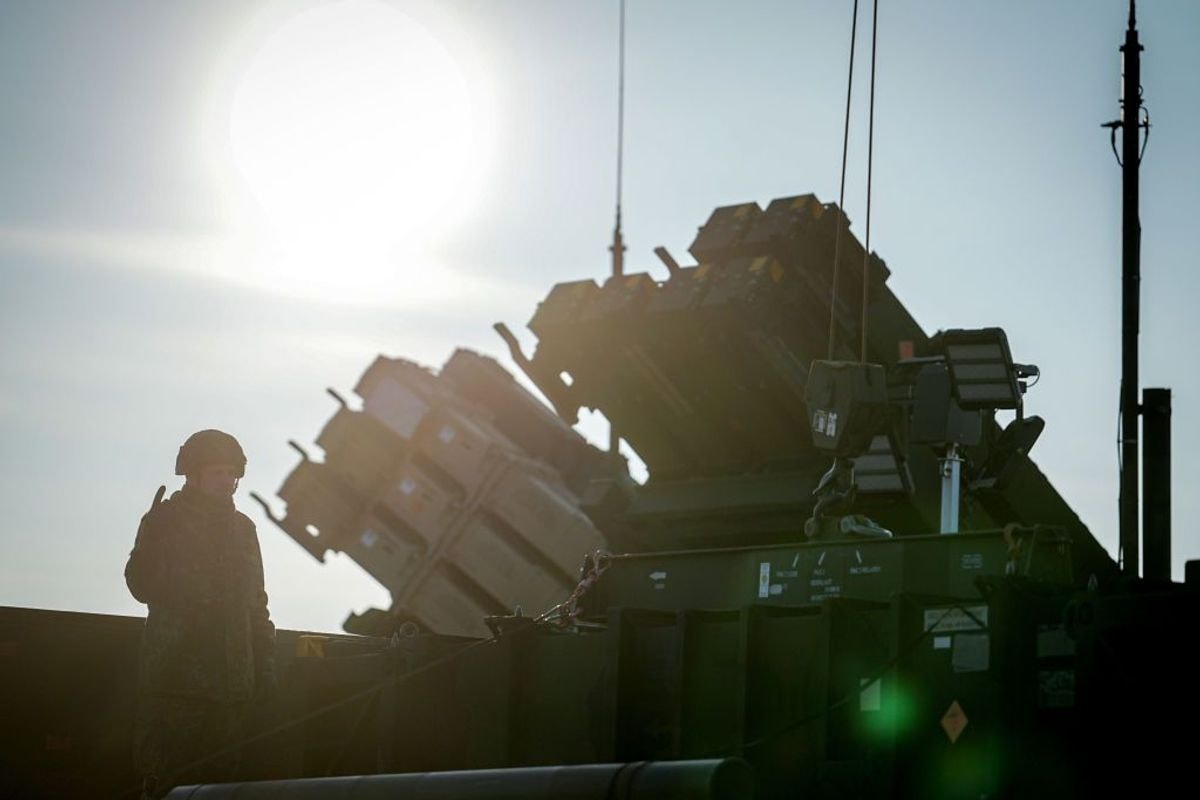
"(The massive overnight attack is) a completely transparent statement from Russia: if Ukraine is not protected from ballistic and other missile strikes, these strikes will continue," Zelensky said on Telegram, calling on Western allies to ramp up the supply of ballistic missile interceptors, such as the U.S.-produced Patriot, to Ukraine.
Speaking later in his evening address, Zelensky warned that Russia could be preparing another large-scale attack overnight.
"We know from intelligence that a massive strike could happen tonight," Zelensky said, urging citizens to heed air raid alerts.
Dnipro Mayor Borys Filatov claimed that Russia had used cluster munitions in the latest attack on Dnipro to "deliberately" try to cause more casualties among civilians, police, rescue workers, and utility crews. Cluster munitions, which are widely banned under international humanitarian law, scatter small explosive bomblets across a wide area. Some may fail to explode immediately, posing a continued danger to civilians.
State Emergency Service named the rescuer killed in Russia's double-tap attack as Anton Yarmolenko, a major of a civilian protection service.
"After the Russian Federation's attack on the city of Dnipro, he went where help was needed, where people might be waiting to be rescued from under the rubble," the State Emergency Service cited its head, Andrii Danyk, as saying in a Telegram post, mourning the death of "a reliable friend, a true professional, and a man with a big heart."
"But the enemy launched a treacherous follow-up strike."

Ukraine's Air Force said Russian forces launched 73 cruise, ballistic, and hypersonic missiles, as well as 656 attack drones. Of those, 40 missiles and 602 drones were downed or intercepted. Air Force spokesperson Yurii Ihnat said eight Zircon anti-ship missiles were used in the strike in two waves of four.
Thirty ballistic missiles, three cruise missiles, and 33 attack drones struck 38 locations, the Air Force added.
Hours after the overnight attack at around 1 p.m. local time, the Kyiv City Military Administration reported the air defense working due to a drone threat. Many local residents went about their lives in the center, some pointing toward an area where distant blasts were coming from. The air raid alert was lifted about half an hour later.
More than 500 State Emergency Service personnel were involved in response efforts across Ukraine, Zelensky said. Russian strikes also hit energy infrastructure in northeastern Kharkiv Oblast and critical infrastructure in Kharkiv, as well as targets in Kyiv, Mykolaiv, Zaporizhzhia, Poltava, Sumy, Chernihiv, and Khmelnytskyi oblasts, according to the president.
During the overnight attack, Poland's Air Force said it had scrambled Polish and allied aircraft to protect Polish airspace.
Russian forces continued their attack later on June 2, deploying approximately 100 additional drones, Zelensky said.
"Unfortunately, the current level of supplies available to our air defense forces does not allow us to intercept a significant number of missiles. There have been strikes," Zelensky said.
The president stressed that Russian drones and missiles rely heavily on foreign-made components. According to Zelensky, 650 attack drones contain more than 17,000 foreign components, without which they could not be manufactured.
"Behind each of these attacks lies complicity — perhaps unconscious, but complicity nonetheless — on the part of those who work for Russia, provide it with funds, help it circumvent sanctions, and seek out not one or two, but thousands of components without which Russian military production would simply grind to a halt," Zelensky said.
In the Podilskyi district, a nine-story Soviet-era apartment building was damaged by what residents said was the blast wave from rocket debris falling nearby.
"What can I say? Putin is a dickhead," 65-year-old pensioner Yevhen Dniprovskyi, told the Kyiv Independent, his face bloodied by shrapnel injuries.

Dniprovskyi was in his room at the time of the attack when the blast wave threw him into the corridor, causing him to hit his head and fall onto the front door, which had been blown off. With blood dripping from his face and a concussion-induced headache clouding his senses, he crawled through the rubble and dust in the corridor to find his wife, who had hit her head on the glass panel of the door and was screaming his name.
"I saw that debris (that hit nearby) from the window flying and I wanted to go see it, but I didn't have time," Dniprovskyi said, explaining how the explosion that immediately followed threw him into the corridor.
Municipal workers were already fixing the building's power lines by about 10 a.m. Most of the windows on one side of the building had been blown out, and several balconies were completely gone.
"I'm in shock," local business owner Marina Ostapenko told the Kyiv Independent.
"It all happened very quickly, just like that. I ran out of the apartment. On the second floor, a woman couldn't get out of her apartment, and I couldn't open it. And there was also a young man, a guy about 20, whose leg was badly cut; there was a lot of blood.
"I held him, we bandaged him up there, and called an ambulance."
Elsewhere in Kyiv, damage to 15-story and 24-story residential buildings was also reported in the city's Solomianskyi district. In the Obolonskyi district, drone debris fell near a kindergarten, sparking a fire at a construction site, Tkachenko added.
Fallen debris also caused fires at gas stations in the Darnytskyi and Shevchenkivskyi districts and at a commercial building in the Sviatoshynskyi district. Another fire was "raging" on the second and third floors of a commercial building in the Shevchenkivskyi district, Klitschko said.
Car fires and exterior damage were reported at a medical clinic in the Holosiivskyi district, while part of a business center collapsed, officials said.
"That's the window of my office," Olesia Yevlakhovych, head of a damaged clinic in the Teremky neighborhood in south-west Kyiv, said. "I want to get in, but I'm not allowed because the building is in a very dangerous condition and at risk of collapse.
"There are just bricks inside — it's all rubble in there. "
The clinic, a family outpatient center, serves around 20,000 people. It employs ten doctors and ten nurses. According to Yevlakhovych, there were no casualties among the staff.
"Our task now is to organize ourselves and provide assistance to our population (in another clinic)."

Olena, 76, and a resident of a neighboring multi-story building, said she used to go to the damaged clinic.
"I heard a loud explosion… I had briefly fallen asleep. I jumped up, but didn't go straight to the window. I went to make coffee, then came back, and everything was on fire. The doctor's office burned for a long time.”
"(Russia) hits everywhere. And it's unclear whether it was even meant to strike there, because this clinic — it's just two unfortunate floors."
Rescue operations have been completed in the Podilskyi and Shevchenkivskyi districts, while firefighters have extinguished fires in the Obolonskyi, Darnytskyi, and Holosiivskyi districts, the State Emergency Service said.
The first explosion was heard in the capital at around 1:30 a.m. local time, just before an air raid alert was declared, a Kyiv Independent journalist on the ground reported. Additional waves of explosions were heard at 2:15 a.m., 4 a.m., and 7:20 a.m., followed by brief disruptions to the power supply, reporters said.


Communities in the surrounding Kyiv Oblast also came under attack overnight. Damage to homes, a warehouse, and a "non-residential" building was reported in Bucha and Vyshgorod, officials reported. Three residents of the region suffered injuries in the attack, Kyiv Oblast Governor Mykola Kalashnyk said.
Filatov, the mayor of Dnipro, said 49 residential buildings had been damaged, with seven "practically completely destroyed." Four kids were among the 37 injured victims, officials said.
In Kharkiv, multiple districts of the city were struck by several drones and missiles, the city's mayor, Ihor Terekhov, reported. Damage was reported to a multi-story residential building, vehicles, and administrative buildings. A total of 10 people were injured in the attack.


The massive missile and drone attack on Kyiv comes as the capital's residents had been bracing for another attack for days. President Volodymyr Zelensky warned on May 29 that Russia is preparing a new mass attack on Ukraine, citing Ukrainian intelligence reports.
"Please heed air raid alerts and stay safe," he urged Ukrainians in his evening address.
The president reiterated the warning in his address the following night, saying that while Kyiv's partners were communicating with Russia in hopes of preventing a large-scale assault, Ukrainians should stay vigilant.
The attack came after a series of public threats from Moscow. Russian Foreign Minister Sergey Lavrov told U.S. Secretary of State Marco Rubio on May 25 that Russia planned to strike Ukrainian "decision-making centers" and urged Washington to evacuate its embassy in Kyiv.
Russia's Foreign Ministry also issued a statement urging foreign citizens, including diplomats, to leave the city. No foreign embassies in Kyiv evacuated staff following the threats.
Moscow's threats came in the wake of one of the largest strikes against Kyiv and the surrounding region in the past year, when Russia launched 90 missiles and 600 drones on May 24.
The May 24 attack struck Kyiv's administrative and cultural core, damaging the Cabinet of Ministers (Ukraine's government headquarters), the Foreign Ministry building, the Kyiv Opera Theater, the Ukrainian House, the Valeriy Lobanovskyi Dynamo Stadium, and the Chornobyl Museum, among other institutions.
read also
Two people were killed and over 80 others injured in Kyiv alone, while a total of four people were killed and nearly 100 wounded across Ukraine. The attack included the launch of an Oreshnik intermediate-range ballistic missile (IRBM), Russia's much-touted novel weapons system.
Foreign Minister Andrii Sybiha said on June 2 that the "only reason" for the overnight strike was "that Putin is a war criminal and loser who has no cards except terror."
"Moscow is losing on the battlefield. No number of missiles can change this," he added, calling on Ukraine's partners to step up military assistance, increase sanctions on Russia, and advance Ukraine's EU membership.
"Terrorists in Moscow must realize that their brutal attacks won’t bring them anywhere. That the price for their regime will only increase. That is the only way out for Putin: to immediately end this war."