At site of Russia's Oreshnik strike, Putin's propaganda lies in ruins
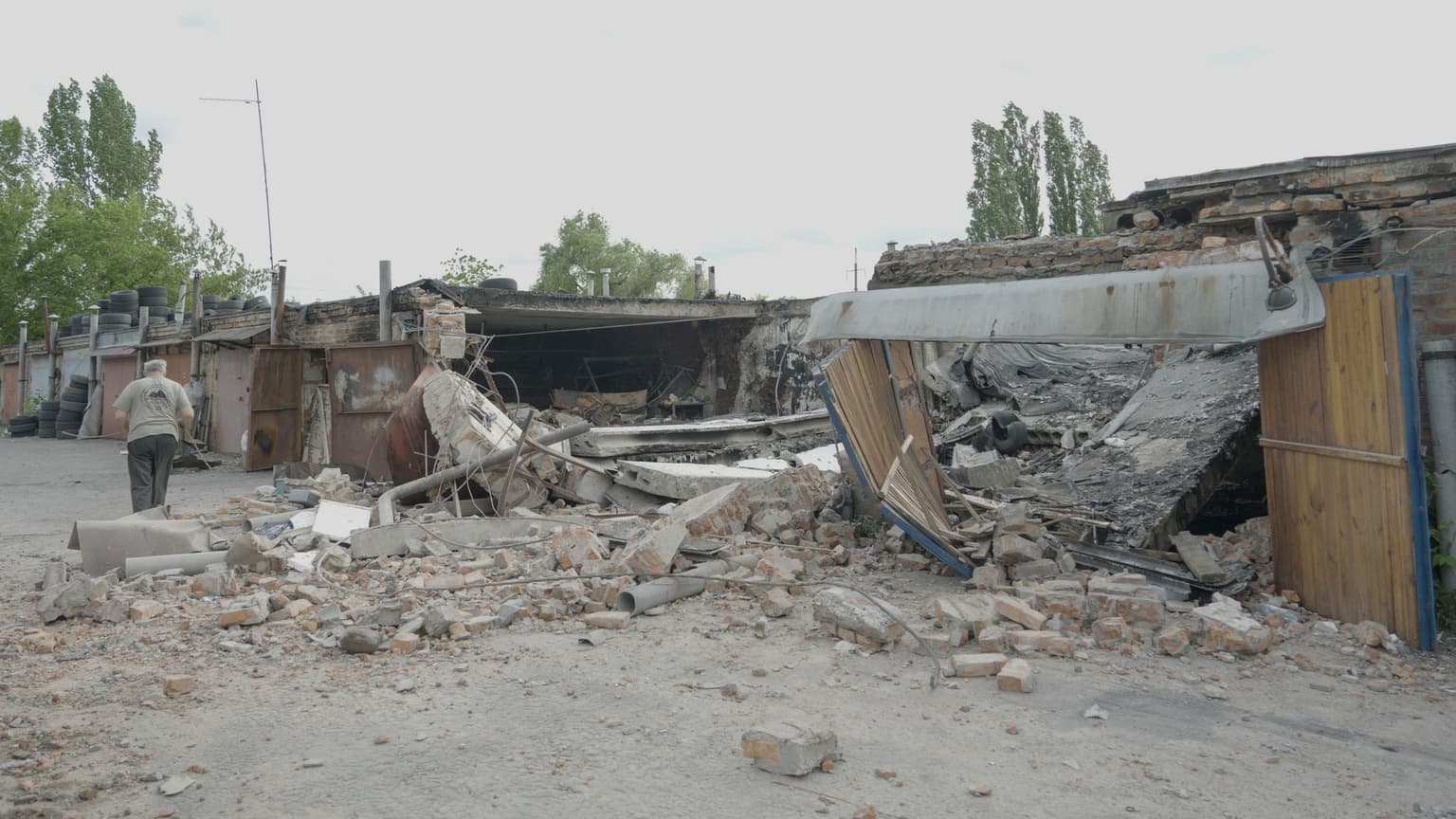
Destroyed garages at the impact site of an Oreshnik ballistic missile strike in Bila Tserkva, Kyiv Oblast, Ukraine, on May 25, 2026. (Anna Nesevra / The Kyiv Independent)
 on Google
In a dusty industrial estate in the city of Bila Tserkva, a Ukrainian grandmother searches through the smouldering ruins of her storage unit for her harvest of potatoes.
Two days earlier it had been hit with what is supposed to be one of Russia's most fearsome weapons — an Oreshnik intermediate-range ballistic missile (IRBM).
"It sounded like thunder, a very long, drawn-out thunder. And then there were six explosions in a row," Nadiia, a Bila Tserkva resident who declined to give her last name, told the Kyiv Independent.
But for a weapon costing over $50 million and which is supposed to make the collective West shudder in fear, the damage it caused was underwhelming.
Although the strike destroyed a handful of storage units — the grandmother's, one containing automobile parts, and another containing plumbing supplies — the majority of the site was untouched.
The hypersonic munitions smashed their way to the units' underground levels, but there was nothing in the way of a crater.
Russian President Vladimir Putin announced the missile's first known combat use when it struck the central Ukrainian city of Dnipro in November 2024, describing it as impossible to "counteract," and a "new conventional intermediate-range" missile.
Russian military commentators and pro-Kremlin analysts have since portrayed Oreshnik as a strategic deterrent aimed as much at NATO as at Ukraine.
But the May 24 strike on Bila Tserkva, the third such attack against Ukraine, has confirmed what many suspected all along — a non-nuclear Oreshnik is an expensive dud, and Russia lacks the expertise to turn it into a useful conventional weapon.
What is Oreshnik?
Despite Putin's claims that Oreshnik — which means "hazel shrub" in English — is a completely new weapon, experts and analysts agree it is actually a slightly upgraded version of the older RS-26 Rubezh.
Oreshnik is nuclear-capable and in theory can carry 36 sub-munitions carried by six MIRVs - multiple independently targetable reentry vehicles. These can be seen in videos of Oreshnik strikes as separate streaks of light hitting the ground.
It can likely reach speeds of around Mach 10 to 11 but it's this speed which partially explains why each strike on Ukraine has done such little damage.

Each of the three times Oreshnik has been deployed against Ukraine, it's been equipped with dummy munitions — essentially large lumps of metal that rely on kinetic energy to cause damage, though as evidenced in each of the strikes on Ukraine, this is minimal.
In order to inflict substantial damage, Russia would have to equip Oreshnik with a nuclear warhead for which it was designed, or develop a conventional warhead — something that, according to experts, Russia simply cannot do.
Its first known combat use came on Nov. 21, 2024, during a strike on the central Ukrainian city of Dnipro. Ukrainian officials initially said the attack resembled an intercontinental ballistic missile strike because of the missile's unusual speed and characteristics, though Western officials later rejected the ICBM assessment. The strike triggered explosions lasting several hours, targeting industrial infrastructure and residential areas in the city.
Russia used the missile again in January 2026 during a large-scale strike on western Ukraine, including the city of Lviv. Russian authorities later claimed the target was the Lviv State Aviation Repair Plant.
The missile was then used for a third time during Russia's massive overnight attack on Kyiv and Kyiv Oblast on May 24, 2026. Ukraine has repeatedly targeted infrastructure linked to the missile system. In February 2026, Ukraine's General Staff said Ukrainian forces carried out a series of strikes against the Kapustin Yar launch site using domestically produced Flamingo cruise missiles, damaging hangars and other infrastructure tied to Russia's ballistic missile program.
Why Oreshnik does such little damage
Because of their immense destructive power and massive blast radius, nuclear warheads delivered by missiles can be detonated relatively high above the ground, anywhere from around 300 meters to three kilometers.
If the warhead actually hit the ground at the speeds an IRBM travels, it would disintegrate before it could explode. The same goes for a conventional, non-nuclear warhead, which can't be detonated high above ground as the smaller blast radius wouldn't reach the target.
"So you'd need to detonate it a couple of meters above the ground and at these velocities you would have to time that detonation down to milli-milli-seconds — and that's just not something the Russians can do," Fabian Hoffmann, a Doctoral Research Fellow at the University of Oslo who researches missile technology, nuclear strategy, and defense policy, told the Kyiv Independent.

"Militarily, I continue to see its utility as very limited. Low accuracy and low kinetic energy even though it's fast means very low lethality against individual targets," he added.
In fact, Russia would have caused more damage in Bila Tserkva with one of its conventional ballistic missiles such as the Iskander-M, a much more cost-effective option at only around $1.4 million, a fraction of the cost of Oreshnik.
It may also have more of a psychological effect for those it targets.
Bila Tserkva has often been targeted by conventional ballistic missiles, and Nadiia told the Kyiv Independent the Oreshnik attack wasn't as terrifying.
"A ballistic missile flies for a long time, and has a louder roar, so I can't say (Oreshnik) is scarier than any other missile," she said.
So what's the point of Oreshnik?
Propaganda, although its effectiveness as a Russian weapon of intimidation has been reduced with each strike on Ukraine.
"I think the signaling value has also decreased significantly, and Russia knows it. The first time was a big deal, the second time less so, now it's almost routine," Hoffman said.
Adding to the Kremlin's woes, a second Oreshnik was reportedly launched on May 24 which may have crashed on Russian military positions near the occupied Ukrainian city of Avdiivka, according to Institute for the Study of War.
But Russia does appear to still have long-term plans for it.
Russian and Belarusian officials have linked Oreshnik to wider escalation rhetoric. Putin previously said Russia and Belarus had selected locations for future deployments of the system in Belarus, with infrastructure preparations and deployment expected by the end of 2025.
Belarusian leader Alexander Lukashenko later confirmed construction and infrastructure work for the missile system was continuing.

The kinetic energy of the Oreshnik’s submunitions do significant damage to anything they hit, but without an explosive payload, or the pinpoint accuracy to deliver it, the overall effect is significantly less destructive than a conventional Russian ballistic missile.
Russian military expert Yevgeny Mikhaylov said launches of the missile cannot realistically be concealed from the United States because Russia must notify Washington before firing an intermediate-range ballistic missile to avoid triggering U.S. nuclear warning systems. According to Mikhaylov, this allows Ukraine to receive advance warning from Western partners before launches.
According to Mikhaylov, Russia is deliberately "saving" Oreshnik for future, larger operations. He said using the missile against ordinary above-ground targets is "irrational" given the high cost of such systems, and claimed it would be more suitable for striking deeply buried underground infrastructure or in a broader confrontation with the West.
But unless Russia makes a technological breakthrough in conventional munitions — or starts a nuclear war — Putin's Oreshnik hype looks set to only get weaker.