'No comment': Why questions on Ukraine's reforms go unanswered by EU officials
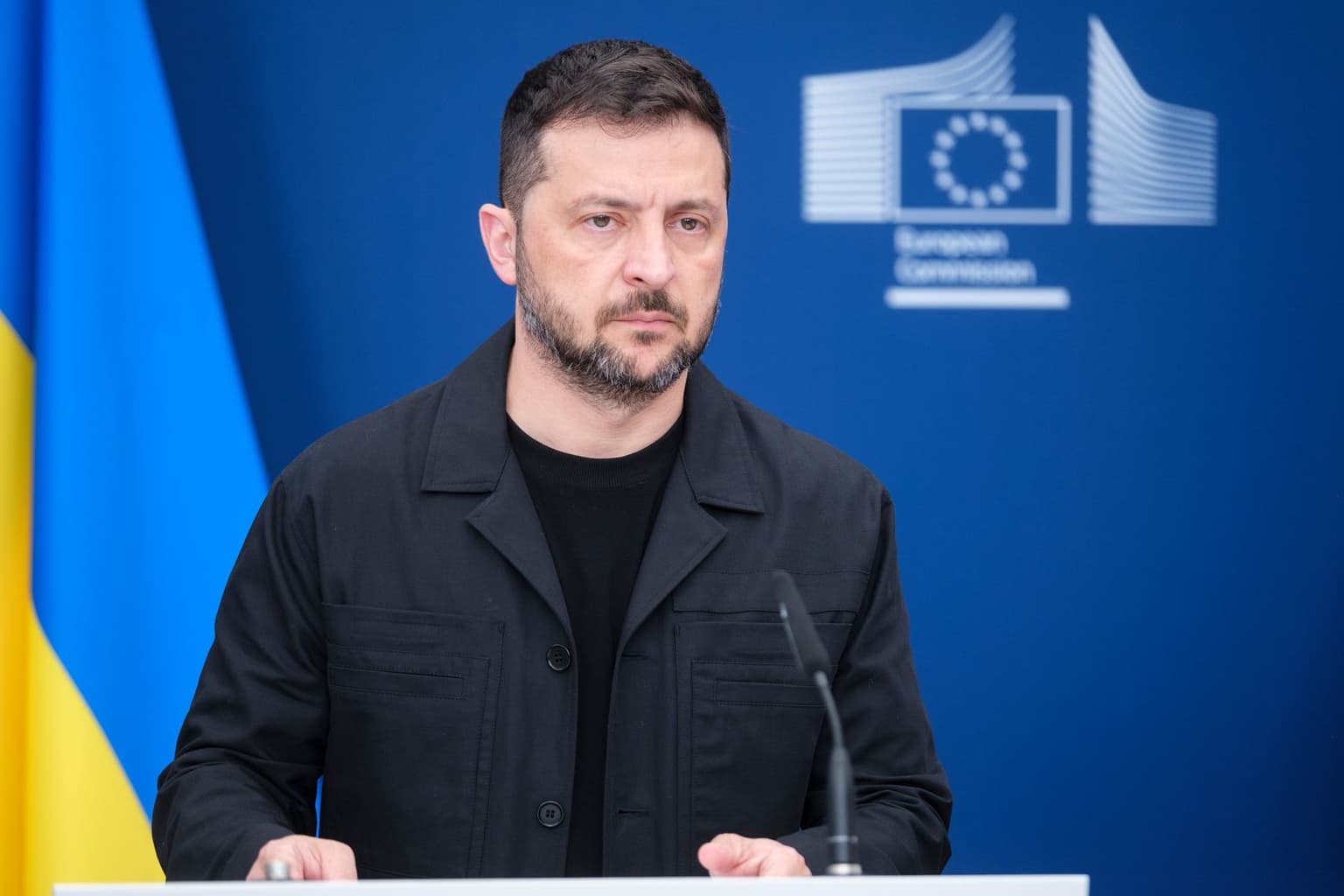
President Volodymyr Zelensky at the European Commission headquarters in Brussels, Belgium, on Aug. 17, 2025. (Thierry Monasse / Getty Images)
 on Google
Chris Powers
"We don't comment on comments."
"We won't comment on an ongoing investigation."
"That's a domestic issue, and so we won't comment."
If you hang around EU press briefings for a while, you will hear these reasons and many more for not answering your question. Requests for comment on Ukraine can, like any other topic, go unanswered, but sometimes for reasons you would not get elsewhere.
And it's not that the EU isn't bothered. In February, senior EU officials shared with the Kyiv Independent their concerns that the pace of reform had slowed, but these comments remained off-record — a very common phenomenon in Brussels that allows diplomats and civil servants to share private information more freely.
The Ukrainian parliament managed to pass some reforms in April but failed to pass others. Critical to that success, albeit partial, is the unlocking of EU and International Monetary Fund (IMF) financing that results from voting those laws through.
Rather than calling out a lack of momentum, the European Commission's strategy is to incentivize the behavior it wants to see. Two senior EU officials told the Kyiv Independent that the payments to Ukraine of the 90 billion euro ($105 billion) loan have been deliberately configured to keep IMF and EU reforms on track.
How so? Of the loan's 16.7 billion euros (about $20 billion) in general budget support being given in 2026, half will be paid as 'Macro-Financial Assistance,' an EU aid mechanism that is drawn up "strictly as a complement to IMF financing."
The rest will be diverted through the EU's Ukraine Facility, which includes conditionality on democracy and the rule of law, as well as a pillar dedicated to EU accession assistance.
EU accession itself, providing a country wants it, is also an important carrot, which is why in Brussels you will commonly hear it being described as "the most powerful and successful" and the "strongest geopolitical tool."
It is also why the EU does not back an accelerated membership process. Instead, you will find a new widespread mantra: accession "must remain a merit-based process."
Choosing battles
"We are not going to call out every stupid thing a politician or parliament says or does," one European Commission official told the Kyiv Independent when asked about the Ukrainian parliament's push for its new civil code, which civil society groups say "violates Ukraine's commitments under its EU accession process."
That official suggested that quickly responding to every issue risks diminishing the power of the EU's public objections.
"Often, they can return to reason on their own."
"When the stakes are high, or if this ever moves to a vote, believe me, we would have something to say," they added.

While the civil code is at an early stage in the legislative process, the EU would prefer to allow democratic forces in Ukraine to play their role first.
"Often, they can return to reason on their own," the EU official said.
There are also fears among some that commenting could do more harm than good.
One European Parliament staffer is worried that raising public concerns about corruption in Ukraine would reinforce stereotypes that Kyiv is hopelessly corrupt.
That worry emerged when the Kyiv Independent asked for thoughts about a major corruption probe that led to President Volodymyr Zelensky's former chief of staff, Andriy Yermak, being charged with money laundering.
More links needed
Another recurring issue in the European Parliament is the knowledge gap. Many do not have Ukraine's domestic politics at the top of their mind, stretched as they are across multiple committees, and primarily there to serve their own voters.
Sometimes, a request for comment from the Kyiv Independent is the first time they are hearing of a problem.
Staffers working in some political party groups have lamented a lack of Ukrainian counterparts with whom they could get this information and stake out a position.
The European Parliament comprises eight political party groups, each composed of national political parties that come together around a shared ideology.
Zelensky's Servant of the People party, which holds the parliamentary majority in Ukraine, is aligned with the European Parliament's liberal Renew group, as is the smaller opposition Holos party.
And the European Parliament's largest political grouping, the center-right European People's Party, has links to Petro Poroshenko's European Solidarity party and Yuliia Tymoshenko's Batkivshchyna (Fatherland) party.

But the second-largest group, the social democrats, and the European Parliament's Greens group, have no counterparts in the Ukrainian legislature.
That lack of counterparts has been cited by staffers in both groups as a reason why they did not already know about the most recent corruption investigations and the draft civil code.
But those same staffers said they would love to work with Ukrainian colleagues, so if you are a Ukrainian politician not yet aligned with a wider EU political family, good news!
Note from the author:
Hi, this is Chris Powers, the author of this article.
I hope you found reading it to be time well spent. In our team, we believe fact-based and truthful reporting should be available to all — that's why we don't use any paywall.
If you'd like to help me and my colleagues keep providing you with in-depth and up-to-date coverage of Ukraine's European path, the war against Russian aggression, and other topics, please consider joining the Kyiv Independent community.