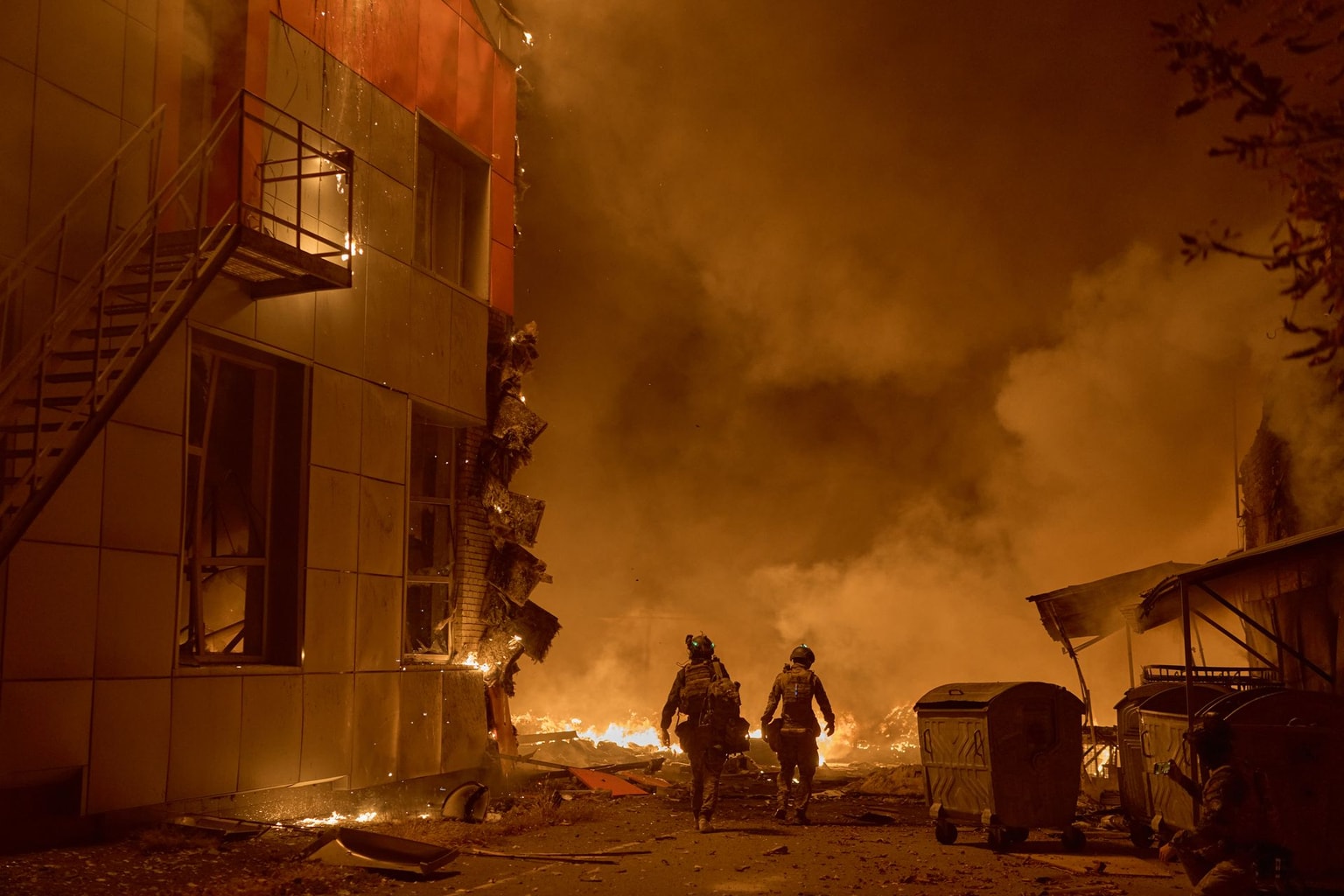
In the eye of Venice Biennale's storm, Ukraine takes center stage
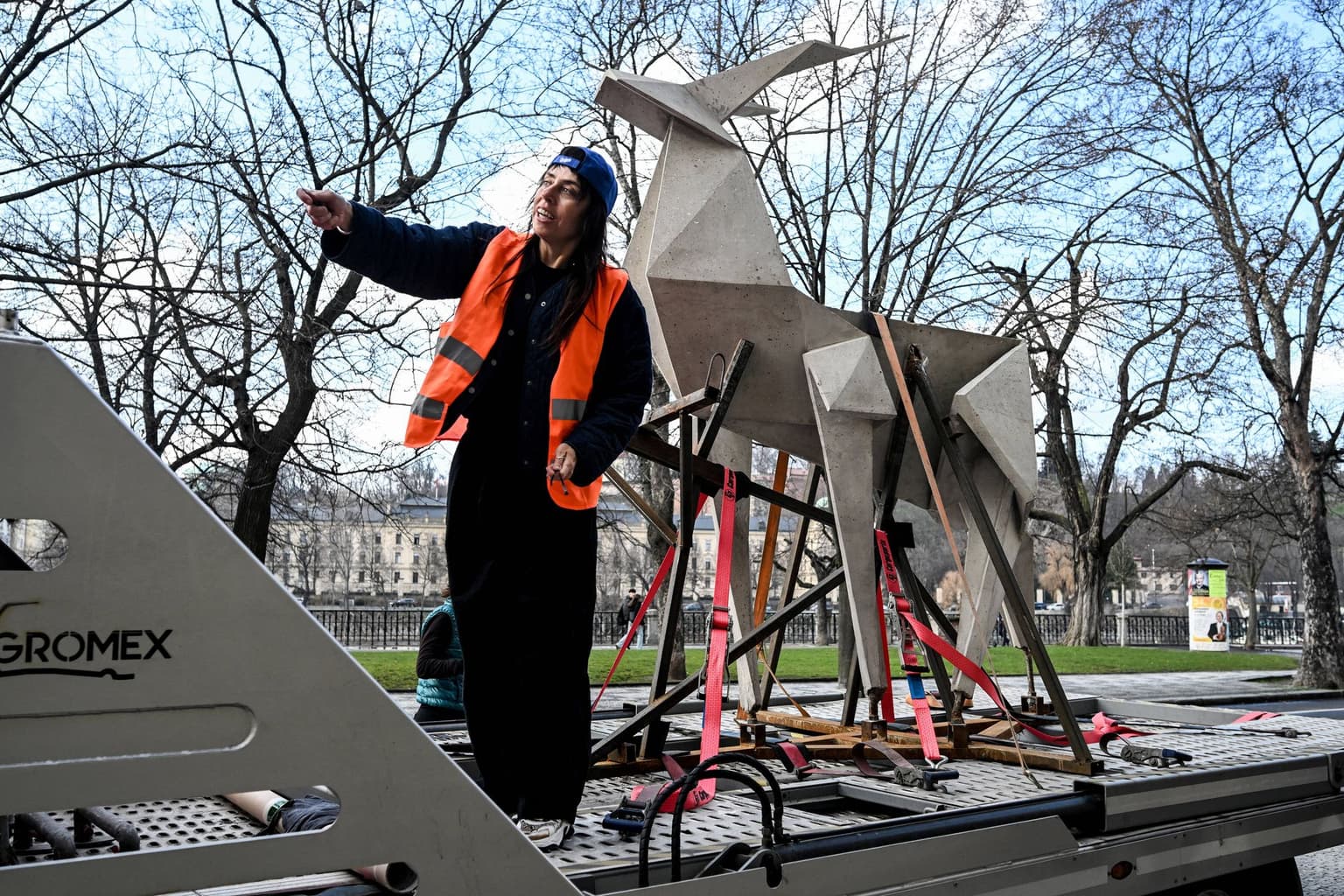
Ukrainian artist Zhanna Kadyrova stands next to her "Origami Deer" sculpture on a transport vehicle in Prague, Czech Republic, on March 12, 2026, during a stopover on its way to the Venice Biennale. (Michal Cizek / AFP / Getty Images)
 on Google
Even before stepping onto the grounds of the Venice Biennale, visitors are met with a striking image visible from behind the gates: a concrete deer, suspended midair from the crane of a parked truck, its form secured by vivid orange lifting straps that crisscross its body.
From a distance, the installation resembles a temporary construction site more than a national pavilion. People stop beneath it, trying to understand whether the structure is still being assembled, or whether this unstable suspension is the work itself.
The deer is an artwork by Zhanna Kadyrova, the artist representing Ukraine at this year's Biennale. Unlike in previous years, the Ukrainian Pavilion is divided into two parts and occupies space in both the Giardini and the Arsenale — the two main locations of the Biennale.
"We need to count on several seconds within the attention span of the visitor, and you either catch it or not," curator Masha Isserlis told the Kyiv Independent during the opening days of the 61st Venice Biennale, one of the world's biggest international art events running from early May until late November.
Ukraine in the spotlight
By the second day of previews, the Venice Biennale was extremely crowded. Heavy rain poured down as people waited in long lines outside the gates of the Giardini, one of the event's main locations, even before the official opening time.
All around Venice, a steady stream of people moved through the city. Many carried umbrellas, wore accreditation badges, took photos with cameras, and held tote bags. Visitors hurried between exhibition openings, discussion panels, and receptions, creating a constant flow of activity throughout the Biennale.
The run-up to this year's Biennale was markedly different from years past, shaped in large part by heightened political tension.
Days before the opening, the international jury resigned following controversy surrounding the participation of the Russian and Israeli pavilions. Protests followed across Venice during preview days, adding to an atmosphere already marked by exhaustion and overstimulation.

"I never saw that number of people being admitted to see the show," Isserlis said. "It made it almost impossible to move throughout the premises."
Yet the opening of the Ukrainian Pavilion took place in a markedly different atmosphere. Under bright sunlight at the Giardini, a dense crowd gathered around the truck holding "The Origami Deer," surrounding the suspended sculpture in a scene that at times resembled a peaceful protest more than an art opening.
Curators, artists, journalists, and visitors stood shoulder to shoulder listening to speeches about solidarity, cultural resistance, and continued support for Ukraine.
Throughout the afternoon, applause, embraces, and conversations in multiple languages moved through the crowd. The atmosphere remained politically charged, but carried a sense of collective presence rarely felt elsewhere during the Biennale's opening days.
The Ukrainian Pavilion's visibility this year was shaped by the conditions of the Biennale itself.
"Until recently, Ukraine was struggling with even getting attention," Isserlis said. "A lot of visitors of the Biennale are running around, and sometimes they don't even make it to the Ukrainian Pavilion."
During the opening days, journalists gathered under Zhanna Kadyrova's suspended "Origami Deer" waiting to interview the artist. Television cameras and photographers crowded around the crane while visitors tried to catch a glimpse of Kadyrova from behind the backs of tightly packed reporters.
Questions ranged from the sculpture's evacuation from Pokrovsk to the broader political tensions surrounding the Biennale itself, including Ukraine's response to the Russian Pavilion's participation.

"The bold, direct message is getting more attention than a more complex project. In the case of Ukraine, it needed a very physical statement," Masha Isserlis said.
Many of the Ukrainian Pavilion's visitors spoke thoughtfully about their impressions of the exhibition. A woman from Taiwan approached the team to express how relevant the war and occupation feel to her. The directness with which the story about the ill-fated city of Pokrovsk was conveyed to visitors prompted emotional sighs, tears, and words of support.
Looking up at the hanging sculpture, a woman from Amsterdam simply said, "Amazingly straightforward. It just cuts through the bu***hit."
Suspended in history
Originally installed in 2019 in Pokrovsk, eastern Ukraine, "The Origami Deer" stood on the pedestal of a dismantled Soviet military aircraft capable of carrying nuclear weapons. The sculpture was conceived as a permanent public work, but in 2024, as Russian forces approached the city, it was evacuated from Donetsk Oblast, transforming a site-specific sculpture into a displaced object moving across Ukraine and Europe.
Despite its direct visual language, the project carries a historical layer that many visitors encounter only after entering the pavilion itself. The deer's evacuation and journey across Ukraine and Europe is presented alongside references to the 1994 Budapest Memorandum, under which Ukraine gave up the world's third-largest nuclear arsenal in exchange for security assurances from Russia, the United States, and the United Kingdom.

According to Isserlis, the pavilion's significance also lies in how the project extends beyond the sculpture itself.
"It's not just Venice, it's also the way to Venice," she said, referring to the deer's movement through multiple European cities before arriving at the Biennale. "The whole project is more than just an art project. Zhanna always attracts people around her, and the community she gathered along the way, people who supported her, musicians, curators, institutions — all of that is part of the project."
At the same time, Isserlis pointed out that the project's historical dimension is often less immediately visible to international audiences.
"I don't think that a lot of Europeans even know the recent history where Ukraine gave up its atomic arsenal for the security guarantees," she said. "That part of our history is incredibly important while we're looking at the geopolitical situation right now."
"Zhanna's project is not as obvious as it looks in the first place," she added. "The project has a depth, a historical meaning, and historical relevance."
In Venice, the sculpture's displacement became inseparable from that history.
Art is not apolitical
For Isserlis, the political tensions surrounding this year's Venice Biennale exposed a broader institutional failure.
"I don't believe in apolitical institutions. I don't believe that art is not political. The Biennale made a big mistake by allowing this year's participation to be handled the way it was. The critique needs to stay strong against the institution behaving that way."
Isserlis described the jury's resignation as "an incredibly important step to show ethical responsibility," adding that "somebody needed to do something."

She also pointed to a visible divide in reactions across Europe. According to Isserlis, support for Ukraine during the opening days came most strongly from countries with direct historical experience of Soviet and Russian occupation, including Poland, Lithuania, Estonia, Latvia, and Finland.
"Western Europe needs to listen more to the East," she said. "Until this listening is happening, there is still a lot of work to be done."
As the rain briefly stopped over the Giardini, visitors continued to gather beneath the suspended deer before moving deeper into the Biennale grounds. Some paused only long enough to take a photograph. Others stayed, trying to piece together the story behind the sculpture hanging above the entrance to Venice's largest art event.
The crane remained parked in place, its bright straps still holding the concrete body in the air. While it was never meant to travel, its displacement serves as a reminder to the Venice Biennale's visitors that the most devastating war on the European continent, just hundreds of kilometers away, is still ongoing.