There is one thing emergency teams need ready on arrival, and it's not what most organizations prepare for
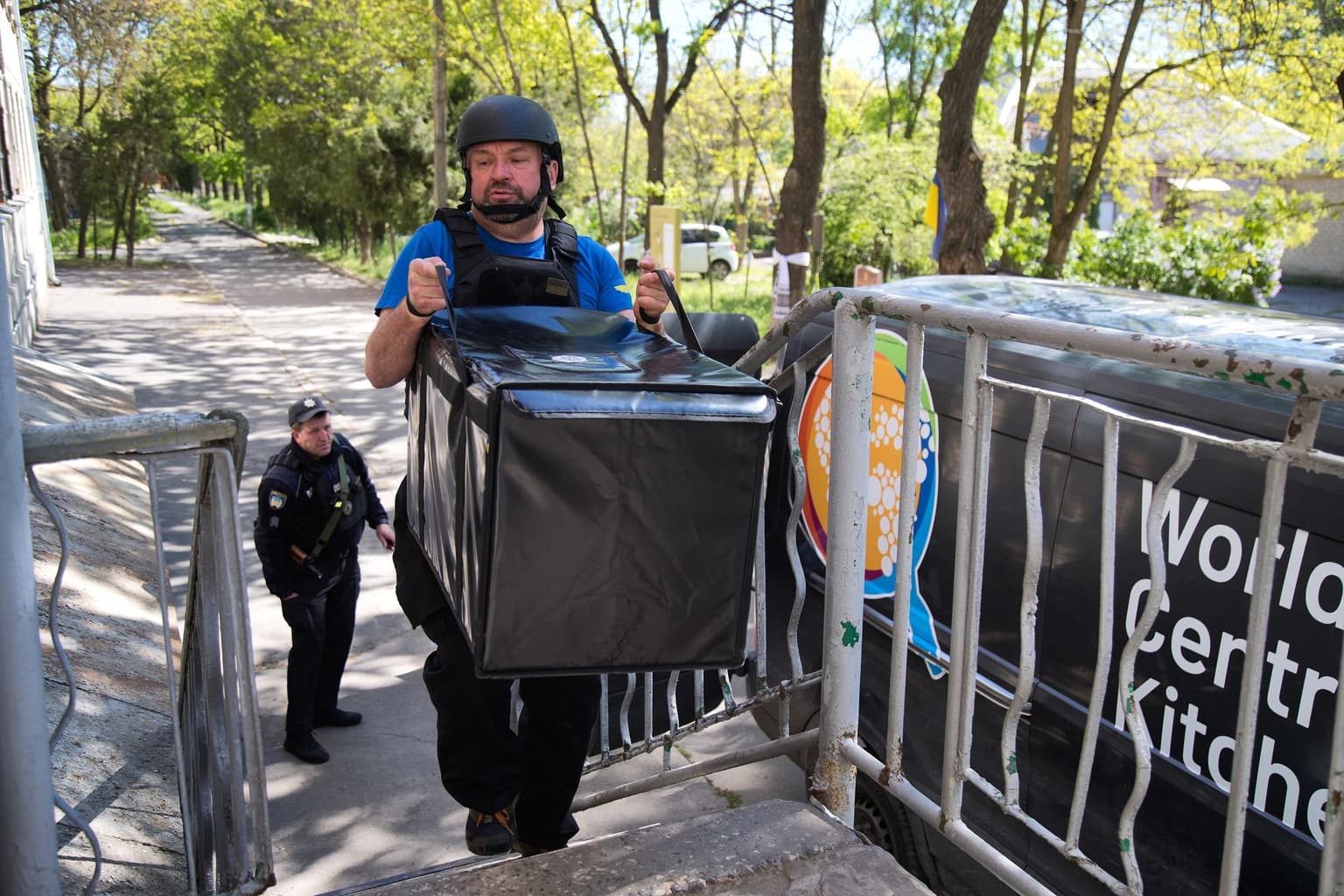
Vitaly, a World Central Kitchen driver, delivers meals to a shelter for internally displaced people in Kherson, Ukraine, on May 5, 2026. (Pierre Crom / Getty Images)
 on Google
Anton Sadykov
Chief Innovation Officer at Adaptis
In January 2023, World Central Kitchen teams traveled to recently liberated communities in Kherson Oblast, delivering hot meals and food packages.
People came for aid, but almost immediately they asked for a way to call home — to reach their children, spouses, relatives in another city, anyone who might know whether the others had survived.
That experience changed my understanding of critical connectivity.
A system matters only when it is ready when a team arrives: a vehicle stops, people gather, someone needs to call a relative, and a coordinator needs to reach the base.
If, at that moment, the team is still looking for power, cables, or the one person who knows how to connect everything, the system has already failed the mission.
After months of occupation, people had lived without reliable information and without contact with those closest to them. For many, one call meant something very simple and very urgent: hearing that their loved ones were alive, and being able to say the same in return.
At the time, I was leading regional operations for World Central Kitchen in Ukraine. The organization had been working in the country since February 2022, providing hot meals in areas affected by war, including front line and recently liberated communities.
The Kherson trips showed us exactly what WCK teams needed. Satellite connectivity had to serve two purposes at once. The first was operational: routes, contact between vehicles and bases, and a quick understanding of where it was safe to go.
The second was human: giving people on the ground a way to reach those waiting for news. The teams were working across different cities and regions, including Kramatorsk, Kherson, Kharkiv, Mykolaiv, Dnipro, Kryvyi Rih, and Zaporizhzhia.
There were ready-made solutions abroad, but they did not solve the most important constraint: time.
Delivery would take months, while the teams were already on the road. Cost mattered as well. It had to be realistic for several teams operating simultaneously. So we started building a Starlink-based solution in Ukraine.
We used Starlink as the basis and prepared the kit for vehicle-based field use: a protective housing, sealing, a weather-resistant RJ45 port, power from the vehicle's onboard system, and a mount that could withstand movement.
We also tested the mount at speeds above 240 kilometers per hour (149 mph) to see how it behaved under airflow on the roof of a moving car.
That experience led me to four requirements I still consider essential for field connectivity.
The first is energy independence. In a disaster zone or near the front line, access to the power grid may simply be absent. The kit must run from the vehicle or an autonomous power source. If the team starts looking for power only after arriving, it loses time before the work has even begun.


The second is physical readiness. If a team arrives and only then begins mounting equipment, time has already been lost. In dangerous conditions, this becomes a very real safety issue, so the terminal must be mounted, configured, and ready before the vehicle leaves the base.
The third is access without extra steps. Volunteers do not have time to deal with passwords and settings. The vehicle stops, and the network should already be available. The doors open, and the team should already be able to coordinate.
The fourth is low visibility. A large terminal on the roof immediately attracts attention, which is very risky in a combat zone. In the field, connectivity is judged in very practical terms: how discreet the kit is, how well it holds on the vehicle, how quickly it starts, and whether it can withstand daily use.
In February 2023, two weeks after the first kits were deployed on Ukrainian routes, a devastating earthquake hit southern Turkey. WCK launched a mission in Hatay and neighboring provinces. I traveled with the team, and the kits we had built for Ukrainian roads went with us.
Turkey was a very different kind of crisis. In Ukraine, destruction often accumulates over time: strike after strike, month after month. An earthquake changes everything in minutes, and surviving mobile networks are overloaded within hours as millions of people try to find one another.
Satellite connectivity became one of the few manageable channels the team could rely on.
Turkey also brought a different regulatory challenge. At the time, the rules around Starlink use in the country were unclear for this kind of humanitarian deployment. The need for connectivity was obvious on the ground, but the legal environment around the equipment remained difficult to navigate.
Still, the work on the ground quickly felt familiar. Connectivity was needed for internal coordination and for working with local communities. The team used it to open maps, find local service contacts, use Google Translate, and explain where people could find medical assistance or support points.
After Turkey, I began looking at Europe's conversation about critical communications differently.
Europe is now developing the European Critical Communication System, a shared infrastructure for police, rescue services, and emergency medical responders across the EU and the Schengen Area.
Much of the public discussion focuses on standards, frequencies, and interoperability. Without those, such a system cannot work. But once a team reaches the site, the questions become much more immediate. Is there power? Who starts the equipment? Is the network ready when the team arrives? Can people nearby use it?
Ukraine's experience can serve as a field test of what happens to connectivity when a team is on the move, infrastructure is damaged, and there is no time for setup.
Kherson Oblast and Hatay were different crises. In the first hours, however, the teams faced a similar task: arrive, understand the situation, reach each other, find the people who needed help, and give them access to information.
The systems Europe is designing now will eventually arrive in that same first hour. After the protocols and frequencies, the questions become very practical. In the first hour of a humanitarian mission, connectivity sets the pace: where the team goes, where it can stop safely, who needs to be found, who receives information, and whether a person on the ground can call home.
The teams I worked with saw this in Ukraine and Turkey within weeks of each other. The circumstances were different, but the same rule applied: connectivity had to work in the first hours, while infrastructure was still broken, overloaded, or absent.
Editor's note: The opinions expressed in the op-ed section are those of the authors and do not purport to reflect the views of the Kyiv Independent.