Inside Russia's 2026 parliamentary election: Banned opposition, rigging, and war
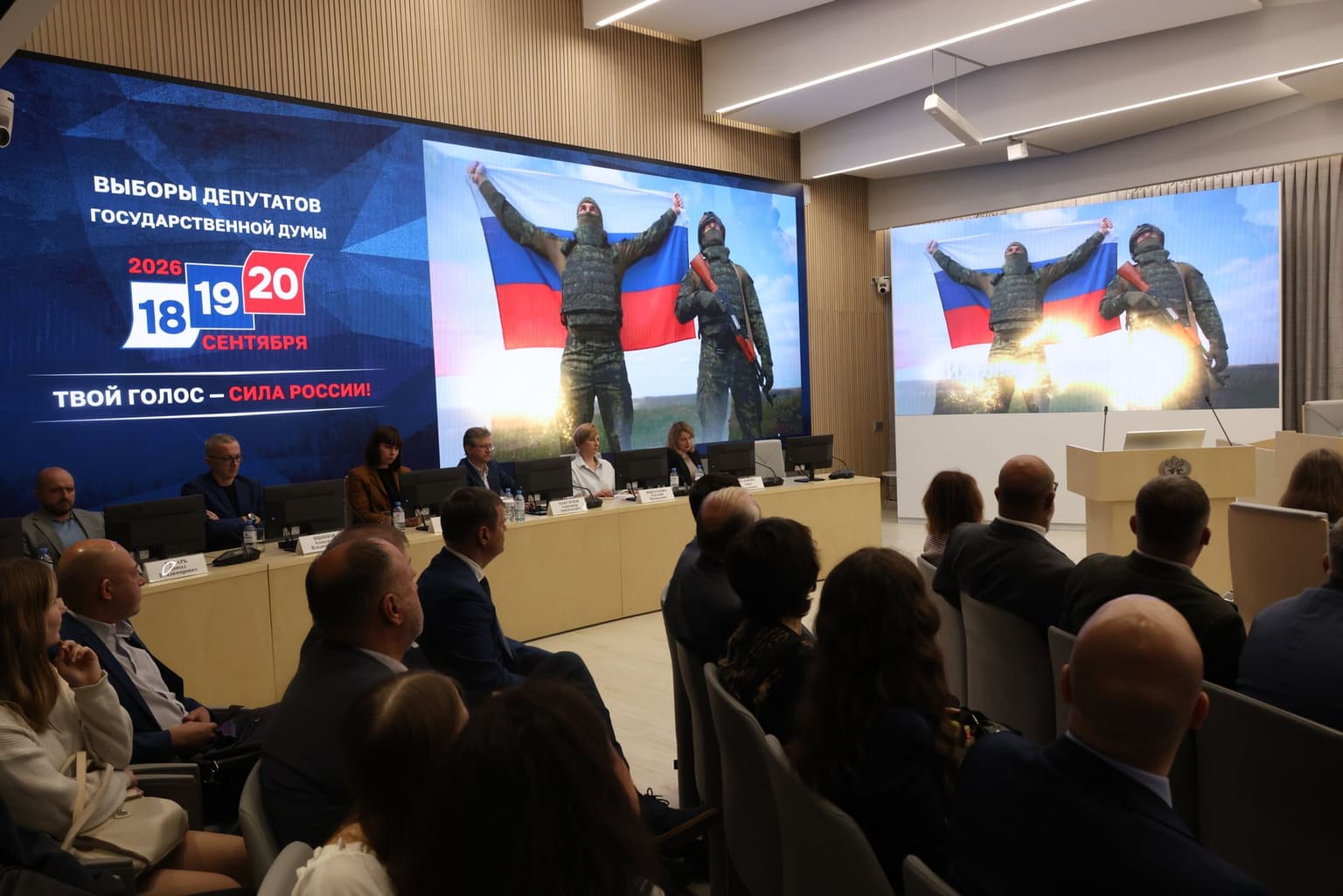
Participants look at the screen showing a video featuring Russian soldiers and promoting participation in the autumn parliamentary elections during a meeting with members of the Central Election Commission, dedicated to the start of the autumn elections, on Sept. 17, 2026, in Moscow, Russia. (Contributor/Getty Images)
 on Google
A parliamentary election kicked off in Russia on Sept. 18 in what is expected to be a rubber-stamp ritual intended to legitimize President Vladimir Putin's rule.
The election will be held over several days and will be completed on Sept. 20.
The voting is taking place amid growing frustration among Russians with the war as its costs mount, and Ukraine intensifies drone strikes on Russian territory.
However, there is little opportunity for voters to express their discontent since anti-war parties and candidates have been barred from running. Virtually no genuine opposition is represented, and massive vote rigging is expected to ensure the Kremlin's victory.
Below, the Kyiv Independent explains the key aspects of this so-called election.
Which parties will participate?
Half of Russia's parliament is elected through party lists, while the other half is elected through single-member constituencies.
The parties that have a chance of getting into parliament include Putin's United Russia and nine other parties that call themselves "opposition" but are in reality controlled by the Kremlin and fully support the war against Ukraine.
Of those nine, four are usually expected to sit in parliament and rubber-stamp the government's decisions.
These include the far-left Communist Party, left-wing and right-wing nationalist parties — A Just Russia and Liberal Democratic Party (LDPR) — and the New People party, set to capture the votes of the younger generation. There are also less well-known parties on the ballot whose primary function is to act as "spoilers" and take votes away from United Russia's main competitors.
"They may formally be separate parties, but they all vote the same way," Russian exiled politician Vladimir Kara-Murza told the Kyiv Independent.
Farida Rustamova, a Kremlin expert and Russian journalist at the media outlet FariDaily, told the Kyiv Independent that both United Russia and its competitors are leading a very quiet campaign because their aim is to avoid any public discussion and make sure that only Kremlin-controlled voters participate.
read also
Are opposition candidates allowed?
Most genuine opposition and anti-war candidates were banned.
"The electoral field has been cleared of opposition, and the goal is to discourage independent-minded voters from taking part in the election," Rustamova said. "This is a thoroughly sanitized election, with no dissent whatsoever. That kind of 'authoritarian beauty' is important to them."
Alexei Navalny, Russia's actual opposition leader, died in jail shortly before the 2024 presidential election. Based on laboratory test results, several European governments said in February 2026 that he had been poisoned with a dart frog toxin and blamed the Kremlin for the murder.
Boris Nadezhdin, a moderate who had previously maintained good relations with the Kremlin, was the only anti-war candidate registered in the initial stage of the 2024 presidential election. However, he was eventually banned from running after he mobilized the anti-war and anti-Kremlin opposition, and lines formed all over Russia and abroad to support his candidacy.
Nadezhdin also sought to run in the 2026 parliamentary election, but he was banned from running in July after being fined for "extremism" when he shared a video featuring the late Navalny.
The same month, he fled Russia after being summoned by the Investigative Committee amid fears that he was about to face criminal prosecution.
Like Nadezhdin, the liberal party Yabloko was not part of the outright opposition to the regime. The party was moderate in its criticism of the authorities and was not seen by the Kremlin as a threat, failing to pass the 5% electoral threshold in legislative elections since 2003.

However, in its 2026 election campaign, Yabloko was the only anti-war party, managing to significantly boost public support and mobilize voters.
In August, the Supreme Court banned Yabloko from running in the election. The formal reasons for the ban were widely ridiculed and included violating copyrights by using non-copyrighted AI-generated images, mentioning the name of a Soviet-era song, and using a public-domain image of the 1945 bombing of Hiroshima.
Furthermore, several Yabloko members have been jailed for up to 11 years for "discrediting" the Russian military under a law that criminalizes any opinion on the war that contradicts the Kremlin's official position.
Some Yabloko and other anti-war candidates remain in single-member districts, however.
"The main reason why Yabloko was removed from this voting list was not that Yabloko was itself a potent competitor, but it turned out to become the only party against war," Ryhor Nizhnikau, a Russia expert at the Finnish Institute of International Affairs, told the Kyiv Independent. "For the Kremlin, the main danger was that society would see the scale of anti-war potential in the country."
Kara-Murza said that, if Yabloko had been allowed to run, "it would have become clear to the whole world that the emperor has no clothes and that there is no mass support for the war."
Russians' attitudes to the war are ambiguous.
On the one hand, 68% supported Russia's war against Ukraine, according to a Sept. 1 Levada Center poll. Analysts see the figure as an indicator of conformism in a highly authoritarian country.
On the other hand, 59% of the Russians supported ending the war and moving to peace negotiations, which indicates growing frustration with the war, according to the Levada Center.
What are the opinion poll results?
Russia's official pollsters, VTsIOM and FOM, are controlled by the Kremlin. Meanwhile, independent polling agencies' activities are heavily restricted in Russia, and results are also distorted by the fear of persecution by a highly authoritarian regime.
According to a May poll by the Levada Center, which is considered to be a bit more independent, United Russia would get 47% of the vote, while LDPR, the Communist Party, the New People, and A Just Russia would receive 16%, 15%, 7%, and 6%, respectively.
According to a Sept. 10 ExtremeScan poll, 18% would vote for Yabloko if it were registered in the election, while United Russia would receive 31.8%, and the Communist Party would get 16.6%.
A Sept. 10 FOM poll projected that United Russia would win 47-49% of the party-list vote, followed by the Communist Party with 14-17%, LDPR with 10-12%, and the New People with 8-9%. A Just Russia would get 6-7%.
Are Russian elections rigged?
The amount of vote rigging has gradually increased since Putin came to power as his dictatorship became more entrenched.
The 2024 presidential election was the most rigged in Russia's modern history, according to evidence published by election experts, observers, and media.

Estimates of vote rigging in the election ranged from at least 22 million votes to about 31.6 million votes, without taking into account online voting and the election at gunpoint in Russian-occupied parts of Ukraine. If these results are included, voting fraud could have amounted to up to around 40 million votes, or 46% of the people who allegedly voted.
The estimates were published in 2024 by Russian election expert Ivan Shukshin and Novaya Gazeta Europe and were based on a mathematical analysis of the results.
"The Sept. 18-20 elections will be brazenly and ruthlessly falsified and will bear no relation whatsoever to what voters actually think," Russian columnist Sergei Parkhomenko told the Kyiv Independent.
What is the opposition's strategy?
Since no genuine opposition or anti-war parties were registered in party-list representation, Putin's opponents were left with few options.
The Russian opposition is divided on how to vote. Or if to vote at all.
The teams of the late opposition leader Alexei Navalny's widow, Yulia, and blogger Maxim Kats, supported by some other opposition figures, on Sept. 14 presented a unified strategy.
In party-list representation, they propose voting for parties other than United Russia that have a chance of getting into parliament: the Communist Party, the New People, or LDPR.
In single-member districts, Navalnaya and Kats approved a united list of candidates. In the districts where there are Yabloko or other anti-war candidates, they proposed voting for them. In other districts, they backed the least pro-war candidates or ones with a bigger chance of beating United Russia.

Other opposition figures, however, call for a boycott or spoiling the ballot.
Nizhnikau argued that "both strategies are rather a call of despair, where neither side nor any strategy can actually have an impact."
Will Russia carry out another mobilization after the election?
In 2022, Russia carried out its first post-World War II mobilization of conscripts for the war against Ukraine. The move sparked protests and prompted hundreds of thousands of Russians to flee abroad.
The mobilization was completed in five weeks, and since then, Putin has been reluctant to announce a second wave. Analysts say Putin was afraid of a backlash from the population and potential damage to the economy.
Instead, the Kremlin has resorted to recruiting a large number of mercenaries through both unprecedented financial incentives and the use of force and intimidation.
Since Russian battlefield gains have been slow, and no decisive breakthrough has been achieved, there is speculation that Putin will decide to announce a second mobilization after the Sept. 18-20 election to boost his war effort.
According to this theory, Putin has delayed the move until after the election, fearing that it could fuel public discontent and impact voting. But military analysts have told the Kyiv Independent before that a mobilization is likely only in the case of a major Russian defeat or front-line collapse.
"I don't expect any formally declared mobilization (after the election)," Parkhomenko said. "It would be a risky, dangerous, and deeply unpopular move, and it's far from clear why Putin would want to take that risk."
He argued, however, that pressure on Russians to sign military contracts would likely intensify, and there would be "an increase in the number of people being dragged into the army in much the same way as they are now."