As Putin edges towards mobilization, Russian reservists are already panicking
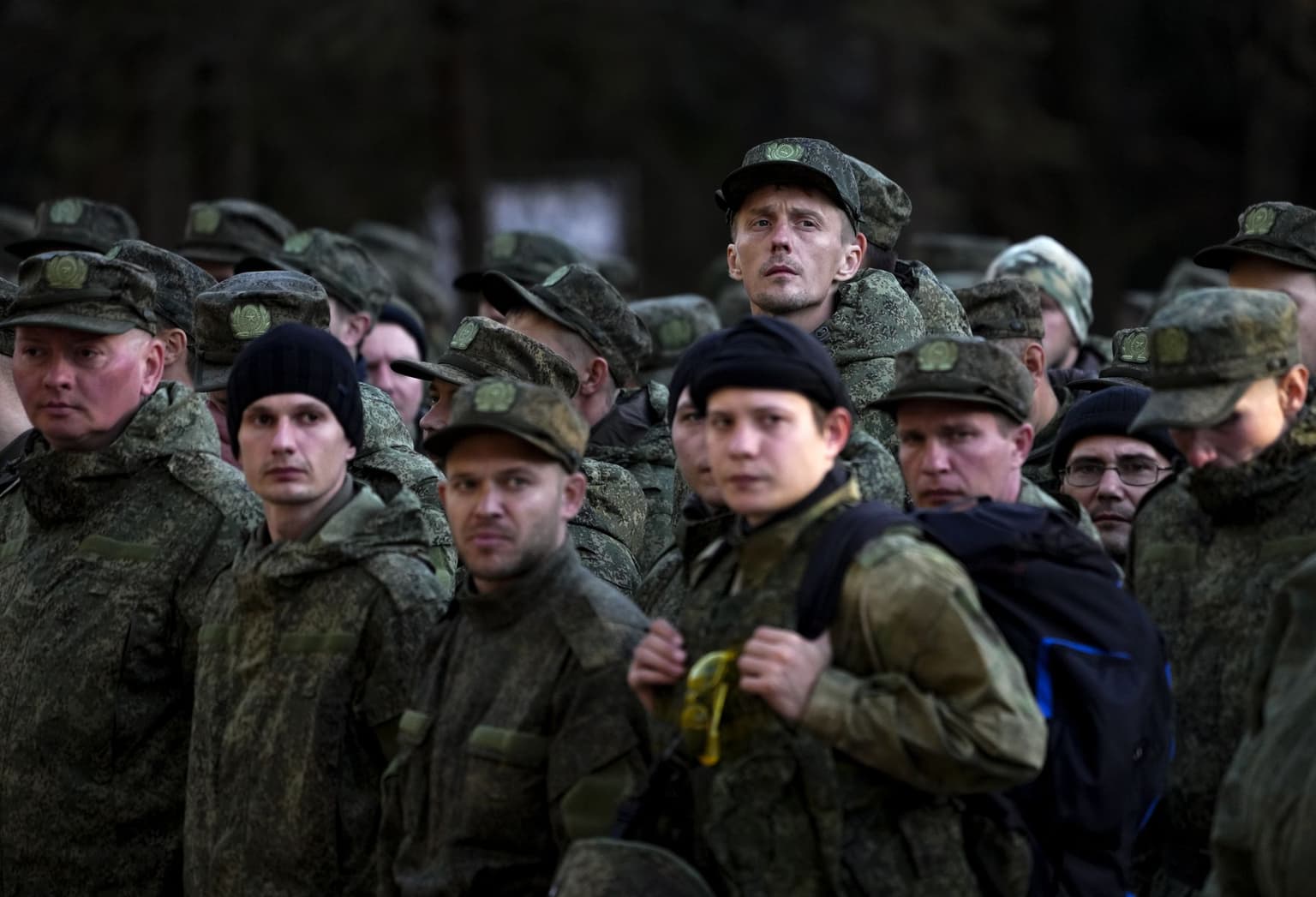
Russian citizens drafted during the partial mobilization are dispatched to combat coordination areas in Moscow, Russia, on Oct. 10, 2022. (Stringer / Anadolu Agency / Getty Images)
 on Google
Nobody expected Russia's parliamentary election to wrest power from President Vladimir Putin, with preliminary results on Sept. 21 showing the Kremlin-backed United Russia party winning once again with nearly 58% of the vote.
Instead, the question after the election is whether, when, and in what form the Kremlin will launch a new mobilization wave that Kyiv has warned could follow the vote — and which Russia may ultimately need to pursue its war objectives.
Russia remains committed to capturing all of Donetsk Oblast, and the Kremlin wants this accomplished by the end of 2026, while Russia's military has sought to push the deadline to March 2027, according to Ukrainian officials.
Either way, to sustain the campaign, Russia will require more manpower. Ukrainian intelligence says Russia's General Staff is prepared to mobilize around 300,000 personnel in 2026 and 2027 each.
These forces are in addition to roughly 400,000 people a year that Russia needs to recruit just to replenish its forces, a senior Ukrainian official told the Kyiv Independent.
Contract recruitment, meanwhile, has been slowing: around 234,000 people signed contracts between January and August this year, compared with roughly 260,000 over the same period in 2025.

But Moscow is also burning through manpower at roughly the same pace it can replace it. President Volodymyr Zelensky said in July that Russia had suffered nearly 225,500 casualties since the start of 2026.
Russia's total military casualties over the course of the full-scale invasion are estimated by Ukrainian authorities at around 1.6 million, including about 700,000 killed. The figures are difficult to verify independently, as neither side publishes its casualty data.
A fragmented mobilization
Putin's first partial mobilization announcement in 2022 triggered the biggest domestic backlash against Russia's war and prompted hundreds of thousands of Russians to leave the country.
This time, people familiar with the matter expect a more fragmented process that combines pressure on reservists, continued contract recruitment, and other measures without the need for a mobilization announcement.
"They will look for half-measures and give each step a separate justification," said Artem Klyga, a lawyer and head of the legal department at the Movement of Conscientious Objectors, an exiled independent Russian NGO that helps Russian citizens to legally avoid conscription.
The Kremlin has flatly denied such plans. On Sept. 1, Putin called reports of a looming mobilization "nonsense," after spokesperson Dmitry Peskov on Aug. 25 had called them "fabricated stories" spread by Ukraine to destabilize Russia internally.

"Everything the authorities are doing is aimed at distancing themselves as much as possible from the word 'mobilization' and from the fear associated with it," Klyga said.
How visible the mobilization process becomes depends on its scale.
The Kremlin still has to decide on how much of the General Staff's request it is willing to approve, as well as on the timing, a Ukrainian defense sector source familiar with the issue told the Kyiv Independent on condition of anonymity.
"If the number is manageable, it could remain hidden. If it is significant, they will not be able to hide it," they said.
Once called up, new recruits would need around two to four weeks of basic training before they could join combat units, according to the source.
Reservists could be first
In Russia, active reservists are a relatively small group within the broader military reserve. They are civilians who have signed contracts committing them to remain available to the Defense Ministry while continuing their normal civilian lives.
Since 2025, the Kremlin has broadened the use of Russia's active reserve, including deployments to protect critical infrastructure and counter drone attacks in their home regions.
Now there are signs of growing pressure on the group.
Klyga said reservists accounted for around 60% of requests for help his organization received this summer, up from the usual 20% to 30% — the highest share it has ever recorded.

"We were genuinely surprised," he said. "A lot of them are receiving [summonses] for the first time in many years, and they panic."
Beyond that contracted reserve, the inactive military reserve is much larger. Any man that completes Russia's 12-month compulsory military service, which can begin from the age of 18, enters the inactive military reserve and becomes eligible for mobilization, even at age 19.
In Ukraine, the main mobilization framework generally applies to military-liable men ages 25 to 60.
Russia is also better equipped today to enforce summonses than in 2022. Electronic notices are legally considered delivered after seven days, even if the recipient does not open them. Failure to appear can trigger restrictions on loans, driving rights, and property and vehicle transactions.
Beyond reservists
The ongoing voluntary contract recruitment is likely to remain one of the main ways Russia replenishes its army.
The system already reaches men across age groups and social backgrounds: students, conscripts, older men, those facing financial hardship, foreigners, and prisoners.
"When we talk about mobilization, we artificially exclude a large group of men who are already being recruited for the war," Klyga said. "In other words, they have already reached everyone they could reach."
What is likely to change is the level of pressure.
Ukrainian military intelligence says Russia is preparing tighter control over military registration, new mechanisms for recruiting prisoners, and additional coercive measures.
Klyga said his organization had already begun seeing more cases of deception and coercion by the end of 2025.
One of the more striking examples came in June, when police and military recruitment officers jointly carried out raids to identify and detain men who had supposedly failed to register for military service in several cities of Russia's Penza region.
Direct mass violence is not the norm, Klyga said, but such raids may signal a shift toward a more coercive recruitment model.
"Next, the pressure could expand to unemployed people and those looking for work," he said.
What does this mean for Ukraine
President Volodymyr Zelensky said most newly mobilized Russian troops would likely be sent either to reinforce Russia’s offensive in eastern Ukraine, particularly in Donetsk Oblast, or to create pressure from the north, including toward Kyiv and Chernihiv from Belarus.
In both cases, the aim would be to stretch Ukrainian defenses and weaken its position in the east.
Meanwhile, Ukraine faces a manpower crisis of its own. Presidential Office head Kyrylo Budanov said in August that the country needs to mobilize at least 30,000 people every month simply to sustain its current force. For a country with a far smaller population base than Russia, maintaining that pace is a much heavier burden.

While Russia retains advantages in manpower, artillery stocks, and ballistic missiles, Syrskyi said in June that Ukraine had gained the upper hand in the drone war, including in FPV drones as well as medium- and long-range strikes.
Ukraine also seeks to level the advantage in other technology fields.
Two domestically produced ballistic missiles are expected to enter service in the coming months, while Kyiv is working with European partners on the Freyja anti-ballistic missile system.
Mykhailo Samus, a Ukrainian military expert and director of the New Geopolitics Research Network, said Ukraine’s response should be to expand the areas where it can offset Russia’s numerical advantage.
"If the Russians want to use the bodies of their citizens instead of technology, that is their choice," he told the Kyiv Independent. "We need to continue developing technology, improve the effectiveness of army corps, create troop groupings, increase the number of drones, and develop robotics and autonomous systems."
"This is not the First World War. This is a war of technology."