Russia's rigged election gives Putin a mandate for all-out war
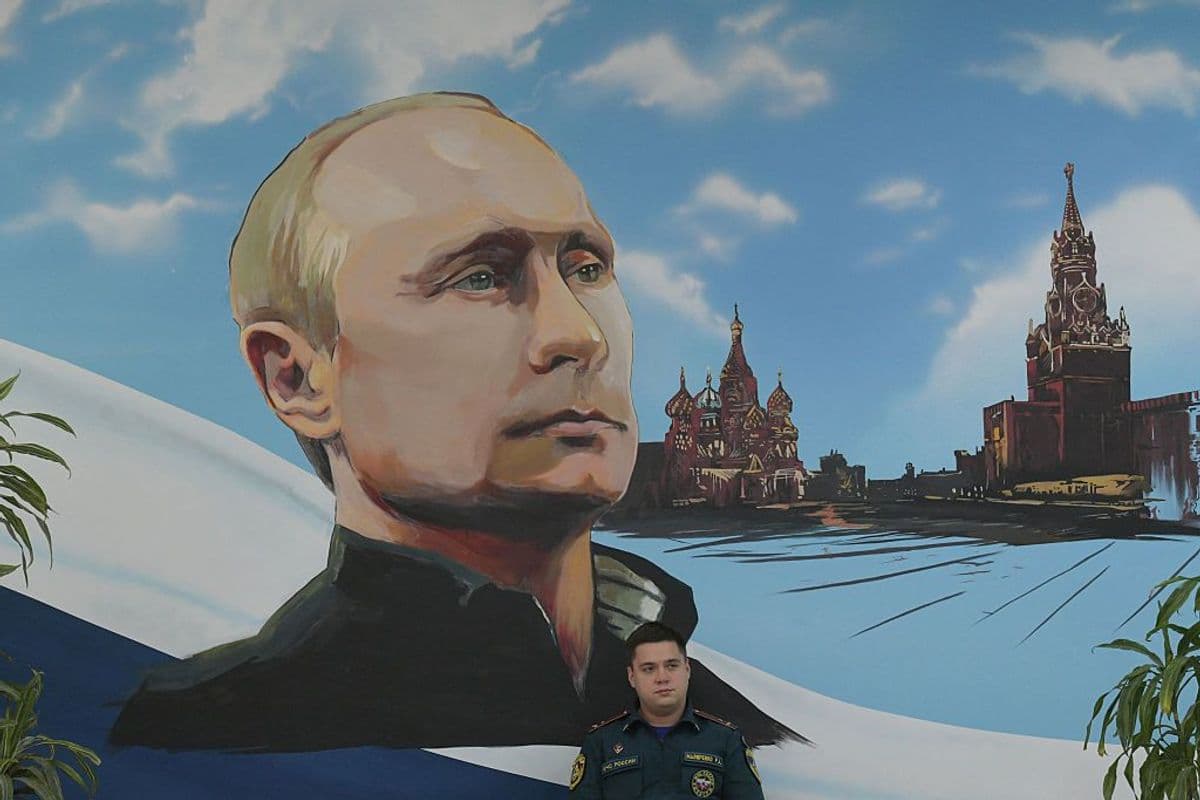
A serviceman of Russia's Emergencies Ministry sits under a mural depicting Russian President Vladimir Putin during Russia's parliamentary election at a polling station in occupied Donetsk, Russian-controlled part of Ukraine, on Sept. 20, 2026. (AFP via Getty Images)
 on Google
Observers described the Sept. 18-20 parliamentary election as the "dirtiest" vote in Russia's modern history. In a country that has not held free and fair elections for nearly three decades, that might seem like a difficult result to achieve.
All independent media were banned soon after the start of Russia's full-scale invasion, ensuring a media landscape where no criticism of the authorities is allowed during elections.
All genuine opposition parties were also banned from running. Even a moderate anti-war party, Yabloko, was barred from competing following a court ruling. But even that was not deemed sufficient by the Kremlin.

During the election, numerous techniques were used to rig the vote on an unprecedented scale: forcing public-sector employees to vote, banning independent observers, ballot stuffing, manipulating electronic voting, and voting at gunpoint in the occupied territories.
"These were the least competitive elections in modern Russian history," Farida Rustamova, a Russian journalist and Kremlin expert, told the Kyiv Independent. "It seems obvious to me that they were also the least free, if only because of how little genuine competition there was and how thoroughly the political and media landscape had been cleared of opposition."
Despite the rigging, some evidence emerged that the ruling United Russia party's performance was worse than expected in non-rigged results, while anti-war protest voting was strong in big cities.
Rigging
With 97.37% of the votes counted, United Russia received 57.96%, while the Communist Party was the runner-up with 13.67%, according to the official results. Along with single-member districts, half of the total, United Russia received a constitutional majority — 355 out of 450 seats, which is an all-time high.
The government-controlled Liberal Democratic Party, New People party, and A Just Russia received 8.96%, 7.91%, and 5.1%, respectively. The threshold for entering parliament is 5%.
"They deliberately went so far as to set a record for election fraud, to demonstrate that no amount of effort or campaigning for anti-war candidates can make any difference," Russian exiled politician Dmitry Gudkov told the Kyiv Independent. "I think (United Russia's) actual support is somewhere around 20–25%, while everything else comes from the use of state resources and outright fabrication."

Roman Udot, an election analyst and former co-chairman of the Golos vote monitoring group, estimated that, out of United Russia's official 57.96%, about 23 percentage points were rigged, representing about 20 million votes.
Meanwhile, Russian columnist Sergei Parkhomenko argued that "trying to analyze the numbers and interpret them as somehow reflecting what voters actually think is pointless."
"The Kremlin simply fabricated whatever figures it wanted," he added.
Russian opposition politician and blogger Maxim Kats said on Sept. 20 that "there was clearly an instruction not to allow anyone who had not been approved in advance to get through."
"In 2021, the objective was to keep unapproved opposition candidates from our side of the political spectrum out, so that there would not be a single liberal in the State Duma," he said. "Now the objective is to ensure that there is not a single person in the Duma who was not put there by the authorities."
Electronic voting
Numerous cases of ballot stuffing and public-sector employees being forced to vote for government-approved parties were reported all over Russia. Independent election observers were obstructed by election commissions and expelled from polling stations nationwide.
Another tool used for vote rigging is electronic voting.
Over the past few elections, independent observers published overwhelming evidence that electronic voting was heavily rigged.
In contrast with the traditional voting system, the results of electronic voting are virtually impossible to verify or recount. Independent observers said that they had been prevented from accessing the e-voting results by the Federal Security Service, Russia's main intelligence agency.
During the latest election, blockchain data from Moscow's electronic voting system could not be viewed or downloaded for independent analysis, electronic voting analysts told the independent media outlet Verstka.
According to independent media, many Russian voters did not vote electronically but received information from the electronic voting system that they did, providing evidence of electoral fraud.

"Employees at large companies were also forced to vote for United Russia," Gudkov said. "They organized all of this through electronic voting so they would not have to transport people anywhere or keep track of them individually — they simply gathered everyone at their workplaces. Most likely, they were told which buttons to press."
On Sept. 20, polling stations all over Moscow stopped issuing paper ballots to voters for hours, attributing this to a "computer error" in the issuing system. Meanwhile, the electronic system still worked.
Opposition supporters attributed this to an attempt by the authorities to prevent paper voting, which is harder to rig.
"I would describe the past three days as a collapse of the electoral system, because it failed at its job," Udot told the Kyiv Independent. "Its job is to fabricate the results, but to fabricate them convincingly enough for people to believe them. That second function has now broken down."
Electoral sultanates and occupied territories
Apart from rigging in-person voting results, the authorities in many regions recorded official results that were written down without a hint of objectivity and were not derived from actual voting results — a technique similar to the one used in Belarusian elections.
In those regions, United Russia's figures are even higher.
Such regions have traditionally been called "electoral sultanates" in Russia. These include many ethnic-minority republics in the North Caucasus, Volga Region, and Siberia, as well as some ethnic Russian regions such as Astrakhan, Kemerovo, and Tula oblasts.
In the Sept. 18-20 election, the number of electoral sultanates expanded, covering much of Siberia and Russia's Far East, Udot told the Kyiv Independent.
In the occupied territories — Ukraine's Crimea, as well as the partially occupied Kherson, Zaporizhzhia, Donetsk, and Luhansk oblasts — the situation was even worse.
While elsewhere there were some independent observers, there were virtually none during the illegal elections in the occupied territories.
Moreover, the authorities introduced early voting lasting several weeks in the occupied territories, making it virtually impossible to verify the results.
Russian soldiers conducted surveillance near voting booths, and voting often took place in a chaotic and random fashion in the street, as opposed to polling stations.
The authorities reported anomalously high turnout numbers in the front-line regions where actual voting is impeded by the war — 81% in Donetsk Oblast, 79% in Luhansk Oblast, 79% in Zaporizhzhia Oblast, and 75% in Kherson Oblast. Only in Chechnya, where elections have traditionally been heavily rigged, the turnout figure was higher — 94%.
According to Dmytro Durnev, an exiled independent journalist from Donetsk Oblast, the number of "voters" in the Russian-occupied part of Donetsk Oblast — more than 1.5 million people — was double the number of people who actually lived in the region.
Early voting over several weeks — a procedure that makes monitoring elections almost impossible — was also used in Russian regions bordering Ukraine. These include Voronezh, Kursk, Rostov, Belgorod, and Bryansk oblasts, as well as Krasnodar Krai.
Opposition candidates
Despite the massive electoral fraud, there is some evidence that United Russia performed worse than expected, and some opposition candidates performed well. These include candidates backed by the anti-war Yabloko party and the Communist Party in single-member districts.
According to Katz, the opposition managed to mobilize voters in big cities, and they turned out to vote en masse.
In St. Petersburg, three or four Yabloko candidates could have won in single-member districts, but their victories were overturned by rigging, Katz said.
Opposition candidates also performed well in some single-member districts in Moscow, Yekaterinburg, Novosibirsk, Irkutsk, as well as in the Komi Republic, Altai Krai, and Omsk Oblast, with their results being rewritten and falsified, he said.
Another piece of evidence for the opposition's strong showing is the results of electronic voting outside Moscow published on Sept. 20. According to them, United Russia led with 49.1%, while the New People party was the runner-up with 15.4%.

Russian political analysts Yekaterina Shulman and Dmitry Oreshkin said on Sept. 20 that United Russia's result in electronic voting was much lower than they expected. Since electronic voting is mostly used for forcing Kremlin-controlled public-sector employees to vote, the ruling party's results there are usually extremely high.
However, outside big cities, the protest electorate was less mobilized, according to Katz. He said that the polling stations where votes were counted accurately show roughly the same results and turnout as in 2021.
The overall result of the election is a mandate for continued aggression against Ukraine, analysts say.
"They are preparing society for the war to continue," Gudkov said. "It was absolutely crucial for them to show that there was no anti-war vote. And if they need to step up mobilization, they will."