Russian citizen who served as Ukrainian Supreme Court's deputy chief charged with corruption
 on Google
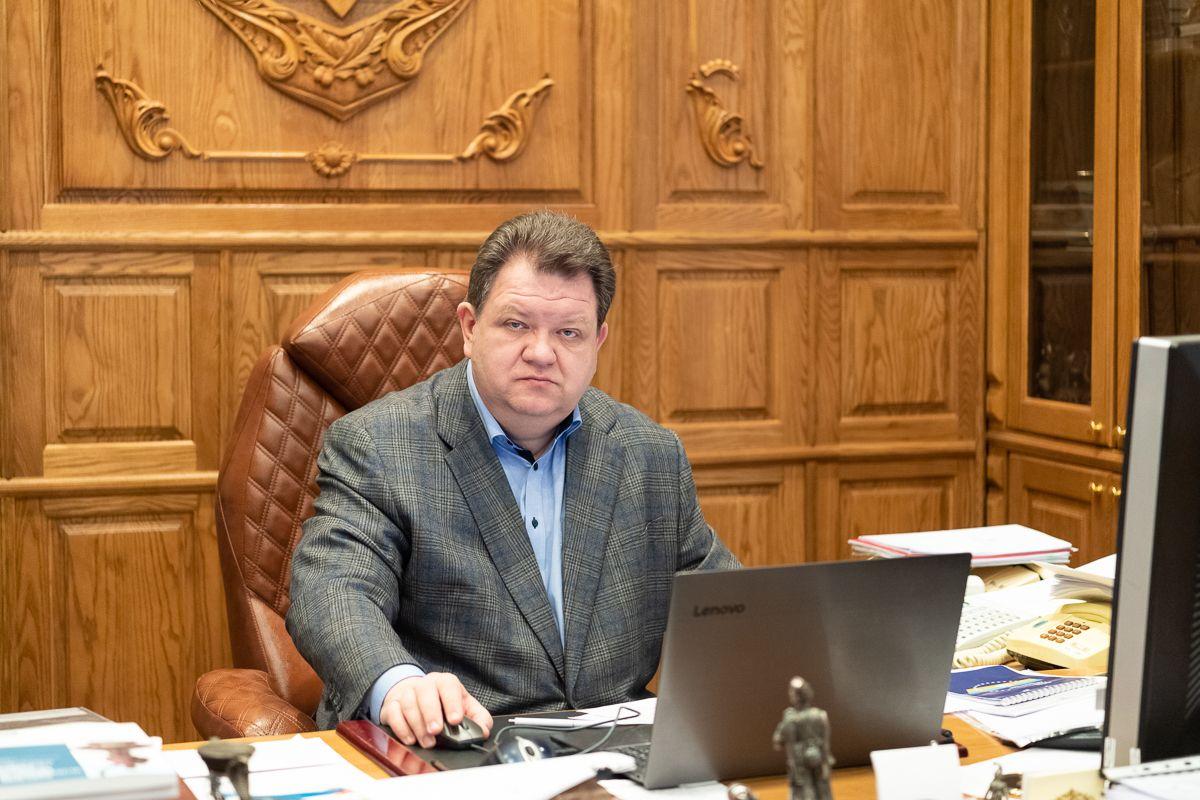
The National Anti-Corruption Bureau (NABU) on Sept. 23 charged Bohdan Lvov, former deputy head of the Supreme Court, with money laundering.
Lvov is one of Ukraine's most scandalous judges. He was fired from the Supreme Court in 2022 due to his concealed Russian citizenship.
The controversy over Lvov's nationality highlighted the necessity of reforming the Supreme Court, which has been engulfed in corruption and other scandals for years.
The NABU did not identify him by name, saying that it had charged a former head of the Supreme Court's commercial division. Lvov served as head of the commercial division and deputy head of the Supreme Court from 2017 to 2022.
A law enforcement source confirmed to the Kyiv Independent that the NABU was referring to Lvov. The Kyiv Independent has requested comment from him and will publish his response once it is received.
In 2021–2022, Lvov acquired assets worth a total of about Hr 26 million ($580,000), including a house and the land it sits on, two apartments, and four plots of land, according to the NABU.
The NABU said it had also charged a former subordinate of Lvov and the subordinate’s mother.
“To conceal the illicit origin of the funds and the assets’ true ownership, he brought his subordinate, who effectively served as his secretary, into the scheme,” the bureau said. “The illicitly acquired property was formally registered in her mother’s name, allowing him to conceal evidence of the crime and launder the assets.”
Lvov was also charged with complicity in large-scale embezzlement in 2025.
As part of the embezzlement case, he is accused of helping the illegal transfer of a state-controlled oil product pipeline to companies allegedly affiliated with pro-Kremlin politician Viktor Medvedchuk in 2017.
Radio Free Europe/Radio Liberty's Schemes investigation project reported in 2022 that Lvov received Russian citizenship in 1999 and still had a valid Russian passport. Schemes cited official information from Russia’s Federal Tax Service and leaked documents from Russia’s official passport database.
Lvov denied the allegations.
Subsequently the Security Service of Ukraine (SBU) confirmed that Lvov had Russian citizenship.
In October 2022, Vsevolod Kniazev, then head of the Supreme Court, fired Lvov due to the constitutional ban on judges with foreign citizenship.
The Public Integrity Council, the judiciary's civil watchdog, concluded in 2017 that Lvov did not meet ethics and integrity standards and did not have the right to run for a Supreme Court job. However, the watchdog's conclusion was ignored by the judicial authorities, and he was appointed.
Lvov has been under investigation for allegedly helping a member of the High Council of Justice to extort a $500,000 bribe in exchange for favorable court rulings.
Lvov has also been investigated as an alleged accomplice of ex-High Commercial Court Chairman Viktor Tatkov and his deputy Artur Yemelyanov, who have been charged with organizing the issuance of unlawful rulings as part one of Ukraine’s largest corruption schemes.
The judge denied the accusations of wrongdoing. He has not been charged in the bribery and Tatkov cases so far.
As the Supreme Court's leadership has been engulfed in corruption scandals, the European Union has demanded a reform of the Supreme Court and included it in EU accession requirements.
The Ukrainian authorities have so far failed to implement the reform.
When the current Supreme Court was created in 2017, the Public Integrity Council established that 22.2% of its judges did not meet integrity and ethics standards, and another 28.8% of the Supreme Court judges could have violated ethics standards.
The authorities ignored the conclusions and appointed the judges nonetheless.
Chickens came home to roost in June 2026, when a court sentenced Kniazev, former head of the Supreme Court, to five years in jail for bribery.
According to the investigators, Kniazev instructed subordinates to put the money into 13 bags for 13 Supreme Court judges.
In May 2026, the National Anti-Corruption Bureau charged three incumbent Supreme Court judges and one former judge of the court with receiving bribes in exchange for rulings as part of the same case.