The problem at the top of Ukraine's judiciary
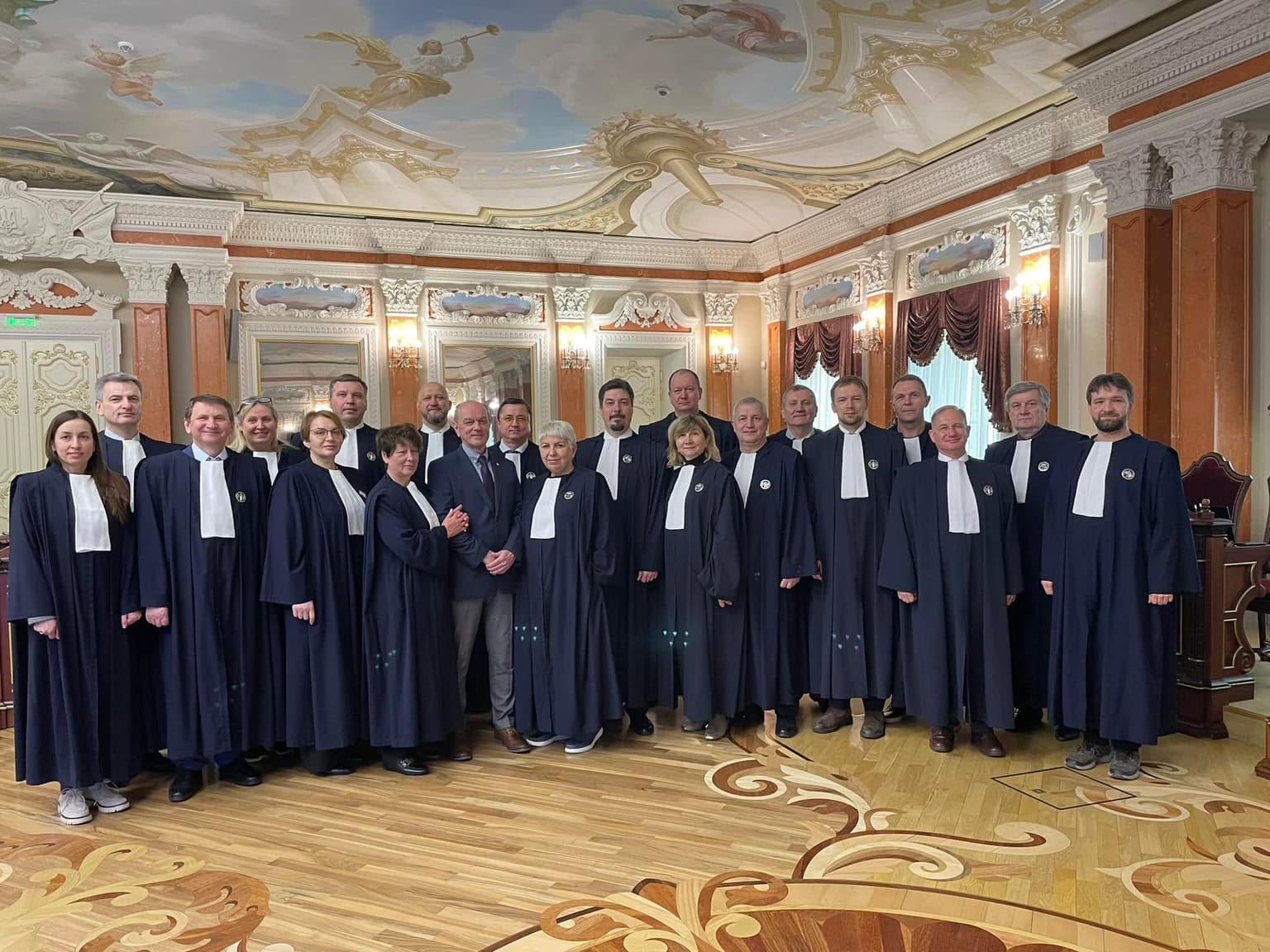
Supreme Court members with then-Supreme Court's chairman, Vsevolod Kniazev (C), in the Supreme Court in Kyiv, Ukraine, in a photo published on Dec. 17, 2023. (Dmytro Hudyma / Facebook)
 on Google
"Nothing can be said to be certain, except death and taxes" is an idiom often attributed to American statesman Benjamin Franklin.
In Ukraine, another certainty has emerged over the years: society's persistent demand for judicial reform — and the judiciary's equally persistent resistance to it.
Following the 2014 EuroMaidan Revolution, Ukraine's highest court was expected to become a flagship of the country's Western-backed reform agenda.
Instead, the Supreme Court has become mired in controversy.
Tainted vetting procedures allowed judges with questionable records to remain on the bench. Corruption scandals have repeatedly engulfed the institution, while the court has consistently blocked efforts to reform the judiciary.
In 2023, Vsevolod Kniazev, then the Supreme Court's chairman, was charged with bribery. Kniazev's deputy, Bohdan Lvov, was fired due to his concealed Russian citizenship in 2022.

According to the National Anti-Corruption Bureau (NABU), Kniazev spearheaded a corruption network in which many other Supreme Court judges were implicated.
Earlier this month, he was sentenced to five years in jail.
Demands to cleanse the Supreme Court have mounted in recent years, and anti-corruption and judicial activists hope Ukraine's negotiations to join the European Union would serve as a launchpad for a future reform.
"(If the EU does not apply pressure), this will send the message to the authorities that this kind of approach is acceptable, and they will keep doing the same thing in other areas as well," Mykhailo Zhernakov, head of judicial watchdog Dejure, told the Kyiv Independent. "And that means we will never achieve meaningful rule-of-law reform."
The President's Office did not respond to requests for comment.
EU integration
Since Kniazev was arrested in 2023, the European Union has demanded that the integrity declarations of incumbent Supreme Court judges be audited with the help of international experts. The demands were included in its Ukraine Facility lending program, the rule of law road map, and negotiations on Ukraine's EU accession.
Integrity declarations are statements in which judges answer questions linked to integrity and ethics standards.
Ukraine must introduce a declaration verification procedure for Supreme Court justices with "the temporary involvement of internationally nominated independent experts," according to a plan approved by EU Enlargement Commissioner Marta Kos and Taras Kachka, Ukraine's deputy prime minister for European integration, in December 2025.
Kachka did not respond to a request for comment by the time of publication.

If the reform is implemented, a panel of international experts would hold joint meetings with the High Qualification Commission, a judicial governance body, and check the integrity declarations of all Supreme Court justices. Anton Zelinsky, a member of the Public Integrity Council, told the Kyiv Independent.
The Public Integrity Council is a civil society watchdog created by the government as part of post-EuroMaidan judicial reforms.
If they conclude that a judge lied in their declaration, the judge can be fired by the High Council of Justice, the judiciary's highest governing body, Zelinsky said.
A competition would then be launched to fill the vacancies, and once again, international experts and the High Qualification Commission would meet jointly and vote for or against candidates, he added.
"Membership in the European community is impossible without the rule of law."
Stanislav Kravchenko, chairman of the Supreme Court, offered a different interpretation of the demand on judges' declarations. He argued that the EU was demanding checks only of some Supreme Court judges, not all of them.
"The EU is not calling for a 'cleansing,' a 'reset,' or a review of all Supreme Court judges," Kravchenko told the Kyiv Independent.
He cited Ukraine's road map as part of its accession negotiations, which envisages reviews of higher court judges, based on a risk-based approach and involving independent experts with an advisory vote.
"The recommendation calls for individual reviews of judges serving on the higher courts, including the Supreme Court, rather than a blanket review of all judges," Kravchenko argued. "A judge's integrity declaration may be scrutinized only when there are grounds to do so — namely, substantial and verified indications of potential misconduct or a lack of integrity."

Zelinsky dismissed Kravchenko's interpretation as an effort to avoid a genuine reform of the Supreme Court and argued that the crucial issue is who will decide which judges pose risks and which do not.
According to the Public Integrity Council, Kravchenko has violated ethics and integrity standards.
Kravchenko has failed to declare some of his assets and violated human rights in one of his cases, according to a 2015 decision by the European Court of Human Rights, the council said.
Kravchenko denied the accusations.
Failure to meet EU requirements
So far, the Ukrainian authorities have failed to implement any Supreme Court reform.
On June 9, parliament passed a bill on judges' integrity declarations that contains a clause instructing the Cabinet of Ministers to draft within six months a separate bill on checking Supreme Court declarations with the participation of independent experts.
Dejure has lambasted the authorities for dragging their feet on the issue and failing to specify that the independent experts must be international. The bill seeks to introduce new integrity declarations for lower-court judges as well, but Dejure argues that it helps them to escape responsibility rather than to cleanse the judiciary.
"We can confirm that the (European) Commission received the Law No 13165-2 on integrity declarations for judges from Ukrainian authorities and is currently assessing it, in view of the Ukraine Plan conditionality and the interim benchmark for cluster 1," a spokesperson for the European Commission told the Kyiv Independent. "There is no specific comment that we can offer at this stage."
Of the incumbent Supreme Court judges, 22.2% were ruled by the Public Integrity Council as not meeting integrity and ethics standards at the time [...] another 28.8% of the Supreme Court judges could have violated ethics standards.
Zhernakov said that, if the EU accepts the judicial declarations bill passed by Ukraine as the fulfillment of a Ukraine Facility requirement, judicial reforms will be blocked.
"In the 12 years since the EuroMaidan Revolution, no major reforms have happened without (Western lending) conditionalities," he argued.
The issue of Supreme Court declarations will pop up in Ukraine's negotiations on EU accession, but this is unlikely to have a major impact, and the authorities will be able to postpone the reform indefinitely without any clear deadlines, Zhernakov added.
"There has been some progress on the accession track, but it is of limited relevance because it is not tied to specific deadlines," he said. "What carries real weight are the commitments linked to funding and clear timelines."
Supreme Court integrity
The root of the problem lies in 2017, when the current Supreme Court was created as part of a Western-backed judicial reform.
Of the incumbent Supreme Court judges, 22.2% were found by the Public Integrity Council not to meet integrity and ethics standards at the time.
The council also submitted information indicating that another 28.8% of the Supreme Court judges could have violated ethics standards.
However, the High Qualification Commission overrode the Public Integrity Council's vetoes at the time, allowing judges with a questionable reputation to get Supreme Court jobs.
"Today, the Supreme Court's reputation and public trust in the institution continue to deteriorate dramatically," Dejure said on a site set up to promote Supreme Court reform.

"The Supreme Court has systematically resisted judicial reform and undermined its achievements, seeking to preserve the old system through courts that remain under its control."
Kravchenko dismissed the Public Integrity Council's vetoes on Supreme Court judges, arguing that the High Qualification Commission had rendered them irrelevant by overriding them.
read also
A Russian citizen at the court's helm
In 2017, the judicial authorities turned a blind eye to the candidacy of Bohdan Lvov, who later rose to become the Supreme Court's deputy chairman, or second-in-command.
Lvov and several incumbent Supreme Court judges had been investigated in a high-profile obstruction of justice and corruption case involving Viktor Tatkov, ex-chairman of the High Commercial Court, and his deputy Artur Yemelyanov. They have not been charged.
Additionally, Lvov had also been under investigation for allegedly helping a former High Council of Justice member extort $500,000 for favorable court rulings. The member was acquitted, but critics attribute this to the sabotage of the case by law enforcement.
He denied all accusations of wrongdoing. In 2022, Lvov was fired due to his concealing his Russian citizenship.

Corruption at the very top
The failed Supreme Court reform of 2017 came back to haunt the judiciary again in 2023, this time affecting the institution's very top.
Kniazev, then the court's chairman, was charged with accepting a $2.7 million bribe at that time in the interests of Ukrainian oligarch Kostyantyn Zhevago.
On June 8, the High Anti-Corruption Court upheld a plea bargain between Kniazev and prosecutors. According to the plea deal, the court sentenced him to five years in jail and the confiscation of his assets.
The case is not limited to Kniazev, however, and exposes a vast corrupt network that allegedly included other Supreme Court judges.
The National Anti-Corruption Bureau and anti-corruption prosecutors said that detectives had documented the existence of a "back office" within the Supreme Court — a law firm that, for a fee, connected the court's leadership with individuals seeking favorable rulings in their cases in exchange for bribes.

The back office was run by Kniazev, who negotiated with judges and passed money on to them, according to the anti-corruption agencies.
The Zhevago case was considered by 18 judges of the Supreme Court's grand chamber. According to the investigators, Kniazev instructed subordinates to put the money into 13 bags for 13 Supreme Court judges.
In 2023, the bureau said that the numbers and series of banknotes owned by three other Supreme Court judges coincided with those received by Kniaziev as a bribe.
In May 2026, the bureau charged three incumbent Supreme Court judges and one former judge of the court with receiving bribes in exchange for rulings in Zhevago's interests as part of the same case.
Meanwhile, Kravchenko argued that the Kniazev case is not relevant in the context of Supreme Court reform, saying that "all relevant circumstances are being established through criminal proceedings."
But Dejure believes that the authorities' failure to reform the Supreme Court "jeopardizes Ukraine's further integration into the European Union, as membership in the European community is impossible without the rule of law."
"There is an urgent need to reform the Supreme Court and fill its ranks with judges who will serve the interests of Ukrainian society and meet EU standards by acting with integrity, professionalism, and independence," the watchdog said.