There are no elections in Russia, only theater
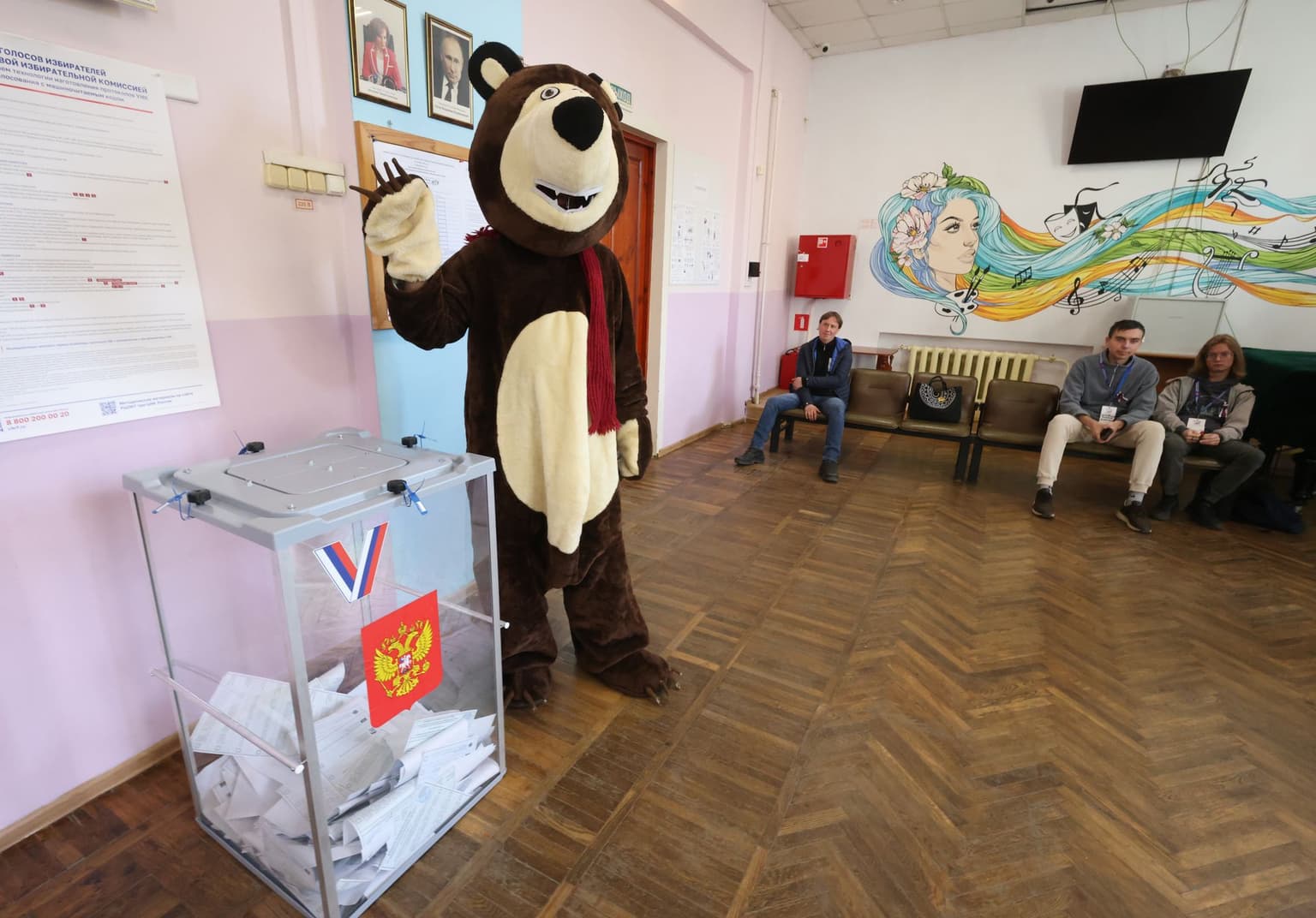
A man in a brown bear costume greets local residents at a polling station during Russia's parliamentary and regional elections in Istra, Russia, on September 19, 2026. (Contributor/Getty Images)
 on Google
Daniil Ukhorskiy
Ukraine program manager at Legal Action Worldwide
This year's most expensive theater production took place last week. Millions of Russians (and some Ukrainians, at gunpoint) played voters.
A host of Putin's cronies embodied democratically elected politicians. The props team did excellent work: ballot papers, boxes, and TV debates (although some actors missed their cues).
Reading the headlines, one could get the false impression that Russia was experiencing a sudden democratic turn. The word "election" dominates, while most outlets eventually provide context and caveats: "tightly controlled," "devoid of opposition," "carefully engineered."
Putin staged this farce to buttress his regime.
Describing this political performance is vital, particularly as it brings with it a campaign of violence, but we must not grant Russia any veneer of legitimacy with charitable descriptions of "elections."
Language matters
In 1958, an American observer covered Soviet "elections" for the New York Times.
The piece fundamentally questioned the practice, starting with the headline: "Why the Russians Bother With Elections." The piece highlighted absurdities ("The ballot needs no "X," it can be put in the box as printed, without further effort.”) and emphasized that, despite appearance, the exercise was a complete sham.
This week's Times piece ran with the more neutral: "Why Russians Hold Elections." Unfortunately, and unwittingly, many news outlets have used language that gifts Putin the democratic facade that he is looking for.
"Forget the words “election,” “majority,” “parliamentary,” “opposition,” when discussing this week’s events in Russia."
Al Jazeera presents "authorities'" and "critics'" views side-by-side, as if there is no independent information about Russia's authoritarian system. An unsuspecting reader of its "explainer" could come away thinking that Russia has suddenly turned into a flawed, but ultimately representative democracy.
"United Russia, which is supported by President Putin, is on course to retain its constitutional majority in the State Duma," writes Steve Rosenberg, arguably the world's foremost Russia correspondent, for the BBC. Putin does not "support" United Russia, he dominates it. And does it make sense to speak of "retaining" a "constitutional majority" in a completely totalitarian state?

ABC News coverage reads like something we may expect in a few months from the U.S. midterms: neutral descriptions of turnout and information about when polls are set to close. The election is "devoid of opposition," but the main reason why (mass repression by Putin and the ruling party) is buried deep in the piece.
This is a small but representative sample of mainstream coverage.
The better pieces make it clear that Russian "elections" are a sham with caveats of varying degrees. Yet in many places they fall back on the standard register used to cover democracies: polls, ballots, constituencies — one that is entirely unsuitable to describe the performance that took place in Russia this week.
At gunpoint
In 1937, the New York Times covered an "election" organized by none other than Joseph Stalin, writing: "The totalitarian autocrats may not command the complete affections of their peoples, but they are strong enough to manipulate the dead weight of their countries; and that is a good deal."
It captured the events with moral clarity, leaving no doubt in readers' minds that Stalin instrumentalized democratic trappings for his pernicious aims.
Putin is not only seeking to project legitimacy, but is also seeking to project strength. Across occupied Ukraine, the same soldiers who terrorize civilian populations brought "ballot" boxes.
Results suggest that turnout was higher in occupied territories than in Russia, a worrying signal of intimidation campaigns and coerced "voting."

In 2023, Russia held "referenda" across occupied Ukraine, seeking to legitimize its illegal invasion and occupation. A hallmark of the process was violence against civilians, including threats, detention, and torture.
Russian coercion extends beyond occupied Ukraine. After years of killing, imprisonment, and exile of political opposition, Russian authorities still managed to find dissenters to harass in the lead-up to last week's "election."
Predictable results, mixed messages
Putin's party will keep control, and the managed "opposition" got their allotted seats. Russia's war against Ukraine will continue, and mobilization and escalated attacks against Europe may soon come. 49 Russian servicemen who fought in Ukraine are set to join the ranks of Russia’s “lawmakers.”
Independent observers noted Russia's sloppy electioneering in the fraudulent results. Russian Election Monitor, an independent organization with longstanding expertise in the area, detailed the banning of opposition parties, ballot stuffing, and aforementioned repression. Nothing about this process was a genuine election.

We should avoid rose-tinted comparisons with the past. Russia has increased domestic repression since its full-scale invasion of Ukraine, but rigged results are nothing new. Russia has not had a free election since at least 2008. In 2021, the most recent previous "election," the United Russia vote was fraudulently doubled.
This is a plea to any editors who will listen – forget the words "election," "majority," "parliamentary," "opposition," when discussing last week's events in Russia.
This is especially important in the age of shrinking attention spans. As editors will be well aware, most readers do not get to the end of the story (Reader, if you're here, well done).
Headlines and ledes are critical, and here, most fail to convey the total emptiness of Russia's "elections." News readers should be left with no doubts: what happened in Russia this week is a mix of political theatre and brutal oppression.
Editor's note: The opinions expressed in the op-ed section are those of the authors and do not purport to reflect the views of the Kyiv Independent.