First known Russian recruited from university dies in Ukraine, exposing Russia’s student recruitment campaign
Russia’s student recruitment campaign is drawing university students into military contracts they may not be able to leave.
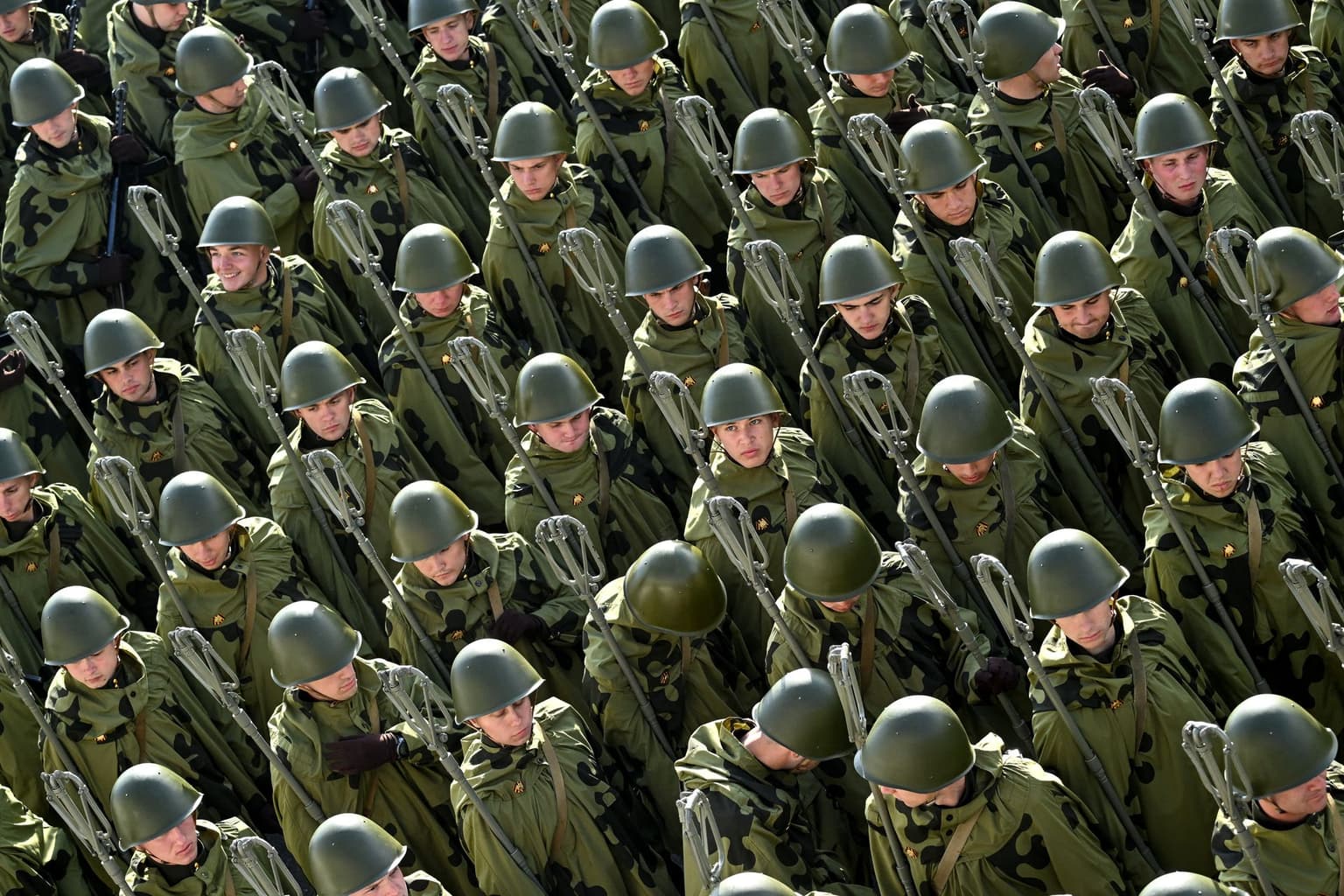
Russian servicemen in Moscow, Russia, on May 7, 2025. (Kirill Kudryavtsev / AFP / Getty Images)
 on Google
When 23-year-old Russian student Valery Averin signed a military contract in January after being recruited into Russia’s drone forces campaign targeting students, he was told he would train as a drone operator. Three months later, he was dead near Luhansk after reportedly being sent into an assault unit despite having no military experience.
His case, reported by the BBC Russian Service, appears to be the first known death linked to Russia’s growing campaign to recruit university and college students for the war against Ukraine.
As Russia struggles to replenish its forces — with battlefield losses exceeding recruitment rates for five consecutive months — without launching another politically risky mobilization wave, students are increasingly becoming a new recruitment pool for the war, with universities themselves pushing them to the front.
Universities’ role
The campaign first surfaced in April, when reports revealed that since January, Russian universities had been tasked with sending around 2% of students, roughly 76,000 recruits, to the military.
Since then, more details have emerged showing the campaign becoming more aggressive.
Russian outlet Mobilization obtained Defense Ministry documents urging universities to intensify recruitment efforts, including expelling underperforming students and offering them military contracts in exchange for academic leave before formal expulsion.
For that, some universities organize meetings specifically for students with academic debt, where military representatives encourage them to fill out military contract forms in advance, "in case of expulsion," Violetta Seleznova, an analyst with the NGO Join Ukraine, which researches the campaign through open-source data, told the Kyiv Independent.
"The student’s academic vulnerability is deliberately used as a window for recruitment: the person has not yet been expelled, but is already entered into the system as a potential recruit," she said.

Artem Klyga, a Russian military lawyer based in Berlin who was among the first to publicly analyze the contracts and expose their hidden details, says the country’s education system has become fully involved in military recruitment efforts.
"Every college and university now has recruitment campaigns. What used to be encouragement has turned into direct pressure and blackmail," Klyga told the Kyiv Independent.
In one Klyga`s case from April, a Moscow student received a mistaken expulsion notice despite having no academic debt. When the student contacted university staff, they were immediately offered the option of signing a military contract instead.
With the summer exam session approaching, pressure on students is expected to intensify in May and June, likely bringing more stories like Averin’s and exposing more details behind the campaign, which may be even more tense than formal mobilization.
"At least with mobilization, the rules are clear — stay at home, and you can avoid going to the war. Now it’s recruitment operating through unwritten rules," Klyga said.
A trap
According to the Russian media Faridaily, the campaign is primarily targeting students aged 18 and older for recruitment into drone units — a new branch of the military presented as more technological and supposedly less dangerous than frontline service.
Students are promised the ability to return to university after their contracts expire, large one-time signing payments, and various social benefits. Some universities also reportedly offer additional incentives, including transfers from paid to state-funded education. Elite institutions such as Moscow State University (MGU) have promised extra financial bonuses.
"The payments will most likely arrive. But the contract itself is a lie," Klyga said, describing it as the same as a standard Russian military contract.
"The state comes directly into classrooms with this recruitment campaign."
He said that the main guarantee regarding discharge after a fixed term of service promoted by Russia’s Defense Ministry does not formally exist in Russian law.
"The commander has the right to discharge someone, but not the obligation," Klyga said.
According to him, a student seeking discharge after the contract period would first have to go through a military attestation commission that reviews the reasons for dismissal.

The commission would then need to recognize those reasons as "exceptional" enough to justify releasing a soldier despite ongoing manpower shortages and recruitment problems. The process would also depend on the needs of the specific military branch in which the student is serving.
Klyga said this mechanism stems from Russia’s classified Presidential Decree No. 580.
"It’s a system where, out of 100 cases, maybe one succeeds. I cannot call this an automatic discharge mechanism," Klyga said.
Recruitment into infantry
According to the contracts circulated online, students are supposed to undergo three months of training before being assigned to drone units if considered suitable.
But the same contracts also state that recruits who do not meet the requirements can be reassigned to other branches of the military, including units facing manpower shortages.
"This is one of the campaign’s main hidden risks: students sign up believing they are joining relatively safer and more technical drone units, while the contracts leave open the possibility of being sent elsewhere," Klyga said.

That is what happened to Averin. His adoptive mother told the BBC Russian Service that he signed a contract on Jan. 3, completed drone operator training on March 24, and ended up dead just 13 days later during a mortar attack near Luhanske in Donetsk Oblast — one of the most intense sections of the front line.
The promised training period also appears unreliable. Russian pro-war Telegram channel "Two Majors," which has more than one million subscribers, complained that new recruits often receive only about a week of preparation before deployment.
"Extremely little time is devoted to training newly contracted personnel. Discussions mention just a week to learn takeoff and landing — and then straight to the front. People end up with no real understanding of combat operations, which explains the losses and poor effectiveness," the channel wrote.
read also
Irritation
As Russia’s war drags on, Russians have fewer and fewer ways to distance themselves from the war, without opposing it. For many students, university had long served as one of the opportunities to avoid the country`s growing militarization.
"Universities used to allow students to exclude this military state from their lives for at least four to six years. And now the state comes directly into classrooms with this recruitment campaign," Klyga said.
Many university students contacting rights advocates are not those signing contracts, but those trying to avoid pressure and remain in university.
"Students understand what is happening because they have access to the internet and consultations with rights advocates. Most are annoyed that this propaganda is interfering with their studies," he said.
At the same time, more opportunities are emerging for students to become involved in Russia’s war effort. One of the most notable is Alabuga Polytech, a pathway that can appear even more attractive to students than joining unmanned forces.
Alabuga Polytech is a dual-education center directly tied to the military production hub in Russia’s Alabuga Special Economic Zone, where students are involved in the production of drones used in the war against Ukraine.
Students can enroll there from the age of 14, study for free, and earn between 30,000 and 70,000 rubles per month (around $370-$860), becoming part of Russia’s war industry and not being sent to the front line.
The Kyiv Independent contacted several publicly featured students from the institution for comment about studying there. One responded, "F*ck off," while others did not reply.
Author's note:
Hi, this is Tania, the author of this article, thanks for reading!
At the Kyiv Independent, we keep our reporting free and accessible to everyone. If you value this kind of coverage, please consider supporting our work by becoming a member.