Explainer: What does Ukraine's latest corruption scandal tell us about how Zelensky governs?
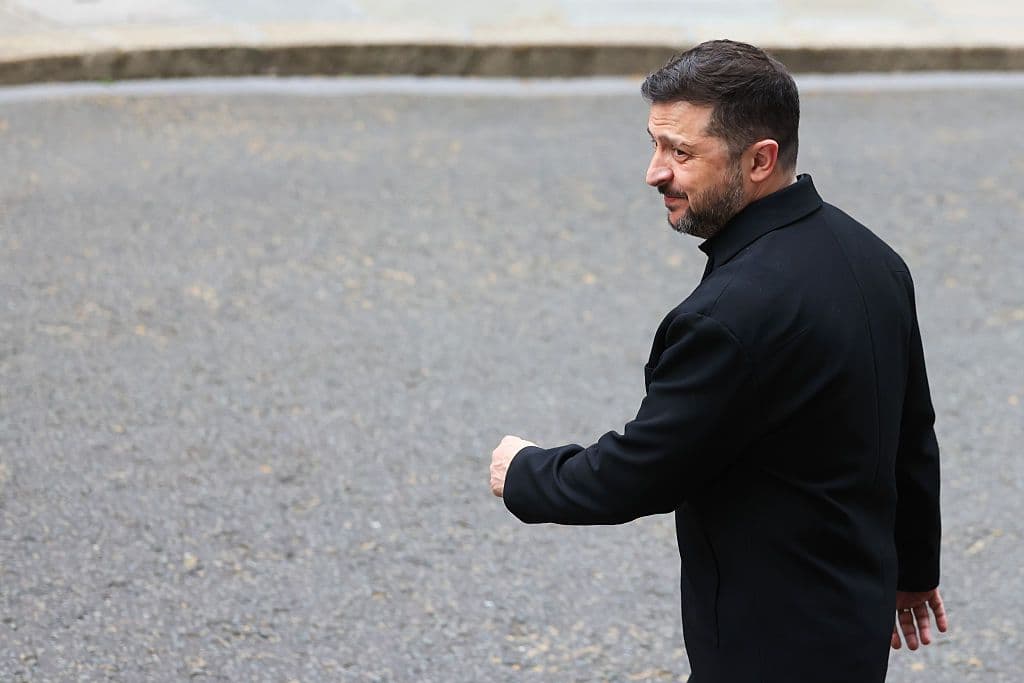
Ukraine's President Volodymyr Zelensky arrives in Downing Street for a meeting with UK Prime Minister Keir Starmer, in London, UK, on Sunday, June 7, 2026. (Chris Ratcliffe/Bloomberg via Getty Images)
 on Google
This week's charges against Iryna Mudra, a presidential deputy chief of staff, and other suspects in a high-profile graft case marked the latest chapter in the corruption saga that has gripped Ukraine since last year.
An investigation centered around state nuclear power monopoly Energoatom has prompted a political earthquake in Ukraine, becoming the biggest corruption case of President Volodymyr Zelensky's tenure.
Specifically, the investigation led to the resignation of Zelensky's Chief of Staff Andriy Yermak — effectively his second-in-command — in November and corruption charges against him in May. Several ministers and a close associate of Zelensky have also been charged.
But the latest revelations suggest that neither the previous high-profile corruption cases nor Yermak's dismissal put an end to the alleged corrupt practices within Zelensky's inner circle.
Following the Energoatom investigation, Mudra and her alleged accomplices resorted to money laundering to raise bail for ex-Energy and Justice Minister Herman Halushchenko, one of the suspects in the case, according to the National Anti-Corruption Bureau (NABU).
The tapes released by NABU also hinted that Mudra wasn't the highest-ranking official implicated in the scheme, raising questions about who was ultimately responsible.
"Mudra allegedly commits a crime — corporate raiding — and is allowed to do so as a reward for her loyalty," Tetiana Shevchuk, an expert at the Anti-Corruption Action Center, told the Kyiv Independent. "She can do all of this, and the authorities turn a blind eye because she is loyal to the president."
She added that "Mudra then allegedly commits another crime — she launders money to protect the president."
"In other words, the president needs to abandon a system of government in which he turns a blind eye to corruption while people remain absolutely loyal to him and are prepared to blindly cover up any wrongdoing in exchange for money and power," Shevchuk said.
Zelensky has not publicly reacted to the latest corruption scandal, and the President's Office did not respond to requests for comment. The president has notably remained mute on the corruption crisis unraveling over the past year.
read also
The biggest corruption scandal under Zelensky
The new investigation is the continuation of a probe into an alleged $100 million corruption scheme involving state nuclear power company Energoatom.
The crisis has been unfolding since July 2025.
As the investigation progressed, Zelensky attempted to eliminate the independence of the anti-corruption bureau in July 2025 by subordinating it to the prosecutor general, an official appointed by the president. Anti-corruption and legal experts attributed this to an effort to stop ongoing investigations.
However, the bureau's independence was later restored amid protests and Western pressure.
The first charges in the case were announced in November, and the scheme allegedly involves kickbacks, bribes, embezzlement, illicit enrichment, and money laundering.
The alleged ringleader is Timur Mindich, a close associate of Zelensky and a co-owner of the president's Kvartal 95 production company. He fled to Israel in November.
Apart from Mindich, the suspects include former Deputy Prime Minister Oleksiy Chernyshov and ex-Justice and Energy Minister Halushchenko.
"If this were a TV series, (the Mudra case) would be a spin-off of Mindichgate," Shevchuk said. "(The effort to bail out Halushchenko) is another attempt to bury the Mindichgate scandal. Nothing has changed. The central figure in this whole story (Zelensky) remains the same."
read also
Yermak's involvement
Zelensky's then Chief of Staff Andriy Yermak was searched as part of the Energoatom investigation and resigned in November. In May, he was charged with money laundering tied to the construction of a luxury residential compound outside Kyiv.
Suspects in the Energoatom case have allegedly given money to ex-Deputy Prime Minister Chernyshov for the construction of the compound, according to the anti-corruption bureau.
Some observers hoped that Zelensky's system would change after Yermak's downfall.
Yermak had consolidated an unprecedented level of power within Ukraine's government, and his critics argued that this accumulation of power created ample opportunities for corruption.
Following his resignation, the influence of the President's Office over parliament and other institutions weakened, according to lawmakers and analysts.
But the latest corruption scandal shows that fundamentally the system did not change, critics say.

"Yermak's dismissal showed that the systemic problem wasn't Yermak, but Zelensky," Shevchuk said. "Zelensky created this system, and Yermak operated within the authority he had been given. Zelensky had vested Yermak with enormous power."
Yaroslav Yurchyshyn, a lawmaker from the liberal Holos party, also argued that Yermak's system remained in place, with his successor Kyrylo Budanov failing to fire Yermak's deputies after taking over the President's Office in January.
"I wouldn't presume to assess how much Budanov knew or how deeply he was involved (in the Mudra case), but what I find telling is that he was given no control over staffing — he was denied the ability to bring in his own people," he added.
New revelations
The argument that the system remained intact gained ground in February, when ex-Justice and Energy Minister Halushchenko was charged with money laundering and organized crime as part of the Energoatom case.
The court set Hr 150 million bail for him, but he struggled to raise the money. He spent several months in a detention facility, and the bail was posted only in June.
This week, Zelensky's now ex-Deputy Chief of Staff Mudra, ex-lawmaker Maksym Mykytas, and lawmaker Vadym Stolar were charged with laundering Hr 150 million ($3.4 million) and transferring the funds through Sense Bank to post bail for Halushchenko.
Shevchuk said that "there probably wasn't anyone willing or able to put up that kind of money" legally.
"Halushchenko was apparently threatening to cut a deal or give some kind of testimony (if the bail is not paid)," she said.
Commenting on the case on Facebook on Aug. 21, Oleksandr Abakumov, the detective in charge of the Energoatom case, said that "in practice, bail becomes the price of silence — an expense incurred by the criminal network to preserve itself."
Halushchenko was not available for comment.
read also
Zelensky's friend is still in the game
Further evidence of the system's continuity emerged from the tapes published by the bureau that suggest that Mindich was still able to influence Mudra and state-owned Sense Bank in June, despite there being criminal charges against him, his escape to Israel, and sanctions imposed against him by Zelensky in November.
On the tapes, Mudra also said that Timur, "an Israeli refugee" — an apparent reference to Timur Mindich — called her and asked her to take over Sense Bank.

"You can't trust these crooks with the bank," Timur allegedly said. "There are serious cash flows there. Take over the bank."
Yurchyshyn said that "someone who still has mechanisms of influence at their disposal and was effectively allowed to flee will obviously continue to interfere and try to exert influence."
"Zelensky's team bears full political responsibility for allowing such informal power brokers to operate," he added.
Are Zelensky and Budanov involved?
The one unanswered question that remains is whether the Mudra case involved someone higher up.
According to the text of the search warrants in the case, Mudra was instructed by someone to raise money for Halushchenko's bail.
She also repeatedly refers to her "boss" on the tapes released by the bureau.
Mudra has two bosses — President Zelensky and his Chief of Staff, Kyrylo Budanov.
Mudra also said on the tapes that someone told her that "corruption shouldn't be fought — it should be controlled." The person's name is partially beeped out, but you can hear the first letter — B.

"Politically speaking, Halushchenko is nobody to Mudra," Shevchuk said. "Why would Mykytas and Mudra be raising 3 million euros for Halushchenko? The logical conclusion is that they were instructed to do it. And then the question is: by whom? I tend to think that even Budanov was simply carrying out orders in this whole affair."
This adds to speculation over whether Zelensky himself appears in alleged transcripts of the tapes published as part of the Energoatom case. The transcripts were published by media outlet Ukrainska Pravda and two lawmakers in April and May.
The transcripts contain a reference to "Vova's" house as part of the luxury compound near Kyiv investigated by the bureau — a short form of the name Volodymyr that many interpreted as a reference to Zelensky.
"It's an open secret or an extremely plausible assumption, but law enforcement agencies have no right to prove it, because the president is protected by presidential immunity," Shevchuk said. "The law does not even allow them to look in that direction."
While some still hope that Zelensky's system may learn from its mistakes, others think it will likely push back against the anti-corruption institutions.
"I would very much like to believe that Zelensky's team is capable of learning from its mistakes, but we haven't really seen that happen since 2020," Yurchyshyn said.