Explainer: What’s the corruption controversy around drone maker Fire Point?
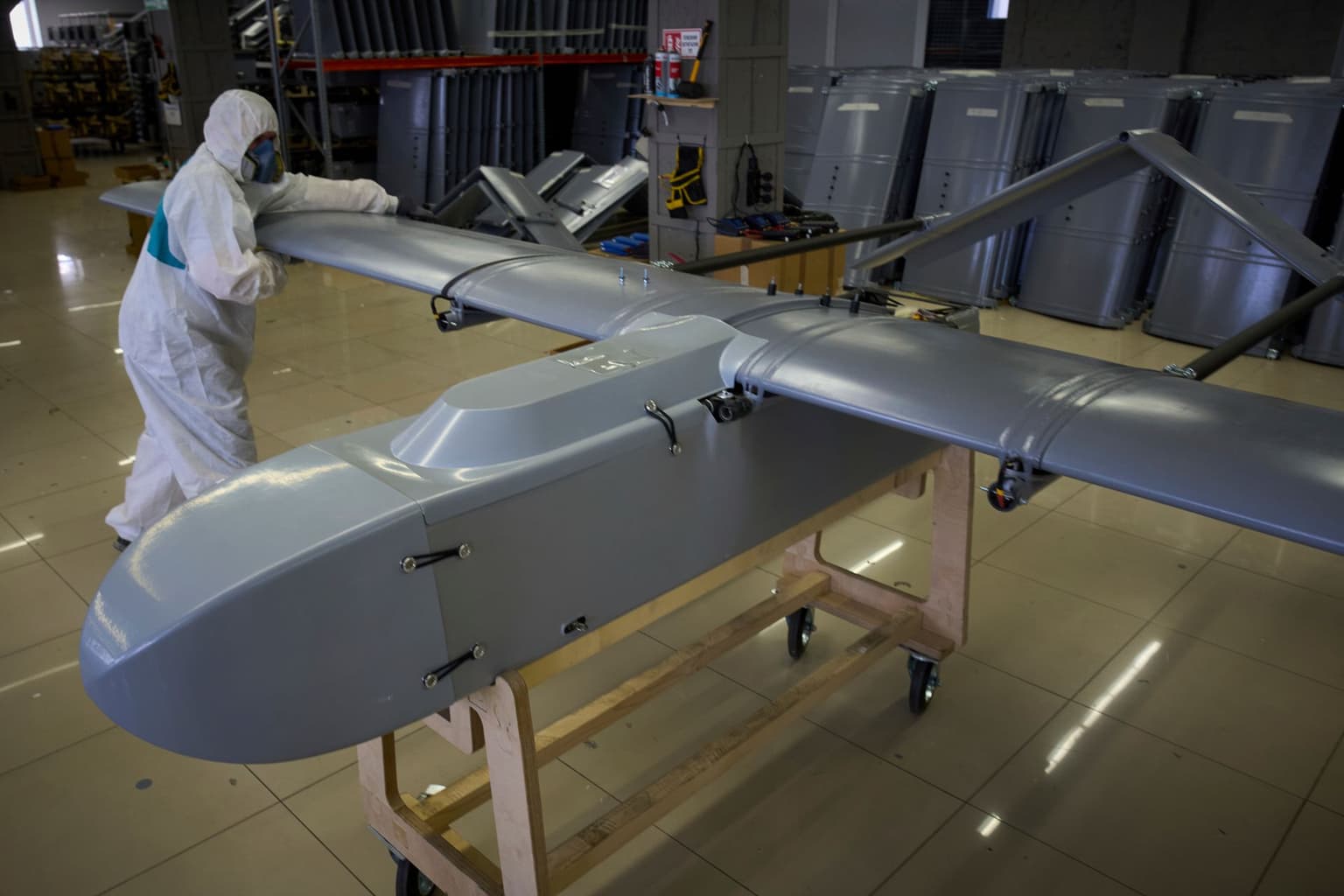
A worker inspects a combat drone at a Fire Point secret production facility in Ukraine on Aug. 18, 2025. (Efrem Lukatsky/AP Photo)
 on Google
Ukrainian drone maker Fire Point has been described as a crucial supplier for the country's army and contributor to the country's war effort.
At the same time, the company has found itself at the center of Ukraine's largest corruption scandal — a $100 million scheme centered around the state nuclear monopoly Energoatom and defense procurement.
This has prompted calls for auditing the company's contracts and owners and nationalizing it, as well as reviewing the rules of defense procurement.
Fire Point and its defenders have described the corruption investigations and criticism of the company as an attack on Ukraine's defense that benefits Russia.
Experts say that Ukraine should find ways to both investigate corruption and the transparency of defense contracts and make sure that Fire Point's production continues without interruption.
Fire Point declined to comment, citing a Kyiv Independent investigation published in August that revealed the company was under a corruption probe and examined its ties to Timur Mindich, a close associate of President Volodymyr Zelensky, alleged to be the company's unofficial beneficiary.
Those findings were later corroborated by law enforcement actions and leaked recordings showing Mindich personally leading negotiations with state officials on Fire Point's behalf, underscoring the sanctioned culprit's de facto control over the company.
What's the controversy?
The corruption scandal involving Fire Point intensified last week following the publication of alleged transcripts of audio tapes linked to the Energoatom case.
The tapes were allegedly recorded by the National Anti-Corruption Bureau (NABU). The Energoatom probe, launched last year, is the biggest corruption investigation of Zelensky's tenure.
Nine suspects have been charged in the case. These include Mindich, ex-Deputy Prime Minister Oleksiy Chernyshov, and former Energy and Justice Minister Herman Halushchenko. Mindich fled to Israel in November.
"All available data strongly suggests that Mindich is either one of the company’s beneficial owners or its sole ultimate beneficiary."
Zelensky's former Chief of Staff Andriy Yermak and Rustem Umerov, current secretary of the National Security and Defense Council, who previously served as defense minister, are under investigation in the case but have not been charged.
The new tapes allegedly recorded as part of the investigation appear to confirm links between Mindich and Fire Point. The company has denied its connection to Mindich.
The new tapes allegedly show Mindich complaining to Umerov about Fire Point's underfunding. The two were also reportedly discussing the sale of a 33% share in the company to foreign investors.

Umerov was allegedly asking Mindich how to approach decisions tied to Fire Point, asking him whether "it will suit us?" when discussing the sale.
The Public Anti-Corruption Council at Ukraine's Defense Ministry said on April 29 that "the public has been presented with unverified but credible evidence of links between former Defense Minister Rustem Umerov, sanctioned businessman Tymur Mindich, and the company Fire Point."
Crucial for Ukraine's defense?
Fire Point dominates Ukraine's market for middle-strike and deep-strike drones, including FP-1 and FP-2. The company also produces Flamingo cruise missiles and is developing a ballistic missile.
Fire Point's supporters argue that there is a coordinated media attack on the company and that the scandal undermines Ukraine's defense capabilities.
"For the second week in a row, an aggressive media campaign against Fire Point has been underway," Anatoliy Amelin, executive director of the Ukrainian Institute for the Future think-tank, said on Facebook. "Russia is the one that won from this. Because the strategic trump card Moscow feared most — Ukraine's independent missile capability — is now being publicly discredited. Who lost? Ukraine. And every Ukrainian."

Anastasia Radina, head of the parliament's anti-corruption committee, disagreed with such assessments.
"It's corruption and backroom deals that undermine defense, not investigations," she told the Kyiv Independent.
There is a longstanding doubt as to Fire Point's actual product delivery. When the company first began publicly touting its successive drone and missile projects, it claimed to be producing 100 FP-1s and one Flamingo every day, a figure Iryna Terekh, formally the firm's CTO, subsequently backtracked when challenged, saying that that was the firm's "capacity" rather than actual production at the time.
Nonetheless, Denys Shtilierman, the firm's official owner, repeated as early as October that the firm was producing two to three Flamingos per day.
OSINTers for Ukrainian military publication found evidence of only 23 Flamingo launches in an analysis published at the end of April.
The firm more recently is busily advertising ballistic missiles and air defense systems that do not yet exist. Shtilierman is also touting the potential for a space-launch program contingent on the UAE-based defense conglomerate Edge Group acquiring a $750 million stake in the company.
It's a deal that Ukrainian anti-monopoly regulators are looking at askance.
Crony capitalism?
Fire Point's opponents counter that the company actually hurts Ukraine's defense procurement by allegedly monopolizing the market. These critics say that Fire Point has achieved its dominant status on the market due to its connections with high-ranking officials.
"Monopoly is the mother of corruption," Yuriy Nikolov, an investigative journalist who has covered defense corruption, told the Kyiv Independent. "What we need is not the best drones from Mindich, but simply the best drones, period."
He argued that the best solution for Ukraine's defense industry would be to introduce a truly competitive market rather than "crony capitalism."

Radina said that the question of whether Fire Point was awarded its contracts in a fair and objective way should be researched.
"This is exactly what I want to ask the Defense Procurement Agency and the Defense Ministry at the next temporary parliamentary investigative commission: how Fire Point was awarded contracts from the outset, under what procedure, how competition with other manufacturers was ensured, and what share of state contracts Fire Point actually holds," she told the Kyiv Independent. "What can be said with certainty is that discussing the allocation of the defense budget in a conversation between a minister and a private individual — clearly representing a defense company — is not a normal procedure."
In the tapes, Umerov refers to a Hr 311 billion ($7 billion) budget for Fire Point products. The company has denied having received this amount from the Defense Ministry.
In a comment to the Kyiv Independent, the Defense Procurement Agency denied any wrongdoing.
"FirePoint may have received all or part of the Hr 311 billion in contracts in a single decision — and that was just within the scope of one separate conversation," Radina said on Facebook. "The real question is whether other Ukrainian arms manufacturers, given that level of financing and an ally serving as defense minister, could have developed better weapons. Could they have produced them more cheaply? Could they have competed at all?"
She argued that "decisions on arms procurement are made behind closed doors — or, as we can now see, in private conversations."
Inflated prices?
Fire Point has also faced accusations of inflating its prices.
Nikolov has compared the declared price of Fire Point's FP-1 drone last year — $55,000 — with the price of Russian-made Shahed drones, which cost $35,000 in the same period, according to the Center for Strategic and International Studies (CSIS)
"So Mindich's 'better drone' turned out to be more expensive than the Russian one, which says a lot about the economics of this war," he said on Facebook. "And there's no point even getting into technical comparisons between these drones."
Fire Point drones have also been compared to Ukrainian-made Lyuty drones, which are actually more expensive.
Yuriy Gudymenko, head of the Defense Ministry's anti-corruption watchdog, argued, however, that the question is much more complicated, and it has yet to be established whether Fire Point's prices were unjustified.

"First, none of this has been proven, and I don't have enough information to make such claims," he told the Kyiv Independent. "This is something investigators need to look into."
Gudymenko said that "these are fairly complicated arrangements that can take a very long time to untangle."
"You can look at plenty of examples — the cheapest option is usually not the highest-quality one," he said. "So relying solely on price as a criterion is a pretty bad approach."
He said that comparing FP-1 drones with Shaheds would be misleading because it would be tantamount to comparing different types of economies, and because of Shahed drones' lower success rate.
Gudymenko added that comparing the price of Fire Point drones with that of Lyuty drones would also be misleading because of the differences between them.
Radina told the Kyiv Independent that it is not clear to her either whether the prices of Fire Point products are inflated, and she is waiting for responses on this from competent authorities.
Links to Russia?
Another controversy involves Fire Point's de jure owner Shtilierman.
Shtilierman lived and had a business in Russia until 2016 and had an IT contract with Russia's Defense Ministry in 2007. This has prompted concerns about whether Shtilerman could be trusted to work with Ukraine's Defense Ministry.
Shtilierman has admitted having Russian citizenship in the past. He said in a 2025 interview that he had been stripped of his Russian citizenship in 2016 based on a request by his ex-wife.
However, it is not clear if Shtilierman's Russian citizenship has actually been terminated. His ex-wife and children continued to live in Moscow until an August investigation by the Kyiv Independent publicized his name for the first time.

Shtilierman subsequently turned to Ihor Fursenko, a longtime fixer for Mindich and, on paper, a Fire Point employee, to get his family out of Russia, as he said in November.
Russian law does not envisage the possibility of stripping someone of citizenship based on a request by a third party. Fire Point did not respond to a request for comment on whether Shtilierman has documents confirming the termination of his Russian citizenship.
The Anti-Corruption Action Center on May 1 published an alleged Russian Constitutional Court document according to which Shtilierman had filed a motion to restore his Russian citizenship, but it was rejected by the court in 2018. The Kyiv Independent could not independently verify whether the document is authentic.
Shtilierman also had a 1.6 billion ruble ($20 million) debt in Russia as of July 2025, the Anti-Corruption Action Center said on May 1, citing official Russian data.
What should be done?
One of the solutions being proposed for the controversy around Fire Point is its nationalization.
The Defense Ministry's anti-corruption watchdog has called on Zelensky to "initiate a process of selective (partial) nationalization of Fire Point from its Ukrainian owners."
Nationalization is necessary to make sure that the company does not lose its contracts with the Defense Ministry, the watchdog said.
"All available data strongly suggests that Mindich is either one of the company's beneficial owners or its sole ultimate beneficiary," the watchdog said.
The group argued that "Fire Point provided knowingly false information about its beneficial ownership" and "should face fines and be designated a high-risk supplier."
If a court confirms this information, "all Firepoint products could effectively become immediately banned from procurement," Gudymenko told the Kyiv Independent.
"The state would then have to solve this problem on the spot, without any transition period or time to prepare a workable framework — everything would simply be prohibited overnight," he said. "That would likely create yet another collapse in front-line supplies, which, to put it mildly, would be very bad for our military. We argued that a possible partial nationalization could help resolve this issue."
Olena Shcherban, an expert at the Anti-Corruption Action Center, said that "what's needed is a comprehensive, objective analysis" of Fire Point's contracts.
"One could review which contracts are being fulfilled and which are not, assess the production capacity involved, and determine where and how the work is actually being carried out," she told the Kyiv Independent.
"If there is any threat to state interests, it should be addressed — whether through nationalization, the purchase of a stake in the company, or the introduction of an independent supervisory board, including representatives from international partners."