Under FPVs and glide bombs, life clings on in Zaporizhzhia
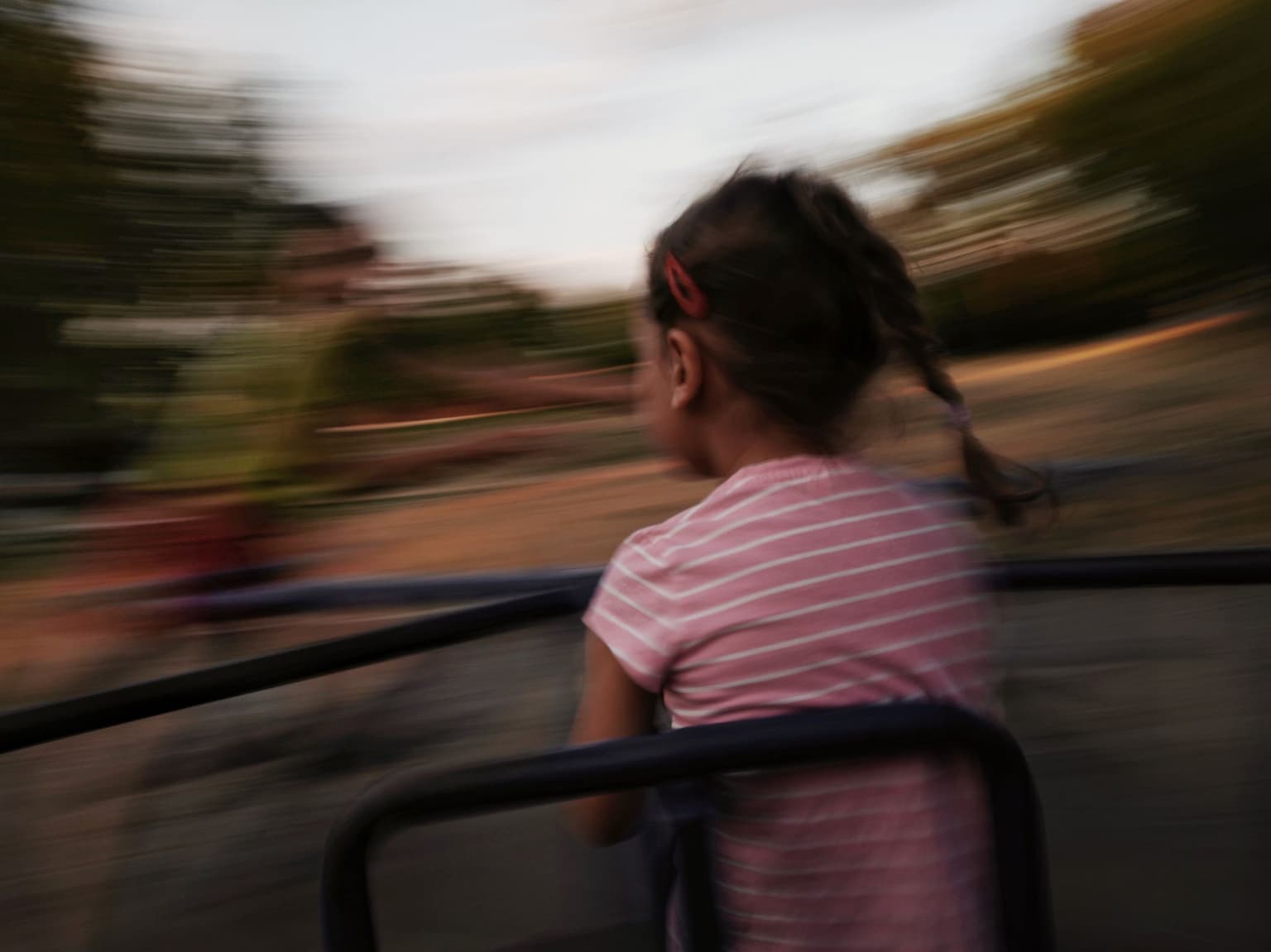
Local children play on a playground in a neighborhood that is regularly targeted by Russian guided bombs and FPV drones, in Zaporizhzhia, Ukraine, on Aug. 11, 2026. (Lisa Bukreyeva / The Kyiv Independent)
 on Google
ZAPORIZHZHIA, Zaporizhzhia Oblast — In Kosmichnyi, the most heavily bombarded district of Zaporizhzhia, children play at a park. Some run around in camouflage clothing, while others laugh as they go up and down a slide.
Suddenly, the buzzing sound of a drone fills the air, replacing the sounds of joy on the playground.

"It's a Shahed!" one of the children yells. They run to hide under the nearby trees, looking up at what appears to be a Ukrainian interceptor drone.
Among them is six-year-old Veronika Didenko, a bright blue-eyed girl in a pink outfit, her straight blonde hair tucked into a long ponytail. She sits calmly on a picnic mat under one of the trees, showing no signs of fear.
"I got used to it," Didenko told the Kyiv Independent at the sandbox, saying that she is not scared of the explosions.

About 700,000 people continue to live in Zaporizhzhia, a city known for its metallurgy and mechanical engineering industries, located on the banks of the Dnipro River in southeastern Ukraine. At the beginning of Russia's full-scale war, it served as a key humanitarian hub for people fleeing from occupied territories, such as Mariupol and Berdiansk.
Since June, Russian drones and glide bomb attacks on Zaporizhzhia have intensified, gradually eroding the relative quietness the city had long enjoyed. Around the same time, first-person-view (FPV) drones started hitting the city center regularly, prompting authorities to install anti-FPV nets over main roads.
Russian troops, struggling to advance toward Zaporizhzhia, have sought to disrupt logistics into and around the city. They have also targeted gas stations, bridges, warehouses, residential buildings, schools, and shopping malls.
Zaporizhzhia's southernmost Kosmichnyi district, about 20 kilometers (about 12 miles) from the front line, bears the brunt of intensified attacks, leaving around 100,000 local residents in limbo over whether to adjust to the new reality or flee.
Two or three glide bombs usually hit Kosmichnyi every day, according to the district head, Volodymyr Volobuev.

A small family
Didenko said she can distinguish the sounds of FPVs, Shahed drones, and glide bombs, having first learned about the war at age 3. Her mother, Yuliia Didenko, raises her daughter mostly on her own after her husband was drafted into the army. She said that her daughter is still, in many ways, a child, and that Veronika sometimes grows tired of hiding in a shelter.
"...she asked where we would move to if a glide bomb hits our house."

"I think that she doesn't understand (the threat of glide bombs) because she asked where we would move to if a glide bomb hits our house," Yuliia said.
Originally from the Russian-occupied town of Huliaipole, farther east in Zaporizhzhia Oblast, the two have found a home here, and Veronika made friends at gymnastics and dancing classes. The house they live in belongs to family friends who have fled Zaporizhzhia.
Fleeing Zaporizhzhia is a safer option, but leaving relatives and friends behind would be difficult, the mother said, while moving elsewhere would be expensive.
"The most important thing is that we are together," Yuliia said. "If anything, together. I don't want to even imagine her without me or me without her."

Intensified glide bomb attacks
In another part of Kosmichnyi district, 77-year-old retiree Liudmyla Pavelko was preparing to buy groceries from a local market when a glide bomb exploded over her Soviet-era apartment building on an August morning.
The blast wave threw Pavelko from the kitchen into the corridor, where she hit her head hard against the wall. Her eyes covered with cement dust, her arms scarred by debris, she crawled out of the front door for rescue workers to find her.
"Everything that was there — the windows, the frames, the tiles from the walls — fell on me," Pavelko told the Kyiv Independent at a hospital two days later.
"I couldn't hear anything either."

Pavelko claims that Ukrainian soldiers lived in a dormitory nearby, which she believes was the target. In front-line cities like Zaporizhzhia, military personnel and civilians often live in close proximity. That can increase the danger to civilians when Russia strikes suspected military targets nearby.
The attack that damaged her apartment building injured 24 people, according to local authorities. With her apartment severely damaged, Pavelko is not sure where she will settle.
"Honestly, I am scared to return there (to the apartment)," Pavelko said. She had lived her entire life in Zaporizhzhia.

Rescue missions
As the deadly attacks on the city become more frequent, rescue workers race to save as many lives as possible at the impact sites.
One of the biggest challenges to their work is the threat of a double-tap strike. Shortly after an initial strike, Russian troops target the same attack site again, deliberately killing rescue workers who rush in to help the wounded.
"We understand that any place where a missile, (aerial) bomb, or Shahed (drone) hit can face a double-tap attack at any minute," Dmytro Borodatyi, head of the Rapid Response Department in the regional State Emergency Service (DSNS), said.
In case of a double-tap strike threat, rescue workers temporarily pause operations to take shelter. But if there are still wounded victims trapped under the rubble, a small group sometimes continues to work despite the risks, according to Borodatyi.
"Every minute is a chance to save a life."
The chance of finding survivors in collapsed buildings is "very low," especially a day or two into the search, he said, which is why they try to work as quickly as possible to locate missing people. Rescue workers understand the risk, including from the threat of falling debris in a collapsed building, but in the moment, their focus is finding survivors, according to Oleh Onishchenko, assistant to the duty shift head in the regional DSNS.

"You understand that there are people or there could be people, and for you, every minute is a chance to save a life," Onishchenko, whose colleague was killed the day before in a double-tap attack, said.
"You understand that the family is still waiting for good news. You understand that (the chance of survival is) one in a hundred since it’s the epicenter of the explosion."
A search operation for missing people under the rubble can last between a few hours and days, sometimes a week, until everyone is found, according to the rescue workers interviewed.
When the missing people can't be located, they rely on a search camera and dog to find them. The rescue workers also hold "a minute of silence" to hear even the slightest sound, such as somebody kicking, they added.

Finding corpses under the rubble, especially if they are children, is psychologically the most straining aspect of the search, according to Dmytro Sosna, the head of the regional DSNS Emergency Rescue Department.
He said he has seen "countless" civilians who were killed before the rescue workers had a chance to save them since 2022, but he tries not to take them too much to heart.
"And, to be honest, some of them even fade from memory. Perhaps it is the brain's way of protecting itself," Sosna said.
Coping
Even as the attacks intensify, many local residents have decided to stay in Zaporizhzhia for now and try to carry on with their lives.

On a sunny day in August, a group of locals sits together at the Dnipro River's sandy beach, a day after what residents said was the worst combined strike they had experienced since the beginning of the full-scale war.
Hennadii Kolomoiets said he had come out to ease the stress after enduring a rough night hiding in a bomb shelter at a metallurgical enterprise as the ground above him shook.
"I think that this (the stress) will remain with each of us who are experiencing this war for the rest of our lives," the 40-year-old Zaporizhzhia native said.
Not far away, at a theater near the Dnipro River, Olha Donik is tidying up after a rehearsal that was cut short by the mass overnight attack. Donik, the director of the municipal theater Actor's House, leads a team of 62 people, including actors, dancers, and musicians, who perform various plays in the front-line city.

She believes that people need to hold on to a ritual from their prewar life, such as going to the theater, and that they may feel less lonely when surrounded by others with the same experience.
"Culture and art explain to us who we are," the 37-year-old said.
"And we need that explanation … We need someone to remind us who we are and why we are here."