Ukraine's defense industry gets a second chance
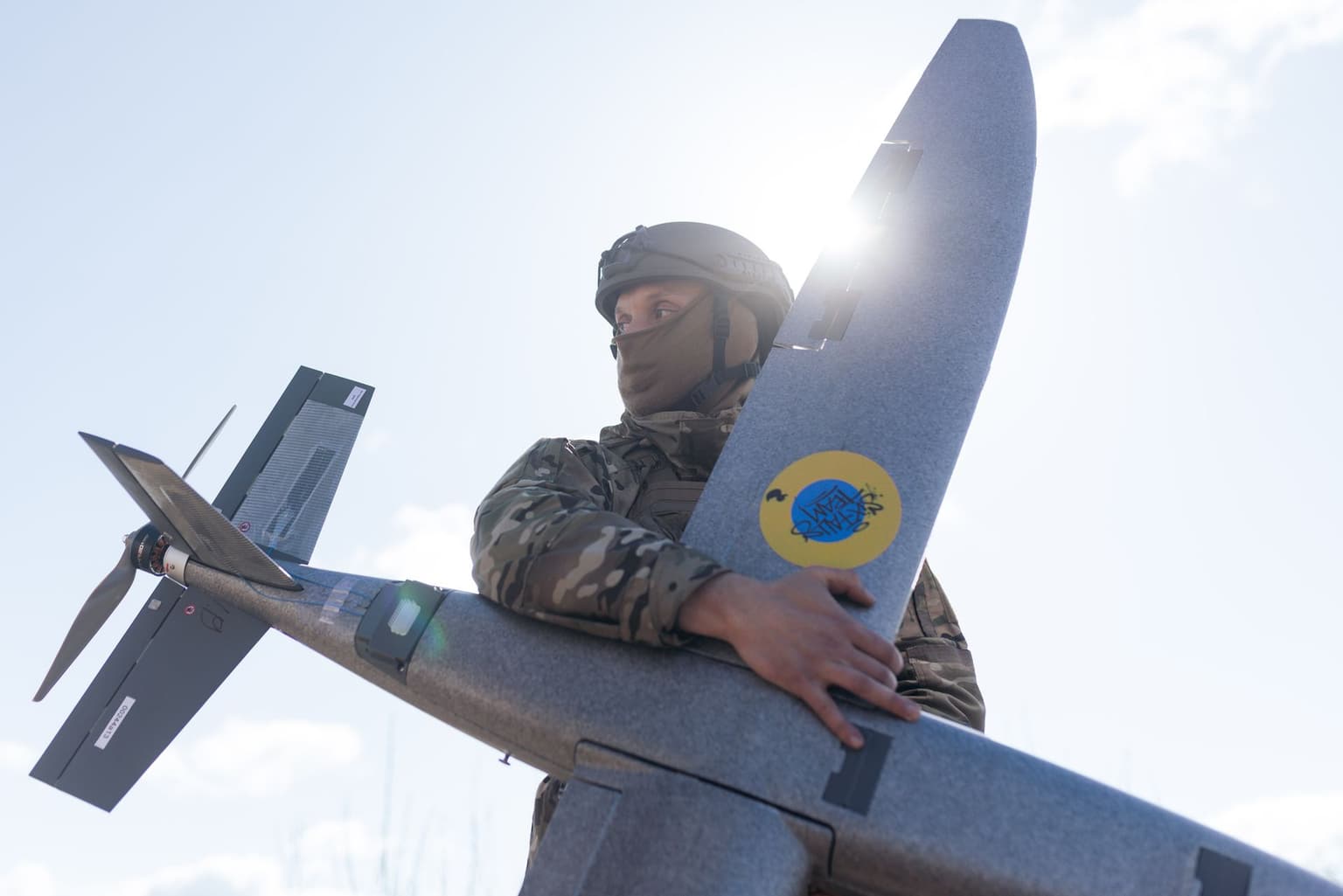
A soldier from the "Taifun" unmanned aerial vehicle unit holds a new model of the "Marsianin" attack drone in Kharkiv region, Ukraine, on April 7, 2026. (Nikoletta Stoyanova/Getty Images)
 on Google
Daria Yaniieva
President of Defense Builder
In 1991, Ukraine inherited the second-largest defense industrial complex of the Soviet Union.
It was so big that almost a third of the Soviet space industry sat on Ukrainian soil, and the system employed millions of people. Pivdenmash, a rocket and space technology juggernaut, built the most powerful intercontinental missiles on the planet. Antonov, a world-famous brand, produced the world's largest aircraft. The city of Kharkiv designed tanks, and Mykolaiv launched aircraft-carrying cruisers.
Nevertheless, within a single generation, much of that capacity had disappeared, and by 2014, the former Soviet Union's second-largest defense producer left volunteers shouldering much of the burden of supplying the army defending Ukraine against Russia's first invasion.
Today, Ukraine is building its defense industry for the second time, and in a way opposite to the Soviet one: from the bottom up, with private money, in open competition, under the harshest quality control in the world — the front line.
According to research by Defense Builder and KSE Institute, a sector dominated by state enterprises before the full-scale invasion now counts more than 1,000 companies, and private business accounts for up to 90% of activity in drone production.
In 2025, the industry produced $13.1 billion worth of output, 31% more than a year earlier. And that is only the funded share of what is possible. The state puts the sector's capacity at tens of billions of dollars. The most important thing, though, lies beyond the figures.
The longer I work inside the sector, the more convinced I am that the real question is what kind of Ukraine this industry will make in 10 years. History here is merciless and useful at once.
In the first scenario, the defense industry becomes the root system of the state, from which much else grows.
In the United States, Silicon Valley grew out of military radar labs and Pentagon contracts; the internet and GPS came from defense programs.
In Israel, the defense sector spawned an entire technology economy. Signals intelligence Unit 8200 still serves as the talent incubator of the cybersecurity industry, and defense exports have set records five years running, reaching $19.2 billion in 2025.
South Korea built its defense industry into a broader industrial push and today ranks among the 10 largest arms exporters in the world, with an ambition to become the fourth.

The second scenario we know from our own history.
By Western estimates, the Soviet defense complex absorbed 15–20% of the entire economy. It lived behind the fences of closed cities and made civilian goods by quota. Soviet television sets came partly from defense plants, cameras from military optics, and Pivdenmash itself produced tractors between missiles.
As soon as the market opened, all of it disappeared almost overnight. Not a single civilian line of the defense complex became an industry able to live without an order from above.
There are a handful of structural road forks a country passes early on its way that separate these two scenarios, and Ukraine has to choose and pass them right now
Fork one is a closed loop or spillover. Do military technology, people, and engineering culture flow into the civilian economy, or stay inside a closed circuit?
The American and Israeli models won on spillover. Ukrainian technologies in autonomy, communications, robotics, and electronic warfare have obvious civilian continuations in agriculture, space, and so on.
But spillover has to be built. It is created by intellectual property rules, education, and dual-use mechanisms. If we seal the sector "for security reasons", we will repeat the Soviet trajectory in miniature.
Fork two is autarky or openness. Japan built technologically superb weapons exclusively for itself, having banned its own arms exports, and within a few decades, its defense industry withered: microscopic production runs, sky-high unit costs, manufacturers closing their defense divisions one after another.
Korea and Turkiye went the opposite way, building their industries with exports in mind from the start, and it was foreign markets that gave them the scale that keeps an industry fit.
Ukraine has spent more than four years in forced autarky and is leaving it right now.
In early July, the government formalized a transparent mechanism of controlled exports, open only to those who simultaneously meet the needs of the Ukrainian army. Our own military gets its weapons first.

We jumped off the Japanese trajectory at the last moment. But a mechanism that exists on paper still has to be made to work. Permission only opens the door, and exports are far from the only mechanism. International revenue also comes through joint ventures, where the partner gains access to technology proven at the front and the Ukrainian company gains scale, capital, and a presence in foreign markets.
The interest is obvious: by the KSE Institute's preliminary estimate, 156 international defense partnerships have already been launched.
At the same time, a quarter of them have already stalled. Openness becomes an industry only together with service, standards, financial instruments, and constant work on the markets, and all of that still has to be built.
Fork three is competition or consolidation from above. In 1993, the Pentagon gathered the heads of the largest defense contractors for a dinner that went down in history as the "Last Supper" and told them: there are too many of you, merge.
Within a few years, the industry had shrunk to five giants. About 22 years later, William Perry, the man who hosted that dinner, publicly admitted that the experiment had turned out badly.
Competition disappeared, prices rose, and innovation slowed so much that outsiders like SpaceX and Anduril had to break the system open.
Ukraine is being built on the opposite principle — open procurement cycles in which hundreds of manufacturers compete for contracts.
That competition is what gives Ukrainian defense tech its speed of innovation. From the outside, the number of players can look like chaos begging to be tidied up. But the market will consolidate the sector on its own in time.

Fork four is doing everything or specializing. In 1987, Israel canceled its own Lavi fighter program.
The decision passed the cabinet by a single vote, the country took it as a national humiliation, and Israelis still argue about its price.
But the main thing happened. Israel admitted it could not carry everything, and the engineers and budgets it freed went into sectors where it became first in the world — avionics, air defense, unmanned systems, electronics.
We, too, will have to say honestly what we are not going to build.
Our advantages are obvious: unmanned systems in every domain, electronic warfare, and, most valuable of all, combat data.
That is where the margin lies that cannot be copied, because years of front-line experience cannot be copied. This advantage has already been paid for, at a price no other country will want to repeat. And it is exactly what international partners are ready to pay for, with contracts, joint ventures, and investment.
Finally, fork five is an island or an archipelago. Korea's defense industry rose from the start together with shipbuilding, the car industry, and electronics within a single industrial policy, and each sector reinforced the others.
A defense industry either pulls a component base, machine tools, engineering education, and capital markets along with it, or remains an island in someone else's ocean.
These forks will have to be passed through institutions — rules of the game, education, standards, capital instruments, validation, and analytics infrastructure.
History rarely gives a second chance, and Ukrainians have managed to become the exception, which we should duly use this time.
Editor's note: The opinions expressed in the op-ed section are those of the authors and do not purport to reflect the views of the Kyiv Independent.