20th-century military leader Yevhen Konovalets reburied in Kyiv
 on Google
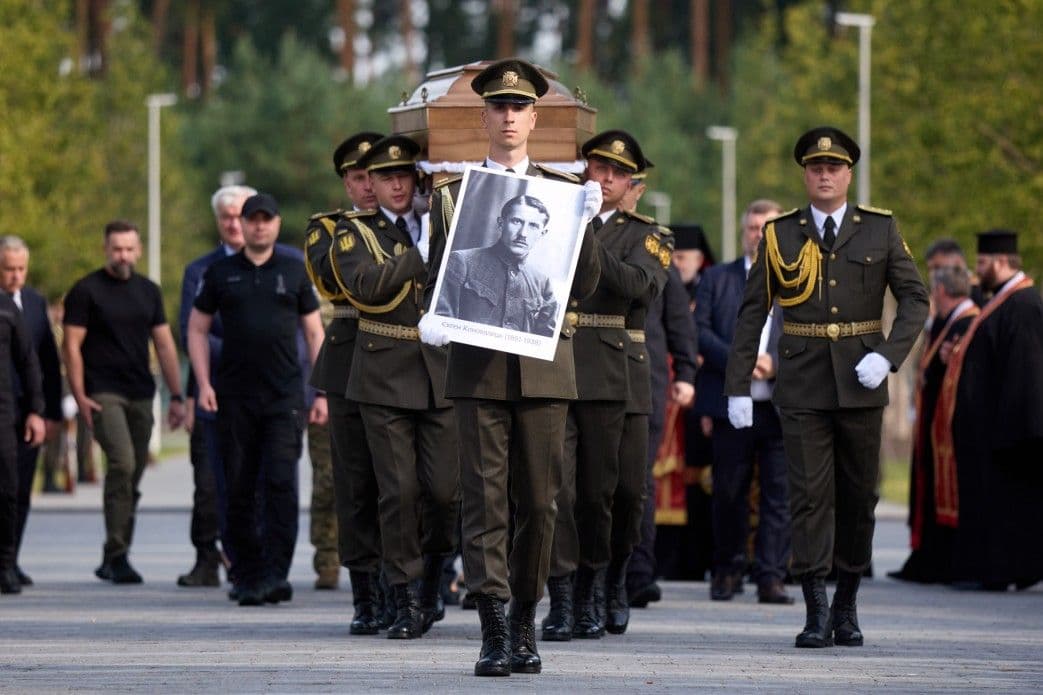
Twentieth-century military leader Yevhen Konovalets was reburied at the National Military Memorial Cemetery in Kyiv, President Volodymyr Zelensky said on Aug. 18, praising him as "an outstanding son of the Ukrainian people."
"Along with him, Ukraine has brought back a part of itself: its memory, its Ukrainian experience, and our national history — the history of all those who, at different times, lived and fought for Ukraine, for our independence, and for our sovereign state," Zelensky said.
"His fate, both heroic and tragic, serves as a symbol of that entire period in our history."
As the founder and leader of the Organization of Ukrainian Nationalists (OUN), Konovalets devoted his life to Ukraine's independence.
He established the Organization of Ukrainian Nationalists (OUN) in 1929, amid the turmoil following Ukraine's defeat in the 1917–1921 War of Independence, which led to the country's territory being divided between the Soviet Union and Poland.
From exile, Konovalets worked to unite Ukrainians into an organized independence movement and also sought foreign support for Ukraine's cause, warning that Moscow's expansionism posed a broader threat to international security.
In 1938, an undercover Soviet agent who had been tasked with infiltrating the OUN assassinated Konovalets in Rotterdam by gifting him a box of chocolates rigged with a bomb.
According to the President's Office, the exhumation ceremony for Konovalets at Crooswijk Cemetery in Rotterdam was attended on Aug. 11 by government officials, members of the local Ukrainian diaspora, and clergy from the Ukrainian Greek Catholic Church.
His remains were brought back to Ukraine on Aug. 13, when he was posthumously awarded state and military honors.
Konovalets' repatriation was preceded by that of Andriy Melnyk, another prominent 20th-century military leader who headed the OUN-M, an offshoot of the organization that formed after Konovalets's assassination.
In his Aug. 18 speech, Zelensky pledged that Ukraine would keep working to bring home its heroes who are buried abroad.
The return of historical leaders like Konovalets and Melnyk comes as Ukraine seeks to establish a National Pantheon to honor its heroes, past and present.
However, government officials involved with the project told the Kyiv Independent that there is no official list yet of which figures will be included — only an established protocol that will be used to decide once the bill becomes a law.