Russia's strike near Poland put Ukraine's railway lifeline in focus. But the bigger threat lies elsewhere
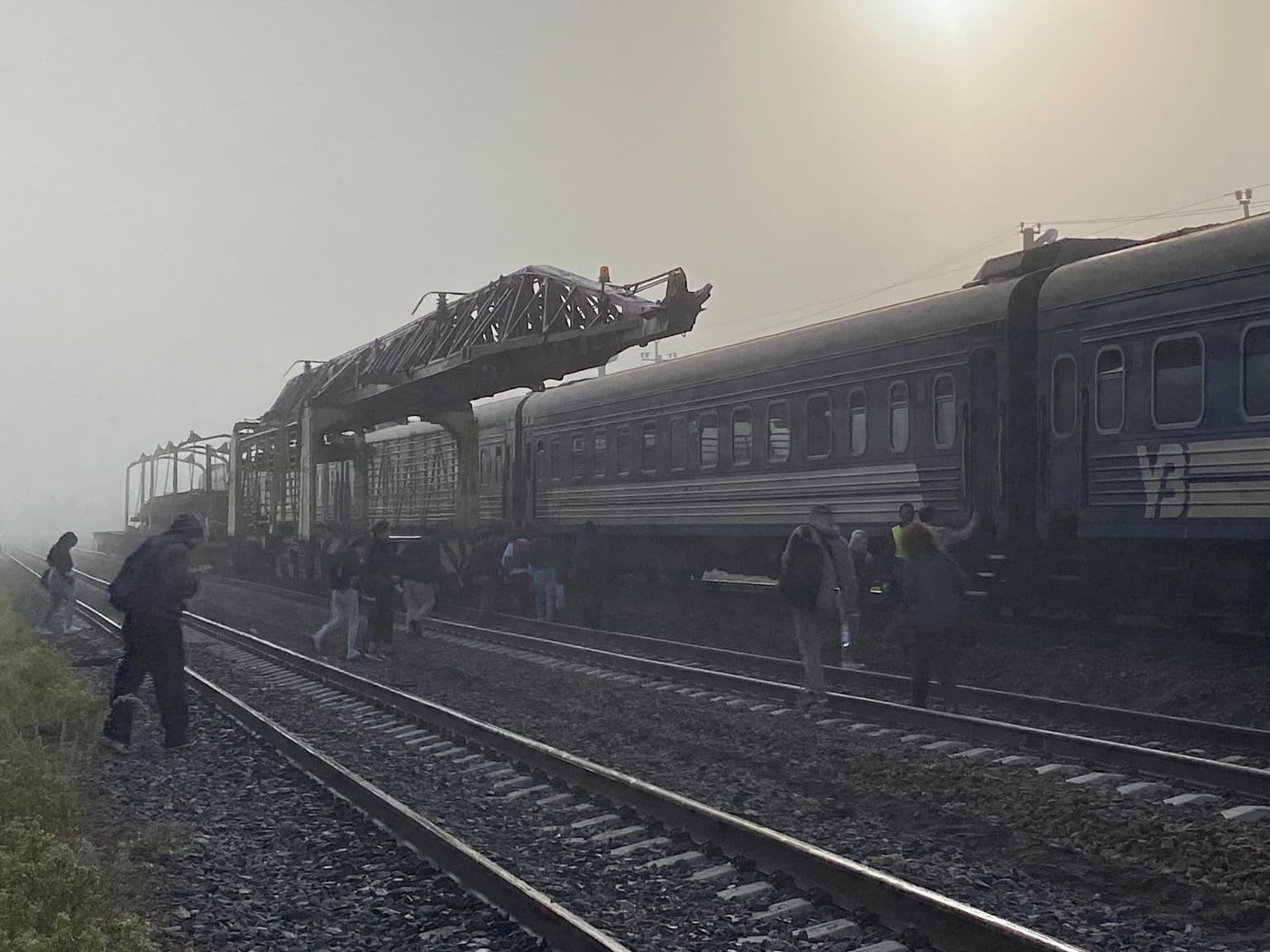
Passengers board their train after being evacuated due to an air raid alert near the border with Poland in Ukraine on Sept. 18, 2026. (Ania Tsoukanova / AFP via Getty Images)
 on Google
On Sept. 13, a Russian drone struck the locomotive of a Kyiv–Warsaw passenger train just 2 kilometers from the Polish border. The attack near Yahodyn caused no casualties, but it drew attention to one of Ukraine's most important links to the outside world amid the pressures of Russia's war — the railway.
Ukrainian state railway company Ukrzaliznytsia said its monitoring team detected the threat early enough to evacuate the crew before the strike on the locomotive.
Russia has targeted Ukraine's railway throughout the full-scale invasion, but the intensity of attacks has risen sharply over 2026. At the same time, Ukraine increasingly depends on the railway for passengers, trade, diplomacy, and wartime logistics.
"The first goal is to disrupt logistics, both passenger traffic and the movement of goods," Foreign Ministry spokesperson Heorhii Tykhyi told the Kyiv Independent.
"The second follows from that — weakening the economy, disrupting transport links with neighboring countries. Intimidating our partners may also be one of their goals."
While Moscow is unlikely to erode international support for Ukraine, he said, the immediate impact on transportation and trade is more serious.
A lifeline
Ukraine historically developed around an extensive railway network, making it far more heavily dependent on rail than most European countries. Its road infrastructure, meanwhile, remains less developed.
Around 60% of the country's freight is transported by rail, and trains account for about 37% of domestic and international passenger transportation, according to Serhiy Vovk, director of the Centre for Transport Strategies.
In many European countries, he said, rail typically accounts for around 10% to 20% of passenger and freight transport.

"A passenger train may arrive six hours late after an attack, while five or six freight trains behind it can remain waiting for hours for capacity to reopen."
The dependence is even greater in foreign trade. About half of Ukrainian exports move by rail, Vovk estimates. For products such as iron ore, metals, and some agricultural goods, moving comparable volumes by road would be prohibitively expensive and place enormous pressure on highways.
Pressure on the railway could grow further if stable operations at Ukraine's Black Sea ports are not restored after another sustained Russian bombing campaign.
"If the issue of stable port operations is not resolved by November or December, domestic storage facilities may remain filled with grain and processed agricultural products that need to be exported," Vovk said.
The railway also became the backbone of Ukraine's "iron diplomacy," carrying foreign leaders and officials between the western border and Kyiv after the airspace closed in 2022.

Passengers increasingly feel the growing pressure on the railway. An attack hundreds of kilometers away can disrupt schedules for hours, and Russia's growing use of drones against trains and railway infrastructure means evacuations or emergency stops can become necessary along the route at any time.
But these visible delays are only one part of a wider disruption that can ripple through the network. Passenger trains operate on fixed schedules and are generally prioritized, while freight trains only move when capacity becomes available.
"A passenger train may arrive six hours late after an attack, while five or six freight trains behind it can remain waiting for hours for capacity to reopen. So the passenger sees the delay. But the larger hidden impact is felt by businesses and the economy," Vovk said.
Real bottlenecks
Vovk does not see attacks on border crossings alone as a strategy capable of cutting Ukraine off from Europe. Western Ukraine has a relatively extensive railway network, so traffic can be rerouted when a route or junction is damaged.
But since the start of the full-scale invasion, Russian attacks have damaged or destroyed more than 500 Ukrainian locomotives, according to Foreign Minister Andrii Sybiha. More than half were hit this year alone.
"Without enough locomotives, the entire system can … grind to a halt."

Replacing the locomotives is difficult. Ukraine uses a 1,520-millimeter rail gauge, meaning most European locomotives cannot simply be transferred into service, and available compatible stocks abroad are limited.
"Without enough locomotives, the entire system can … grind to a halt," Vovk said.
Amid migration, mobilization, and losses among railway workers, Ukraine is also short of about 10% of the locomotive crews it needs, he said. Unlike a damaged track, that shortage cannot be fixed quickly.
"You cannot train a qualified driver in a year," Vovk said.
A winter stress test
New rules allowing trains to continue operating under lower-level air threats rather than automatically stopping came into effect on Sept. 18. Under the highest threat level, boarding and disembarkation are suspended while passengers and staff move to shelters.
Decisions on trains already in motion are made on a case by case basis, using information from Ukrzaliznytsia's monitoring teams.
The company is also dispersing rolling stock and passenger flows, developing protected facilities for workers and passengers at major junctions, and exploring greater use of electronic warfare systems.
With winter approaching, preparedness becomes more urgent.
"A train that stops for hours in an open area in summer is an inconvenience. In freezing temperatures, particularly with children or elderly passengers on board, it can become a safety problem," Vovk said.

Protocols may increasingly need to ensure that trains stop near stations or populated areas where passengers can access shelter, electricity, and heat, he said.
Besides protecting tracks and stations under constant Russian threat across the country, Ukraine also needs to restore and procure locomotives, train new personnel, and build reserves.
"Otherwise, when passenger and freight volumes increase, the problem may no longer be whether the tracks are available, but whether there are enough locomotives — and enough people — to keep trains moving," Vovk said.