Ukraine wants a National Pantheon to honor its heroes. Now it has to decide who belongs there
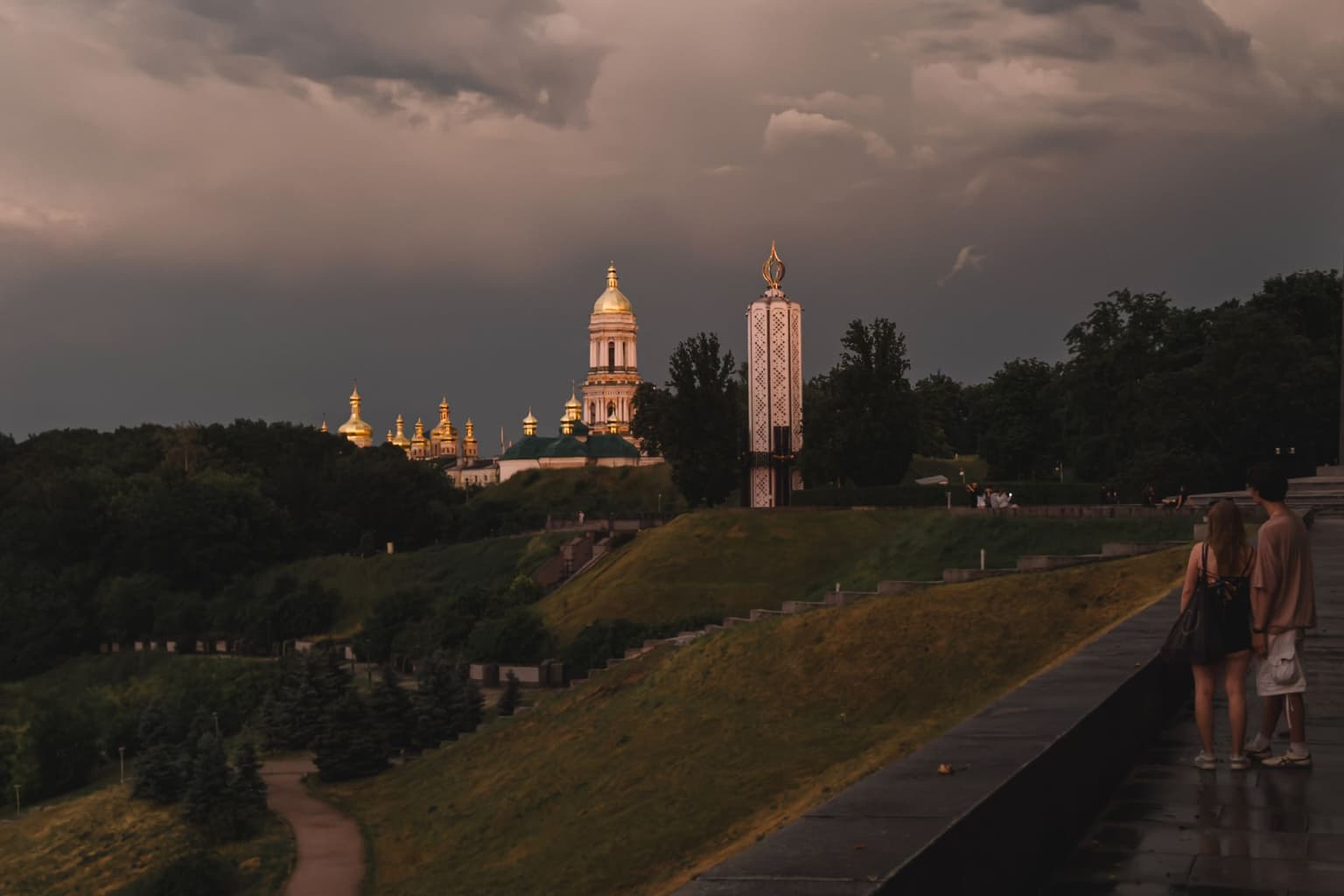
A man and a woman look toward the Kyiv Pechersk Lavra after a thunderstorm in Kyiv, Ukraine, on June 29, 2026. (Andrew Kravchenko / Global Images Ukraine / Getty Images)
 on Google
Ukraine is moving to establish a National Pantheon to honor generations of people who defended, built, and shaped the nation.
The effort comes after years of Russian attacks that have damaged churches, museums, historic landmarks, and other cultural sites, reinforcing what Ukrainian officials and many cultural experts describe as a broader assault on the country's history and identity.
"The names of all the heroes who, across centuries and eras, fought for Ukraine and inspired its people will be joined together and forever written into our history with respect, with honor, and with the full recognition of our state," President Volodymyr Zelensky said in late June when he submitted a draft law on the National Pantheon to the Verkhovna Rada, Ukraine's parliament.
"This is what it means for Ukraine to respect itself, to cherish its own, and to defend what is rightfully ours — our fundamental right to be Ukrainians."

The Verkhovna Rada advanced the initiative in early July, with the bill stipulating that the National Pantheon would be built on the grounds of the Kyiv Pechersk Lavra, one of the most sacred landmarks of Orthodox Christianity.
Until the president signs it into law, Ukraine's National Pantheon remains largely a concept, with no public timeline for its completion, no chosen design, and no official list of names of those buried at the site.
Yet the debates surrounding it have already begun, reflecting a broader struggle over how Ukraine remembers its past, honors its dead, and defines its national identity in the midst of an existential war.
What's the pantheon supposed to be?
Ukraine's effort to build a National Pantheon is not without precedent. Across Europe and elsewhere in the world, such memorial sites serve as testaments to national identity, with each country setting its own standards for who deserves a place among its heroes.
In its press release about the draft law in late June, the President's Office said that Ukraine's National Pantheon could include not only military figures but anyone who has made a contribution to Ukraine's independence, statehood, culture, or society.
According to the bill, the Culture Ministry, which is already responsible for overseeing the hallowed grounds of the Lavra, will be oversee the details of the Pantheon's construction.
According to Deputy Culture Minister Ivan Verbytskyi, selecting the Lavra as the site for the pantheon is a logical decision, given that the centuries-old monastic complex already serves as a final resting place for hundreds of Orthodox monks, medieval nobility, and other historical figures.
"From this perspective, creating such a memorial is very much in keeping with the long tradition that has existed at this site for centuries," Verbytskyi told the Kyiv Independent.

"In many ways, this Pantheon would simply continue what the Kyiv Pechersk Lavra has always been — a place of remembrance for those who shaped our past. We have a legacy to build on here."
As for the construction itself, the site will be located within the national preserve of the Lavra, which is situated in a buffer zone that is separate from the core grounds designated as a UNESCO World Heritage site. This means that the Pantheon would not encroach upon the cultural heritage of the Lavra.
The Culture Ministry, while maintaining ongoing communication with UNESCO, will also collaborate with the Cabinet of Ministers to select the project's architect and design through a merit-based process, according to Verbytskyi.
Public speculation has already begun over who might be buried in the Pantheon, given the recent return to Ukraine of 20th-century military leader Andriy Melnyk's remains from Luxembourg, and plans to reinter Organization of Ukrainian Nationalists (OUN) founder Yevhen Konovalets from the Netherlands.
However, when it comes to Melnyk and Konovalets, their repatriations are reportedly separate from the project for now, and it's still too early to say with certainty who will be included.
"The procedure of the state will decide who is eligible for this memorial — and the procedure will be quite strict. There should be a new law for each person," Verbytskyi said. "There is not a list yet — only a procedure for how that list will be created."
According to the details outlined in the bill, this bureaucratic process aims to spark public discussion and actively involve Ukrainian society in the decision-making process.
Regarding how forms of remembrance are determined — such as the honorary reburial of remains or the installation of cenotaphs — a permanent collegial advisory body attached to the legal entity that manages the Pantheon will be responsible for deciding it.
The makeup of the collegial advisory body will consist of a "competitive basis," according to Oleksandr Alfiorov, the head of the Institute of National Remembrance.
"It will include representatives of the Ukrainian Institute of National Remembrance, scientific institutions, specialists in history, national remembrance, education, and memorialization, as well as representatives of civil society organizations in the fields defined by the draft law," Alfiorov told the Kyiv Independent.
However, the ultimate decision-making authority rests with the Ukrainian government.
"Informational, exhibition, or digital formats may be envisaged as potential components of the Pantheon, but their specific creation and operating procedures are to be determined by project decisions, acts of the Cabinet of Ministers, and decisions adopted in accordance with the procedure established by law."
Memory building during wartime
After the 2014 EuroMaidan Revolution, which ousted pro-Russian President Viktor Yanukovych, Ukraine launched an unprecedented effort in scale to reclaim its historical narrative from generations of Russian control.
In the spring of 2015, the Ukrainian government enacted a set of decommunization laws that mandated the removal of communist symbols from public spaces, the renaming of streets and cities that reflected the Soviet legacy, and the declassification of Soviet-era archives.
The purpose of these measures was to distance Ukraine from Russian influence and to reestablish a Ukrainian-centered historical memory — an initiative that gained an added sense of urgency as Russia began its war against Ukraine by illegally annexing Crimea and launching an invasion in eastern Donetsk and Luhansk oblasts.
Yet, as Yulia Yurchuk, a historian at Södertörn University who specializes in memory studies, points out, the drive to reclaim Ukraine's past from Russian narratives long predates the revolution.

What has changed since 2014 is the sheer scale and popularity of the movement, which has grown significantly in response to the Russian threat.
"I saw tendencies to reclaim (Ukraine's) history from the very collapse of the USSR. Even more so, the reclamation of the past and historical heroes was part of the process that led to the USSR's collapse," Yurchuk told the Kyiv Independent.
"But if in the 1990s the main reclamation work was done by a small group of intellectuals and activists, it found a massive response in the 2000s, especially with the revolutions of 2004, and then even more so after 2014. After 2022, the process became more popular and supported by the state. I would even say that it became the cornerstone of the state's historical and cultural policies."
Amid the devastation and horror of the full-scale war — including relentless drone and missile attacks on Ukrainian cities and the occupation of one fifth of the country's territory — Ukraine is more compelled than ever not only to reclaim, but also to preserve its history and celebrate those who have defended it.
"Historically, when we speak about the rise of the cult of national figures, we should remember that it is connected to (19th-century) ideas of romanticism, belief in a national spirit, and the greatness of exceptional personalities," Yurchuk said.

"This cult was undermined in the 20th century, especially after World War II. In Ukraine, we are now back to the romantic ideals of heroism, which is understandable. We see our friends, colleagues, and relatives who are doing incredible things, making enormous sacrifices. We cannot help but view them as heroes."
Ukrainians have felt compelled to honor not only the soldiers and civilians who are currently resisting Russian aggression, but also those who fought for Ukraine's independence in earlier generations.
By reclaiming the stories of these individuals, Ukrainians are forging a sense of continuity between past and present struggles for national sovereignty and identity, while directly challenging long-standing Russian narratives that have sought to delegitimize past resistance.
"Ukraine was denied the right to tell its own story on its own terms for a very long time," Yurzhuk said, adding that Ukrainian society "has made a huge leap from silencing to heroization" of certain historical figures Russia has long sought to demonize.
At the same time, the speed at which this has occurred has left a need for more discussion and knowledge sharing among the broader public that has previously existed primarily among academics.
Not an easy discussion
One of the more complicated questions is the repatriation of those who fought for Ukraine's independence throughout the 20th century, one of the most tumultuous periods in European history.
Russian propaganda has long sought to exploit Ukraine's fight for freedom, especially regarding the history of the Organization of Ukrainian Nationalists (OUN) and its military wing, the Ukrainian Insurgent Army (UPA).
Historians have debated in scholarly research how to characterize the legacy of these groups.
"Given the context of the formation of an independent Ukraine at the beginning of the 20th century, as in the Central-Eastern European region as a whole, it should be noted that Ukrainian nationalism was one of the important driving forces behind the creation and existence of the Ukrainian state prior to its occupation by Bolshevik Russia," Alfiorov said.
Nonetheless, diplomatic tensions with some neighboring countries have already flared over Ukraine's approach to memory politics. Earlier this spring, Poland voiced strong objections when Ukraine named a military unit after the UPA, active during the Second World War.
Poland has said that the UPA was responsible for the Volyn Massacres of 1943–1945 and that its members killed tens of thousands of Poles.

While Ukraine's official position on diplomatic matters is determined by the Foreign Ministry, Alfiorov said that the Institute of National Remembrance is committed to doing what it can to strengthen mutual understanding between the two countries.
"The complex and tragic pages of Ukrainian-Polish relations should be the subject of an open professional dialogue, joint study of documents, proper commemoration of all innocent victims, and rejection of collective blame against either the Ukrainian or Polish people," Alfiorov said.
Members of the collegial advisory body tasked with selecting honorees for the Pantheon will also seek to exclude those specifically implicated in crimes against civilians. Their aim is to ensure that commemorating Ukraine's heroes does not obscure or diminish the suffering of victims of the sweeping tragedies of the 20th century — whether under Nazism or Communism.
"It should be emphasized that Ukraine will not commemorate individuals responsible for crimes against humanity or supporters of Nazism, Communism, and Russian imperialism, and will consider — now and in the future — each individual figure, or group of figures, proposed for commemoration at the national level, on a case-by-case basis," Alfiorov added.
One of the most pressing tasks ahead is to continue educating the world about Russia's long-standing history of aggression toward Ukraine.
According to Oxana Shevel, a political scientist at Tufts University who has extensively studied memory politics, the inevitable criticism over whether certain Ukrainians who went into exile following Soviet victory over Ukraine's independence movements deserve to be repatriated or honored in the future Pantheon must be grounded in the historical reality that these individuals were forced abroad, persecuted, or killed primarily as a result of Russia trying to destroy Ukraine.
"Had Ukraine not been a stateless nation for so much of its history, the question of where historical figures should be buried would never have arisen," Shevel told the Kyiv Independent.
"In a sovereign Ukraine not occupied by the Soviets, these individuals would naturally have been laid to rest on Ukrainian soil, and the focus would shift to how their legacies are interpreted, discussed, and taught."
Note from the author:
Hi, this is Kate Tsurkan — thank you for reading. As a student of 19th century French literature, the Pantheon in Paris was always one of my favorite places to visit. I am very happy that Ukraine will also have a Pantheon to honor its own heroes and I hope you can appreciate as much as I did learning about the complex bureaucratic process that will go behind making it a reality.
If you like reading about this sort of thing, please consider supporting The Kyiv Independent.