Ukraine war latest: For second time in 4 days, Russia targets Kyiv, killing at least 26 in mass missile attack
 on Google
Key developments on July 6:
- For second time in 4 days, Russia targets Kyiv with mass missile attack, killing at least 26
- Russia’s largest oil refinery in flames as Ukraine strikes Omsk, 2,500 km away from border
- Ukraine strikes Russian oil refinery in Yaroslavl
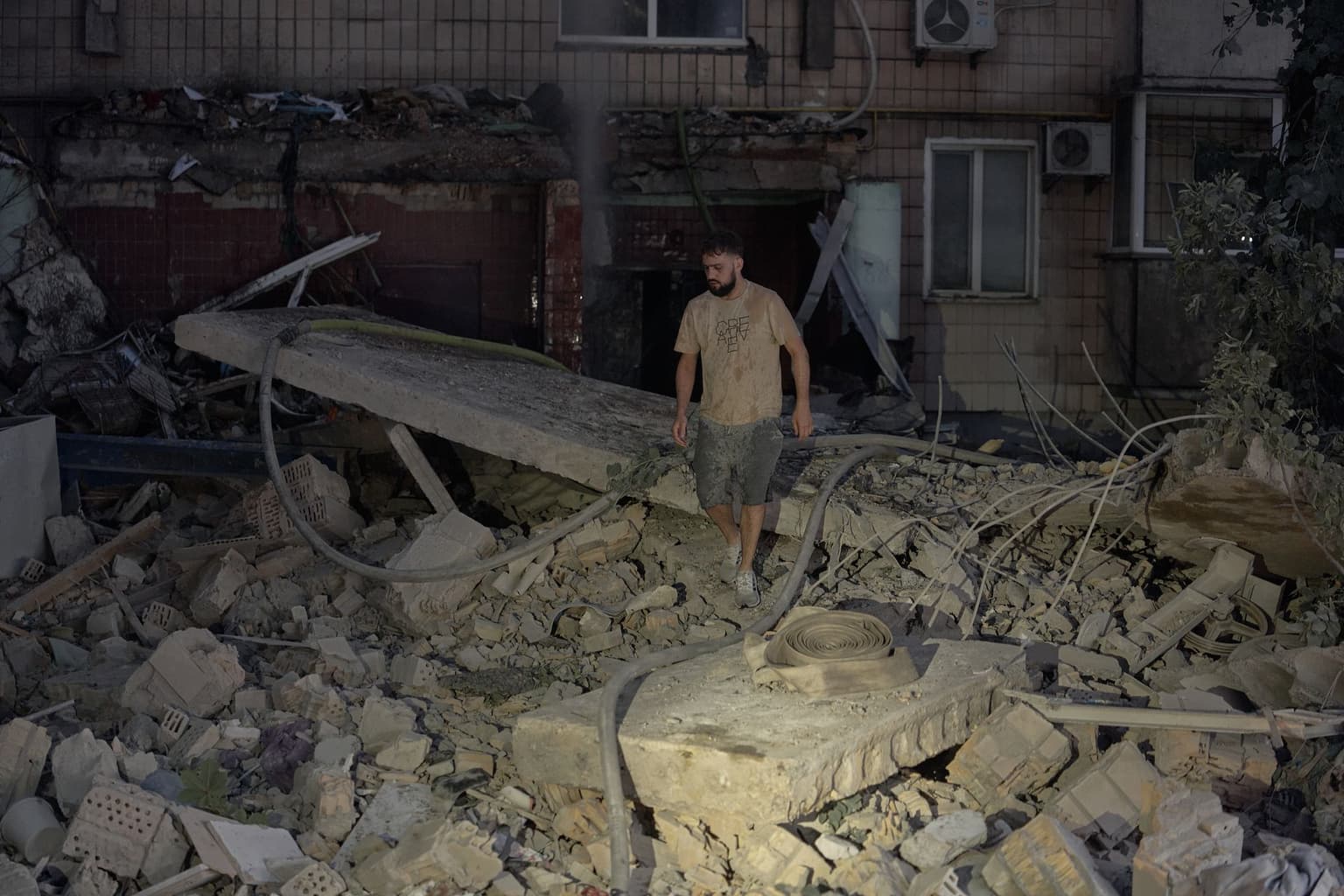
Russia launched waves of missiles and drones toward Kyiv overnight on July 6, killing at least 26 people and injuring dozens more, including seven children, just hours after President Volodymyr Zelensky warned of yet another large-scale attack targeting the capital.
Tymur Tkachenko, head of the Kyiv City Military Administration, reported that a residential building was partially destroyed between the 5th and 9th floors in the Podilskyi district of the city. Photos and videos posted to social media show part of the facade of the building caved in following a missile strike.
Additional residential multi-story buildings were also struck in the Podilskyi, Obolonskyi, and Holosiivskyi districts, and three other apartment buildings were targeted in the Darnytskyi district.
In the city of Kyiv, at least 19 people were killed, and more than 90 others were injured, including six children, authorities reported. Ukraine's State Emergency Service added that search and rescue operations were ongoing as of 9:29 p.m. local time at two locations in apartment blocks damaged by the attack in Podil and Darnytsia districts of Kyiv.
"It is believed there may still be people under the rubble," DSNS said.
It added that seven people had been killed and 29 others injured in the town of Vyshneve, around 2 kilometers (1.6 miles) southwest of Kyiv.
More than 600 people had been evacuated from the town due to what Minister of Internal Affairs Ihor Klymenko said was the "threat of a second detonation." He did not provide further details. Zelensky described the situation in the town as "difficult."

More than 400 rescuers and police officers were involved in the emergency response, Zelensky said.
Ukraine's Air Force said Russia launched a combined attack involving 23 ballistic missiles, 39 cruise missiles, six hypersonic Zircon anti-ship missiles, and 351 attack and decoy drones overnight, with Kyiv as the primary target.
Air defenses shot down 37 cruise missiles and 326 attack drones, while 23 ballistic missiles, six hypersonic Zircon anti-ship missiles, and 18 drones struck 34 locations across the country.
Serhii "Flash" Beskrestnov, a military expert and adviser to Defense Minister Mykhailo Fedorov, told Radio NV that Ukraine had run out of missiles needed to counter Russian ballistic attacks.
"We simply don't have the missiles. We have nothing to use against ballistic missiles," Beskrestnov said.
He said Ukraine has already ordered more Patriot missiles, which are currently in short supply worldwide, and is asking NATO countries to lend missiles from their own stocks, promising to return them later. However, many countries want to keep their reserves amid fears of possible Russian aggression, he added.
Defense Minister Mykhailo Fedorov said Russia was increasingly relying on ballistic missiles to strike residential areas, as it seeks to exploit Ukraine's shortage of Patriot interceptor missiles. He said Moscow is launching ballistic missiles "on a scale never seen before", adding that the world is producing fewer Patriot interceptors each month than Russia fires at Ukraine over the same period.
Responding to the attack, Zelensky said Ukrainian forces had achieved "good results" in intercepting Russian drones and cruise missiles but remained unable to stop the ballistic missiles because of the shortage of Patriot interceptor missiles.
Kyiv Mayor Vitali Klitschko further reported that the attack destroyed "non-residential buildings" in the Podilskyi and Obolonskyi districts, as well as several garages, a warehouse. "Non-residential" buildings were also damaged in the Holosiivskyi and Darnytskyi districts.
Governor Mykola Kalashnyk said homes, businesses, and "other civilian infrastructure facilities" have been damaged in the communities of Bucha, Vyshhorod, and Brovary in Kyiv Oblast.
It follows one of the deadliest Russian attacks on Kyiv just four days earlier on July 2, which killed 31 people and injured more than 100 others.
Several explosions were reported around 1:40 a.m. local time, and then again during subsequent waves of strikes at 2:10 a.m., and 3:15 a.m., according to Kyiv Independent journalists on the ground and local media outlets.
Thousands of Kyiv residents headed to underground metro stations for shelter, as Ukraine's Air Force warned of several dozen missiles flying towards Kyiv.
Local residents also reported power outages in the Sofiivska Borshchahivka neighborhood of Kyiv Oblast, a suburb immediately west of the capital.
The attack also damaged facilities operated by DTEK, Ukraine's largest private energy company, including company buildings and premises, destroyed some office equipment, and damaged repair vehicles with shrapnel, the company said. No employees were injured, and Kyiv's power grid remained stable despite the damage.
DTEK said the hardest-hit communities were the towns of Boyarka and Vyshneve in Kyiv Oblast, which remained without electricity following the strikes.
Air raid alerts were issued for almost all of Ukraine's regions overnight. In response to the missile launches, Poland's Air Force said it scrambled fighter jets to preventively protect the country's own airspace.
The all-clear was given in Kyiv just after 5 a.m., but air raid sirens sounded again around 8 a.m. due to Russian attack drones over the capital.
Zelensky warned during his evening address that Russia was preparing for another large-scale attack against Ukraine, urging civilians to heed air raid alerts and calling on allies to accelerate deliveries of Patriot air defense missiles.
Russia’s largest oil refinery in flames as Ukraine strikes Omsk, 2,500 km away from border
Ukrainian forces struck an oil refinery in Omsk, nearly 2,500 kilometers (around 1,550 miles) from Ukraine's border, overnight, the General Staff said on July 6.
The Omsk refinery was the last of Russia's 11 largest gasoline producers to be hit by Ukrainian forces, according to the military.
A fire broke out at the site following the strike, and the extent of the damage is still being assessed. Preliminary information indicates that the ELOU-AVT-11 primary oil refining unit was hit. The unit has a design capacity of 8.4 million metric tons of crude oil per year, according to the General Staff.
The Omsk oil refinery is Russia's largest by refining capacity, processing more than 21 million metric tons of crude oil per year. It produces a wide range of fuels, lubricants, and petrochemical products and is involved in supplying the Russian military, the General Staff said.
According to the military, the facility has a refining depth of around 99%, one of the highest rates in Russia, and produces a wide range of petroleum products.
The Omsk refinery was not the only Russian oil facility targeted overnight. Ukraine's Security Service (SBU), together with other branches of the Defense Forces, carried out a series of strikes against Russian energy infrastructure and military targets in occupied Crimea, the agency said.
Ukrainian drones struck the Yaroslavl oil refinery and the Yaroslavl oil pumping and dispatch station, with explosions and smoke reported near the refinery, according to the SBU.
The agency also confirmed a strike on an oil terminal at the port of Vysotsk in Russia's Leningrad Oblast. The attack disabled two oil loading arms and hit three petroleum product storage tanks, the SBU said.
Drones also targeted the First Plant oil refinery in Kaluga Oblast, where a fire broke out following explosions at the facility.
Elsewhere, Ukraine targeted Russian fuel supplies to occupied Crimea as the peninsula faces mounting shortages following repeated Ukrainian strikes on energy infrastructure.
Ukraine’s Unmanned Systems Forces struck two Russian shadow fleet tankers in the Sea of Azov that were carrying a combined 7,000 metric tons of fuel to occupied Crimea, Commander Robert "Madyar" Brovdi said. The volume was equivalent to roughly 200 rail tank cars, according to Brovdi.
The strikes come as occupied Crimea faces severe fuel shortages following continued Ukrainian attacks on Russian energy infrastructure. The authorities suspended fuel sales entirely on June 21 amid the worsening shortages.
The SBU also reported a separate operation against military and energy targets in occupied Crimea. Ukrainian drones struck three aircraft hangars at the Hvardiiske airfield, as well as a Pantsir-S2 air defense system near Simferopol and a mobile fire group in Kerch, according to the agency.
A petroleum storage tank and a pumping station at the TES-Terminal-1 oil depot were also hit.
Ukraine strikes Russian oil refinery in Yaroslavl
Ukraine's military carried out an attack on the Russian city of Yaroslavl overnight on July 6, reportedly striking the city's oil refinery, Russian Telegram media channels reported.
Photos and videos posted to social media by local residents purport to show smoke billowing out of the area of the oil refinery.
The extent of the damage caused was not immediately clear. Although it was not immediately clear as to what weaponry was used in the reported strike, Kyiv's forces often target oil refineries with domestically-produced long-range drones.
The Kyiv Independent cannot immediately verify the reports. Ukraine's military has not yet commented on the reported strike.
The Yaroslavl Oil Refinery, located approximately 250 kilometers (150 miles) northeast of Moscow and approximately 700 kilometers (435 miles) from Ukraine's border, has often been a target of Ukrainian attack. The most recent attack on the refinery occurred just one week prior on June 28.
Kyiv considers energy facilities to be valid military targets, as the energy sites provide fuel and funding for the Kremlin's war machine.
Ukraine has been waging an increasingly successful deep strike campaign against Russian oil infrastructure, disrupting production at major facilities and in some cases halting operations indefinitely.
Ukraine's refinery attacks have mounted pressure on the Kremlin by aggravating a domestic fuel supply crisis that has already caused export bans, price hikes, and sales restrictions across Russia.
Russian President Vladimir Putin acknowledged the situation publicly in remarks on June 28, admitting that "there are still lines at gas stations, and the right grade of gasoline isn't always available."
In an attempt to mitigate the crisis, the Russian government on July 2 also passed a decree relaxing quality standards for gasoline products.
Note from the author:
Ukraine War Latest is put together by the Kyiv Independent news desk team, who keep you informed 24 hours a day, seven days a week. If you value our work and want to ensure we have the resources to continue, join the Kyiv Independent community.