Zelensky in Serbia: What Ukraine wants, and what Belgrade gains
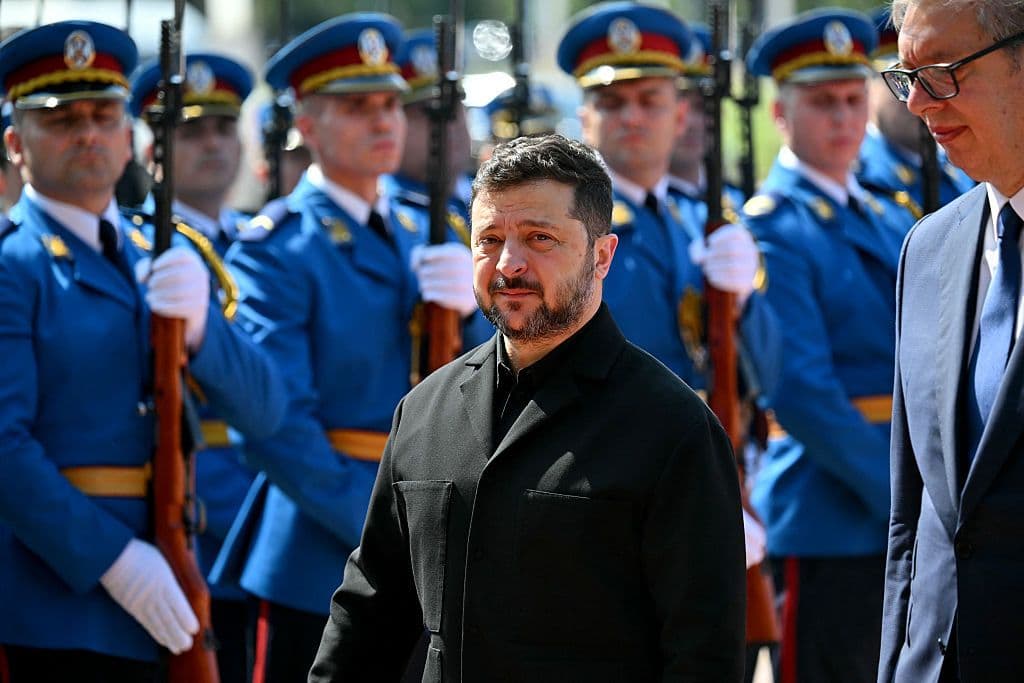
Serbia's President Aleksandar Vucic (R) and President Volodymyr Zelensky review the honour guard during a welcoming ceremony in front of the Palace of Serbia, in Belgrade on Aug. 8, 2026. (Andrej Isakovic / AFP via Getty Images)
 on Google
President Volodymyr Zelensky's visit to Serbia, the first by a Ukrainian head of state since 2018, could mark a new chapter in relations between the two countries. It also raised questions about what each side hopes to gain.
What is Kyiv trying to achieve by deepening ties with Serbia, one of the few countries in Europe, alongside Turkey and Russian ally Belarus, that has not imposed sanctions on Russia? And what does Belgrade, still heavily dependent on Moscow for energy supplies, stand to gain by welcoming the Ukrainian leader?
"We did not discuss any form of military cooperation. What happens once the war is over is another matter," Serbian President Aleksandar Vucic said at a joint press conference with Zelensky. Serbia's leader is often portrayed as a politician sitting on two chairs, carefully balancing between East and West.
"For Zelensky, the visit represents another blow to Russia, given that Serbia is perceived as part of Moscow's sphere of influence," Serbian political scientist Aleksandar Djokic told the Kyiv Independent. "For Vucic, this is an attempt to signal he aligns with Europe's policy towards Ukraine, while attempting to secure at least some progress in Serbia's EU accession talks," he added.

The two presidents have repeated earlier official statements — Serbia and Ukraine respect each other's territorial integrity. But this time, Zelensky's remarks provoked criticism in both Pristina and Tirana. They also evoked reactions within Ukraine itself. Ukrainian outspoken lawmaker Oleksiy Goncharenko described Zelensky's position as a "diplomatic blunder," and stated that Kyiv should, in turn, recognize Kosovo's independence.
"There is nothing new about this — Ukraine's position is driven by the fact that Russia invoked the Kosovo precedent to justify its annexation of Crimea in 2014. This makes Ukrainian recognition of Kosovo politically difficult," Nikola Burazer, program director at the Belgrade-based think tank Center for Contemporary Politics, told the Kyiv Independent.
The significance of Zelensky's visit may lie less in the repetition of old assurances over territorial integrity, and more in what came next. During the joint press conference, Vucic also broke the news: Serbia is opening a drone factory with Israeli partners in September. While no Serbian-Ukrainian defense deal was announced, Vucic invited Zelensky to attend the launch, hinting at a potential new chapter in Serbia-Ukraine cooperation.
Serbia, an EU candidate country since 2012, has one of the more substantial defense industries in Southeast Europe, a legacy of Yugoslavia's military-industrial base.
The sector remains heavily export-oriented, with state-owned Yugoimport SDPR acting as the main player in the market. They produce small arms, rockets, as well as artillery and mortar ammunition, while increasingly developing aircraft and combat vehicle manufacturing.
A new chapter
The drone factory, the first of its kind in Serbia, will be operated as a joint venture between Israeli defense group Elbit Systems, which will hold a 51% stake, and Serbia's Yugoimport SDPR with the remaining 49%, according to an earlier BIRN report. (Kyiv Independent could not verify this data, since the enterprise has yet to appear in Serbia's company register).
While the size of the investment has not been disclosed, Serbia's state broadcaster reported that the new factory plans to produce small, highly sophisticated attack drones, most likely the Lanius-X.
Since Russia launched a full-scale invasion of Ukraine in 2022, Serbia's arms industry has become an increasingly difficult factor in Belgrade's balancing act between Moscow and the West. Even though Serbia's president repeatedly claimed that Belgrade has not supplied weapons to Kyiv directly, people familiar with the matter who spoke to Kyiv Independent on condition of anonymity said Serbian-made ammunition has found its way to Ukraine through third countries.
Belgrade has consistently denied supplying Kyiv directly, maintaining that it cannot control the final destination of weapons legally sold to third countries.
In 2024, the Financial Times estimated that about 800 million euros' worth of Serbian ammunition had reached Ukraine through intermediaries since Russia's full-scale invasion began.

"There are not many countries that can provide Ukraine with Soviet-style ammunition," Florian Bieber, professor of Southeast European history and politics at the University of Graz, told the Kyiv Independent. "Serbia is one of them, which makes it an important supplier. I would expect this to be the most important issue for Zelensky," Bieber added.
Over the years, Moscow did little to conceal its frustration. Most recently, in May 2025, Russia's foreign intelligence service, the SVR, accused Serbia's defense industry of trying to "shoot Russia in the back," invoking with evident sarcasm the two countries' traditional image as "Slavic brothers."
"It is very important for Vucic to stress that Serbia is not helping Ukraine directly, because the ruling party's voters are largely pro-Russian," Burazer said.
Vucic temporarily halted arms exports in June 2025 under pressure from Moscow, but later said Serbia was prepared to sell ammunition to EU countries "even if some of it ultimately ended up in Ukraine."
Ahead of Serbia's first drone factory opening in September, Bieber said it is "too early to tell whether Serbia and Ukraine will be prepared to take military cooperation to a new level."
"If Vucic further distances himself from Russia, this might happen, but so far, the visit is mostly symbolic," he added.
What Serbia gains from Zelensky's visit
Zelensky's visit came at a particularly difficult moment for Vucic's domestic politics.
Serbia has been gripped by its largest sustained anti-government movement in years, since the collapse of a concrete canopy at Novi Sad railway station killed 16 people in November 2024.
What began as a student-led movement developed into a broader challenge to Vucic's rule. In June, tens of thousands of demonstrators across Serbia demanded early elections. Serbia's president recently said he intends to step down before the end of his presidential mandate.
Brussels has also sharpened its criticism. The European Commission has said reforms in Serbia have slowed significantly and called on Belgrade to reverse backsliding on freedom of expression. Earlier this year, the EU halted payments to Serbia due to controversial changes imposed on Serbia's judiciary.
The fact that Serbia's heading for early elections made the timing of Zelensky's visit even more significant, says Burazer. "Vucic has successfully pursued a strategy of conducting one policy at home and another in the West," he said. "Zelensky's visit is part of a policy that generates little controversy domestically but potentially significant gains in the West." One such gain could be progress in Serbia's stalled EU accession process.
"Opening Cluster 3 in EU negotiations would not bring Serbia closer to membership, but it would blunt one of the opposition's main lines," Burazer added.
Bieber sees the same calculation. Under domestic pressure and greater EU scrutiny, Vucic is seeking to make himself appear "indispensable" to the West. "This is Vucic's long-standing strategy to position himself internationally in a manner that deflects from his authoritarian rule," Bieber said. "Clearly, he is more worried about his external position than domestic criticism by nationalist and pro-Russian forces."
Serbia remains one of Europe's few remaining buyers of Russian natural gas, underscoring a dependence that leaves Moscow supplying about 80% of its total gas imports.
The visit did not end without a concrete outcome — President Vucic pledged that Serbia would help restore "a smaller Ukrainian city or region," without any further details. President Zelensky thanked him in advance.