Ukraine stalls on justice, anti-corruption reforms promised to EU
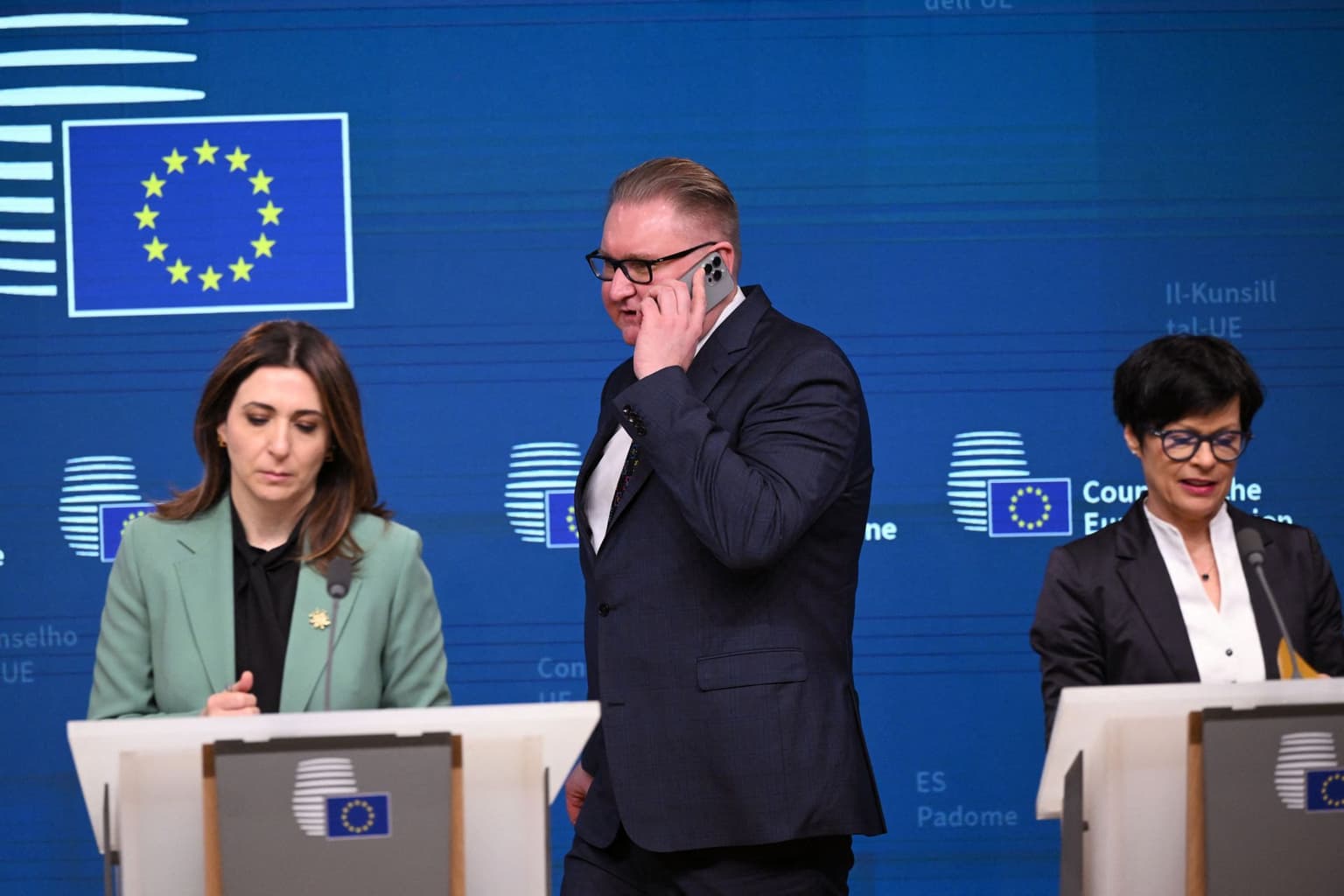
Ukraine's then-Deputy Prime Minister for European Integration Taras Kachka (C) arrives for a press conference with Cyprus Deputy Minister for European Affairs Marilena Raouna (L) and EU Commissioner for Enlargement Marta Kos (R) in Brussels, Belgium, on March 17, 2026. (Nicolas Tucat / AFP / Getty Images)
 on Google
Back in December, Ukraine agreed to a comprehensive package of rule-of-law reforms, as one of the steps needed to move forward with EU accession talks and secure necessary funding.
Soon after the agreement was signed, the government deprioritized the promised reforms.
"None of the crucial reforms related to the justice system, law enforcement, or anti-corruption have been implemented," Vitaly Shabunin, head of the Anti-Corruption Action Center's executive board, told the Kyiv Independent.
The roadmap was endorsed by EU Enlargement Commissioner Marta Kos and Ukraine's then Deputy Prime Minister for European Integration Taras Kachka. Most of the clauses of the Kachka-Kos plan are included in the benchmarks for Ukraine's EU accession.
Several clauses of the initial 10-point plan were also included in July in the EU's Ukraine Facility lending program as requirements for loan disbursements.
None of this seemed to bother Kyiv.
Anti-corruption and judicial experts argue that President Volodymyr Zelensky's administration has little appetite for implementing the promised reforms. They say Zelensky fears losing political control over law enforcement, and he is also wary of independent investigators taking on corruption in his inner circle.
"What is at stake is Ukraine's future in the EU," Shabunin said.
The President's Office did not respond to requests for comment.
Spokespeople for Vsevolod Chentsov, the new deputy prime minister for European integration, the Justice Ministry, and the Ukrainian parliament's law enforcement committee all declined to comment.
Little progress made
According to an EU assessment published in June, only 15% of the Kachka-Kos plan had been implemented despite the end-of-year deadline, with progress largely limited to the initial stages of the legislative process.
Mykhailo Zhernakov, head of judicial watchdog Dejure, said that, according to his information, Kachka "had been urging the authorities to at least start taking action" to implement the plan.
Kachka lost his job during the July government reshuffle and is set to be appointed as Ukraine's ambassador to the EU.
"It feels as though Kachka ended up paying the price for the bold commitments he made," Anastasia Radina, head of parliament's anti-corruption committee, told the Kyiv Independent.
At the same time, Kachka has also faced criticism for not pushing strongly enough for the plan's implementation.
Kachka did not respond to a request for comment.
read also
Controversial integrity declarations
According to the Kachka-Kos plan, Ukraine must adopt a law improving the mechanism of integrity declarations for judges — statements in which judges answer questions linked to integrity and ethics standards.
In June, parliament passed a law on integrity declarations.
However, the judicial watchdog Dejure said that "while presented as a measure to improve judicial integrity declarations, the bill would in fact make it easier for judges to evade accountability for false statements."
"Instead of reviving a weak but important mechanism for vetting judges' integrity, lawmakers have chosen to dismantle it altogether," the watchdog added.

The Ukrainian authorities denied the accusations.
It is not clear if the European Commission will accept the bill as complying with its Ukraine Facility lending program.
"The European Commission is assessing the law carefully in the context of the conditionality under the Ukraine Plan, and will finalize its assessment once Ukraine submits it as part of a payment request," the commission told the Kyiv Independent. "In carrying out this assessment, the (European) Commission will take into account any relevant opinions of the Venice Commission."
The next installment in the program is scheduled for September.
However, Kos, the EU commissioner for enlargement, allegedly persuaded lawmakers to support the bill, two sources familiar with the matter told the Kyiv Independent.
Supreme Court reform
The plan also envisages auditing the integrity declarations of incumbent Supreme Court judges with the help of international experts. The EU has demanded a reform of the Supreme Court due to the corruption scandals that have engulfed the institution.
The bill on integrity declarations passed by parliament contains a clause instructing the Cabinet of Ministers to draft, within six months, a separate bill on Supreme Court declarations.
"It's unclear why they need six months to draft a bill that will contain just three provisions," Anton Zelinsky, an expert at Dejure, told the Kyiv Independent.
The European Commission told the Kyiv Independent that "while there is no specific deadline," the commission "encouraged Ukraine to prioritize this reform."
State Investigation Bureau
Another clause of the so-called Kachka-Kos plan stipulates passing a bill to reform the State Investigation Bureau "in line with best European practices."
Since its creation in 2016, the State Investigation Bureau has faced accusations of being a political tool of the President's Office. Oleksiy Sukhachov was appointed as the bureau's head in 2022 as a result of a non-transparent contest that anti-corruption activists described as fake and politicized.
Zelensky pledged in January to submit a bill to reform the bureau by the end of the month. So far, he has failed to do so.
Radina and opposition lawmaker Yaroslav Zheleznyak submitted an alternative bill on State Investigation Bureau reform in August 2025. But the Ukrainian parliament has so far failed to consider it.
"Unfortunately, nearly a year has passed since then, and there has been virtually no progress on it," Radina said.
Anti-corruption agencies
The Kachka-Kos plan envisages "strengthening the independence of the National Anti-Corruption Bureau (NABU) and the Specialized Anti-Corruption Prosecutor's Office (SAPO) and protecting their jurisdiction from circumvention and undue influence." It also calls for "expanding the jurisdiction of NABU and SAPO to cover all high-risk positions" — a reference to employees of the President's Office currently exempt from oversight — and ensuring that the NABU has access to impartial forensic examinations.
The demands followed a conflict between the Zelensky administration and the anti-corruption institutions.
The standoff culminated in July 2025, when Zelensky signed a law that subordinated the NABU to the prosecutor general, an official appointed by the president. The bureau's independence was later restored amid protests and Western pressure.
Radina said that she and her colleagues are working on a bill on independent forensic assessments for the NABU. The Anti-Corruption Bureau remains heavily reliant on external forensic procedures, limiting its ability to operate independently and raising concerns about potential leaks of sensitive information from the institution.
Prosecutor general
According to the reform roadmap, Ukraine should also "conduct a comprehensive review of the selection and dismissal procedure of the prosecutor general, with a view to aligning it with European best practice." The plan also envisages reinstating transparent contests for other top prosecutor jobs.
In June, Radina submitted to parliament a bill seeking to select the prosecutor general in a transparent contest with the participation of international experts.
Radina's opponents argue that the Kachka-Kos plan does not envisage a contest involving international experts.

Kachka himself has faced criticism for saying in a July 27 interview that there is no direct demand for a transparent contest and claiming that Ukraine's controversial prosecutor's office is "good."
"There may be different interpretations of the benchmark, but I'm not aware of anyone having proposed an alternative approach so far," Radina said.
Ukraine's prosecutor generals are appointed by the president with parliament's approval and have been seen as closely aligned to whoever is in power. Radina's bill seeks to depoliticize the prosecutor general's appointment.
Ruslan Kravchenko, the current prosecutor general, has faced scrutiny, partially due to his role in the crackdown on the Anti-Corruption Bureau in 2025.
"Revised selection and dismissal rules should improve objectivity, transparency, and merit-based procedures, and lead to the depoliticization of the position of the prosecutor general," the European Commission told the Kyiv Independent.
Other clauses
According to the plan, Ukraine must also extend "the involvement of international experts in the selection commission for the High Qualification Commission," a judicial governing body.
The international experts' mandate expired in June 2025. So far, the Ukrainian authorities have not extended it.
Another clause concerns canceling the controversial 2017 amendments that dealt a major blow to corruption cases by severely limiting the terms of investigations and setting strict deadlines for sending cases to trial. Some of the amendments were repealed in 2023, but the main ones remain.
The plan also stipulates appointing, without delay, internationally vetted Constitutional Court judges and members of the High Council of Justice, the judiciary's main governing body.
Zelensky has so far failed to appoint one of the Constitutional Court judges nominated in February 2025, while the Ukrainian parliament failed to appoint two Constitutional Court judges the same year.