The peace in Ukraine that worries NATO
European leaders want the fighting in Ukraine to end. Many also fear that a ceasefire could free a battle-hardened Russian military to probe NATO's eastern flank.
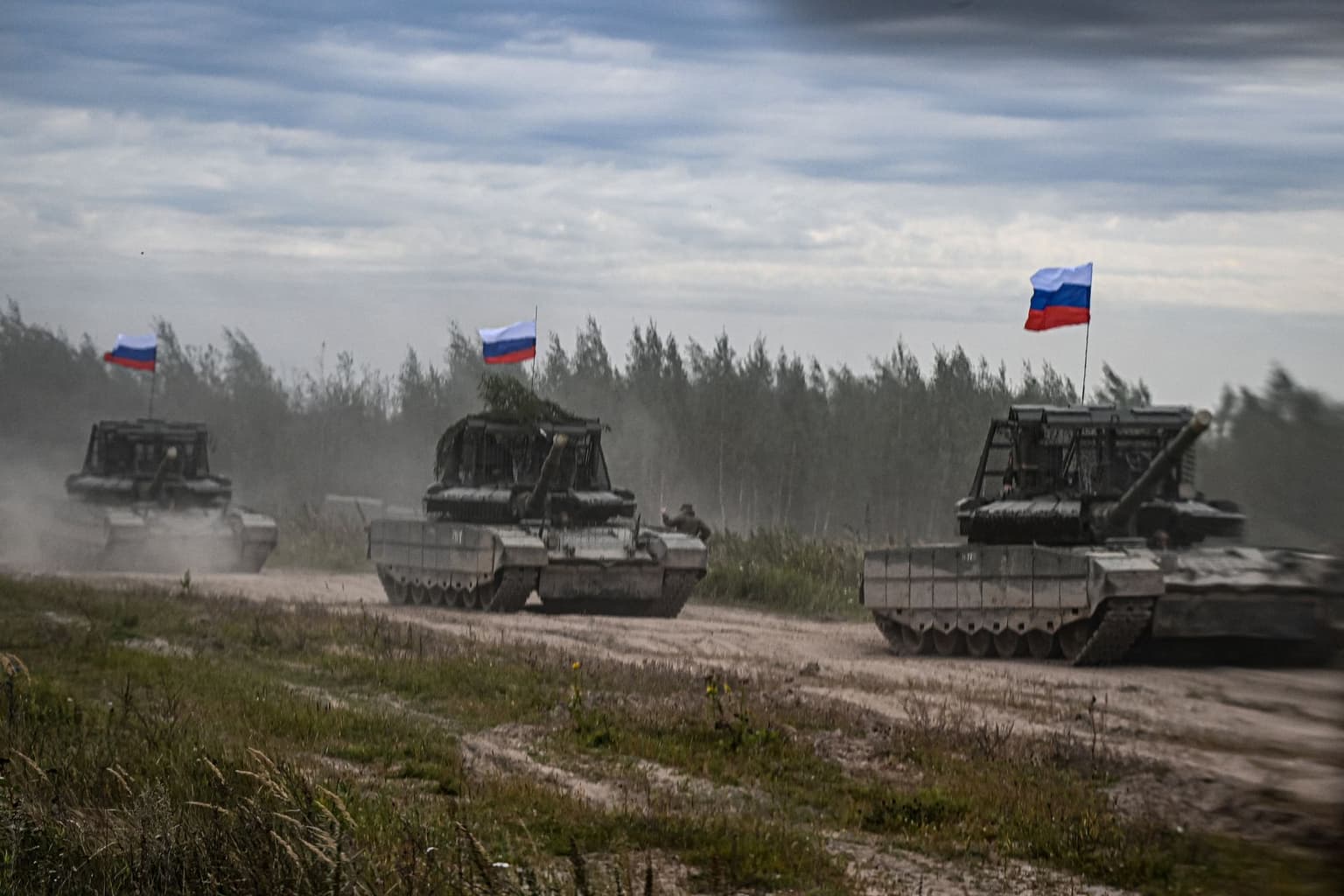
Russian tanks move during the Zapad-2025 joint Russian-Belarusian military drills at a training ground near Borisov, Belarus, on Sept. 15, 2025. (Olesya Kurpyayeva / AFP / Getty Images)
 on Google
A potential ceasefire would provide Ukraine a much-needed respite — but would raise difficult security questions for NATO states along Russia's frontier.
Even as the U.S.-led peace push has slowed, officials in Kyiv still hope they can end the active phase of fighting before winter.
And while Europe firmly backs these efforts, its planners are increasingly sounding the alarm about the prospect of battle-hardened, modernized Russian armies freed for deployment along the Baltic or Nordic borders.
"As soon as there is some sort of conclusion to the Russian aggression in Ukraine… there is a possibility that Russia might test the Baltic states… (and) NATO altogether," Tuuli Duneton, undersecretary for defense policy at the Estonian Defense Ministry, told the Kyiv Independent.
And although the frontier states are rushing to shore up their defenses, NATO's internal divisions appear to offer Moscow a perfect opening.
How far Russia is willing and able to push will depend not only on the alliance's ability to respond firmly, but also on the eventual shape of any armistice in Ukraine.
Russia is building up its strength
Roughly half of the 1.5 million active Russian military personnel are deployed along the 1,200-kilometer (745-mile) front line in Ukraine.
This is a different army from the one that drove armored columns headlong into Ukrainian defenses back in 2022.
Despite suffering over 1 million casualties, Russia has been offsetting its losses while adapting to the realities of modern war, from mass drone deployment to electronic warfare.
Recent joint NATO-Ukrainian exercises already demonstrated that the alliance remains behind the curve when it comes to drone warfare.
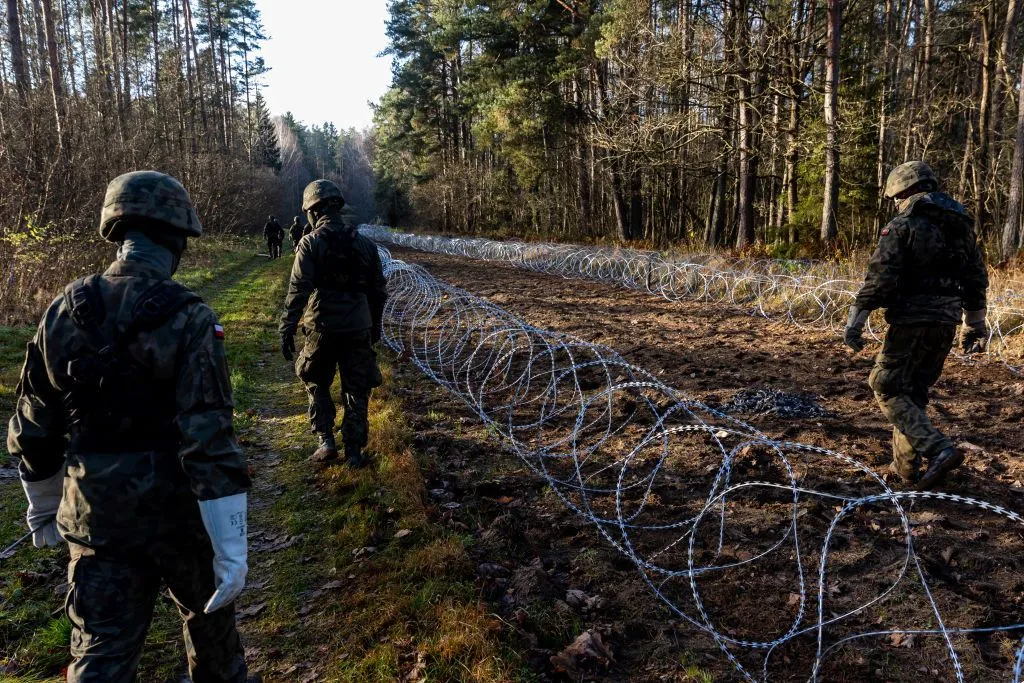

"It is likely that the Russian Armed Forces will be stronger after the war ends or freezes," Matti Pesu, a security expert at the Finnish Institute of International Affairs, told the Kyiv Independent.
"It will also be battle-hardened and, in some limited areas such as drone warfare, more technologically advanced than Western armed forces."
Even as the war in Ukraine rages on, Moscow is steadily building up strength along NATO's northeastern flank.
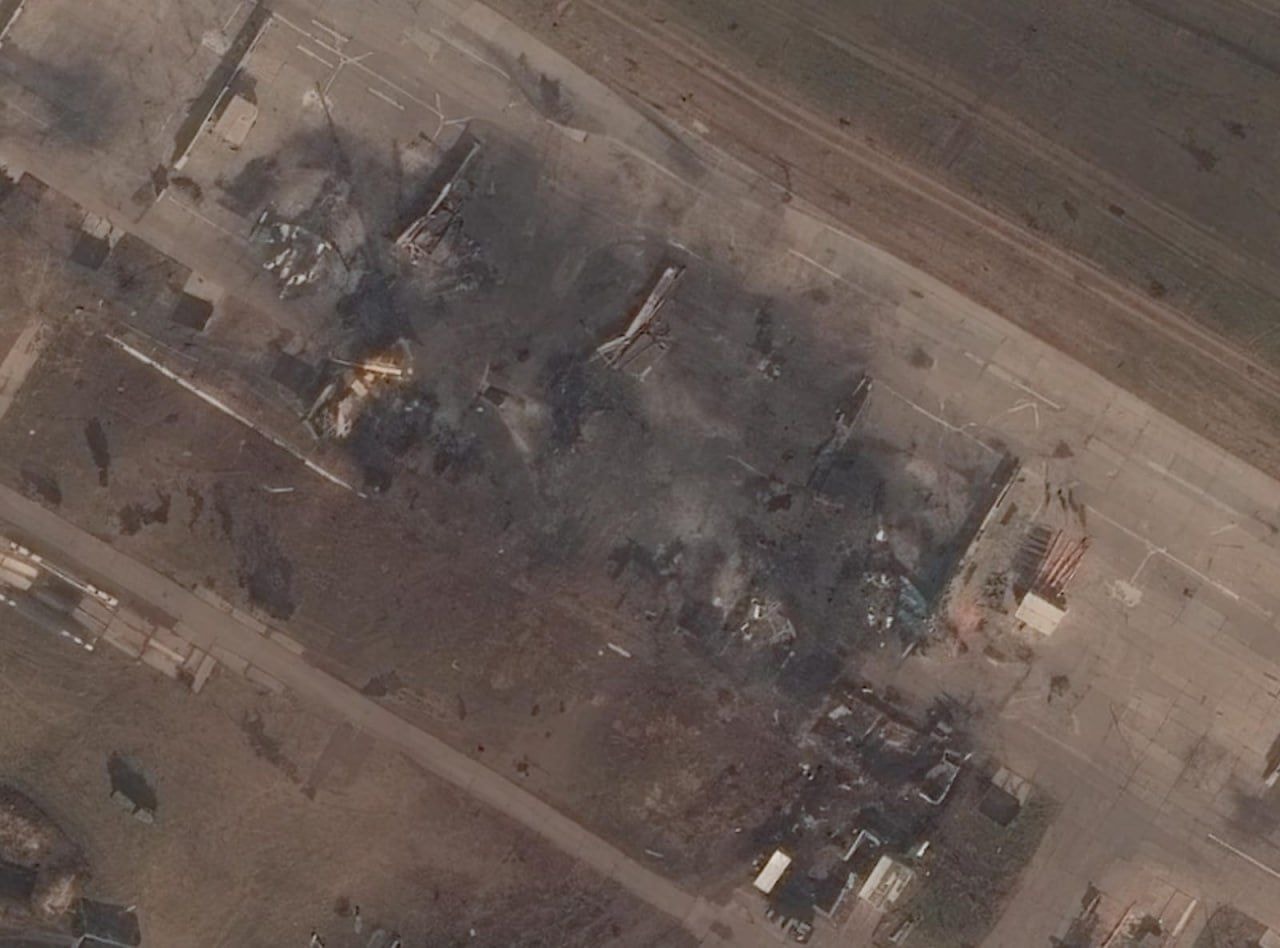
Satellite imagery reveals that Russia is constructing barracks, warehouses, and bases from the border with Norway's Arctic region of Finnmark to Karelia at the Finnish border.
Additional equipment is reportedly being amassed along Russia's roughly 2,640-kilometer (1,640-mile) borders with NATO, including in the Kaliningrad exclave.
Finland — which accounts for the largest share of this border — expects the number of Russian troops in its neighborhood to rise from 20,000 to 80,000 as a result of this buildup.
A rumored next wave of mobilization would certainly be a political challenge for the regime, but, as Pesu says, also a "worrying scenario" for NATO.
On the military-industrial front, Russia has ramped up artillery munitions production 17 times since 2021, making 7 million rounds last year, according to Estonian intelligence.
Kyiv also warns that Russia plans to produce 7.3 million first-person-view (FPV) drones in 2026, a massive jump from the estimated 180,000 in 2023.
And while Moscow's tank fleet was badly battered in the war, there are already plans for massive buildups in the coming years.
The question remains — how fast could Moscow deploy these capabilities against Europe once a ceasefire is concluded?
When could Russia attack?
Experts and officials who spoke to the Kyiv Independent say Russia has the means to launch a low-intensity operation to test NATO at any moment — if there is political will in the Kremlin.
Latvian intelligence has even reported signals that Russia may be preparing such provocations against the Baltics or Poland.
However, a European intelligence source told the Kyiv Independent that Moscow does not seem currently intent on attacking NATO.

Yet, the source acknowledged that "Russia's behavior is susceptible to miscalculations," noting that "starting the full-scale war in Ukraine was a major miscalculation that they are still dealing with."
A full-scale invasion to seize a whole NATO country is another matter than a low-scale provocation, however.
Tomas Jermalavicius, a security expert at the International Center for Defense and Security (ICDS) in Tallinn, estimates Russia will be able to pose a "severe full-scale threat to NATO's eastern and northeastern front-lines between two and five years from the moment the ceasefire is achieved."
German army chief, Christian Freuding, in turn, said it is "NATO-agreed intelligence" that Moscow will be prepared to invade a member state as early as 2029.
Even when hostilities in Ukraine end, Moscow will likely need to pause and rebuild its strength. According to Pesu, Russia will not emerge from the war as a stable country and will have to grapple with a weakened economy.
Wartime spending and inflation have pushed its economy to the brink, with Ukraine's drone campaign against Russian oil refineries only increasing the strain on industrial output and budget revenues.
But experts worry that easing sanctions in the event of a ceasefire could speed up Russia's recovery — and therefore its ability to recuperate militarily.
A Chatham House report warns that Western leaders may even cut security aid to Ukraine once hostilities end, believing "that the challenge to their defense and security has been resolved."
The shape of a ceasefire in Ukraine will also be decisive for the outlook of Russia's attack on NATO.

Should Ukraine retain a large and well-equipped military, its strongholds, and steady Western support, Moscow's freedom of action would be limited.
In other words, "even if there is some type of ceasefire," Russia would still need "to maintain considerable military potential in Ukraine, against Ukraine," Kaupo Rosin, head of Estonian intelligence, told the Kyiv Independent.
"The eventual outcome of the war of aggression and Ukraine's fate are central," Pesu adds.
"From NATO's perspective, Ukraine should remain as capable as possible, which the Russians then should also take into account in their defense planning."
How ready is Europe?
The good news for NATO is that some European governments are finally opening the taps for defense investments.
The EU's defense spending has increased by 75% between 2021 and 2025, though the growth has varied across countries.
While the EU struggled to deliver 1 million rounds to Ukraine in 2023 due to capacity constraints, it can now produce around twice that number.
And it is front-line states like the Nordics, the Baltics, and Poland that are leading the way, not only in defense spending but also in expanding their forces.
All three Baltic countries and most Nordic states maintain some form of conscription, albeit within the limits of relatively small populations.
Poland, in turn, is focused on expanding its professional military and voluntary reserves.
NATO has also been strengthening its footprint in the northeast.
The alliance has been scaling up battalion-sized battlegroups to brigades, Germany is deploying a permanently stationed brigade in Lithuania, and NATO is building new bases and command posts in its newest members — Sweden and Finland.
And while there are still gaps — from air defense to personnel and command and control — "these are being addressed with considerable investments," Pesu says.
The challenge, however, "is generating mass at scale, especially in the areas where cost efficiency so far favors the enemy," such as drones and anti-drone systems, Jermalavicius warns.
While Ukraine and Russia churn out millions of drones every year, the European defense industry plans to scale production to only 100,000 drones and drone defense systems by 2027.
Unmanned systems have become ubiquitous on Ukrainian battlefields, inflicting the majority of casualties, destroying warehouses, and cutting supply lines.
If Russia applied lessons learned from Ukraine against NATO, "we would be in much more trouble than we would like to admit," Jermalavicius says.
Moscow could replicate the Ukrainian naval drone campaign that ravaged Russia's Black Sea Fleet against NATO's Baltic surface vessels and lines of communications.

Similarly, Ukraine's drone campaign to isolate Crimea could be replicated by Russia against ground lines of communications running through the Suwalki Gap between Poland and the Baltic states, the expert says.
To neutralize this threat, the expert argues, NATO would have to quickly escalate and, for example, destroy Russian capabilities in Kaliningrad.
But therein lies another weakness — the political will to pull the trigger.
"We can hold the proverbial fort, at least for a while, but we need allied solidarity, support, and involvement to deter further escalation beyond the threshold and into the realm of a full-scale war," Jermalavicius said.
The U.S. aims to shed most of Europe's defense burden by 2027, several major European economies still struggle to ramp up defense spending, and a wave of far-right and far-left forces threatens to further destabilize Europe's unity.
Russia does not have the strength to face off against a full force of NATO.
The concern is that it might not have to.
read also
Note from the author:
Hi, this is Martin Fornusek.
I hope you enjoyed this article. In our team, we believe fact-based and truthful reporting should be available to all — that's why we don't use any paywall.
If you want to see more in-depth coverage of regional politics and how it shapes Ukraine's struggle against Russian aggression, please consider joining the Kyiv Independent community.