Europe's far right has a Putin problem
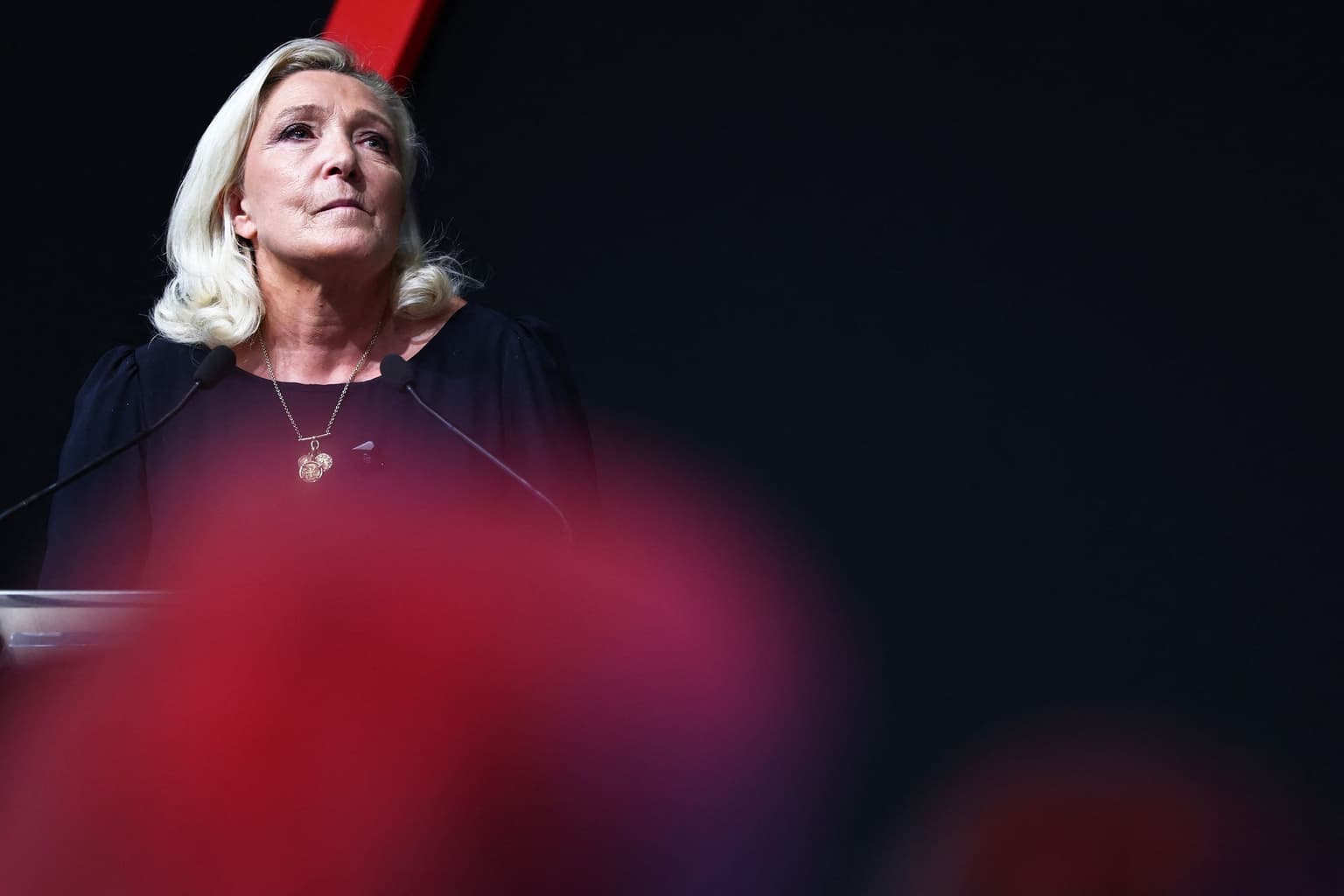
Rassemblement National (RN) candidate Marine Le Pen in Paris, France, on Sept. 28, 2026. (Anne-Christine Poujoulat / AFP via Getty Images)
 on Google
Europe's far-right parties grow increasingly divided on something that once united them — sympathies for Vladimir Putin's Russia.
As nationalists and right-wing populists across Western Europe move closer to power, many are seeking to distance themselves from their past admiration for a country waging Europe's largest war since 1945 while conducting hybrid attacks against much of the continent.
Despite finding common ground on dislike of liberalism, NATO, and the EU, Europe's far right is being forced to rethink its relationship with Moscow — much like it had to do with U.S. President Donald Trump.
France's National Rally (RN) and the U.K.'s Nigel Farage now harden rhetoric on Russia while signaling a more conditional, rather than simply hostile, approach to Ukraine, as part of a strategy to cast a wider net of voters.
But the Alternative for Germany (AfD), which has emerged as Europe's largest and most extreme nationalist party, is moving in the opposite direction.
The split comes at a critical moment. The National Rally's Marine Le Pen is a frontrunner for the French presidential election next April, the AfD is leading the German polls, and Farage's Reform party was, until very recently, a favorite to win the next elections in Britain.

Experts who spoke to the Kyiv Independent explain the reasons behind this divide and what the coming string of European elections could mean for Ukraine.
Farage, Le Pen seek Russia detox
For years, far-right leaders have been ranked among the most Moscow-friendly voices in European politics.
In 2014, Farage, the man who later led a campaign to push the U.K. out of the EU and whose Reform party now polls second at 22%, expressed his admiration for Putin as an "operator."
As recently as 2024, while Russia’s full-scale invasion had already been raging for two years, he suggested that the eastward expansion of the EU and NATO provoked the war.
Comments like these have made it easy for his opponents to blast him as a Putin fan.
Now, Farage seems intent on proving he is no such thing.
"Russia in general and Putin in particular are extremely unpopular with Brits, so why would they want to convey the impression that they have any sympathy with them?"
Last year, the Reform leader called the Russian dictator a "very bad dude" and said NATO should shoot down Russian jets intruding into its airspace.
On Ukraine, he has cautiously affirmed support for Ukraine — even backing the idea of using frozen Russian assets for Kyiv's benefit.
And while he criticized plans for a post-war "reassurance" force in Ukraine as outlined by the Labor government, Farage backed sending British troops to the country, if on a temporary basis and as part of a U.N. peacekeeping mission.
Reports have emerged that Farage is even considering a trip to Ukraine as part of his quest to brush off his Russia-friendly image.
A similar shift is taking place across the English Channel.
Prior to 2022, Le Pen said that the Russian occupation of Crimea was not illegal, and her party took out a loan from a Russian bank.

But after Moscow launched its full-scale invasion of Ukraine, she backpedaled.
Now, the three-time failed presidential candidate sees she has a real chance to win, with a court clearing a path to her candidacy despite last year's embezzlement conviction.
As the vote nears, she is treading cautiously on foreign policy.
Le Pen has condemned Russian aggression and has backed continued military assistance to Ukraine, even as she wants Paris to cut financial aid — citing France's own budget constraints — opposes Kyiv's EU membership, and is skeptical about future EU aid if it burdens France.
She also said she would be happy to visit Ukraine for talks with President Volodymyr Zelensky.
The RN's younger co-leader, Jordan Bardella, has taken a tougher stance on Russia, naming the country a threat — something that Le Pen avoided in a recent interview with the Financial Times.
Both party chiefs also blasted Moscow in September over its seizure of European business assets in the country and denounced Russian interference and destabilization efforts.

Elsewhere in Europe, far-right parties have proved they can tone down their views on Russia and Ukraine in exchange for government seats.
Matteo Salvini, head of Italy's League party, remembered for once sporting a T-shirt with Putin's likeness, has largely fallen in line behind Italian Prime Minister Giorgia Meloni's firmly pro-Western, pro-Ukraine course, save for some symbolic resistance.
And the former Dutch government also maintained its support for Kyiv, even though Geert Wilders's far-right Party for Freedom (PVV) was the strongest party in a short-lived coalition.
Czech Prime Minister Andrej Babis, a right-wing populist, while expressing his disdain for EU plans to earmark billions of euros of support for Ukraine, echoed Zelensky's take on a set of recent pro-Russian moves made by the U.S.
"Trump effectively betrayed us by concluding the business deal with Putin, and we have to do something," Babis said on Oct. 16.
Elsewhere, the far right doubles down
This shift is far from uniform, however.
As Meloni, Italy's right-wing, anti-immigration prime minister, prepares for the 2027 elections, she faces a new pro-Kremlin challenger.
Roberto Vannacci, a retired army general, left the League in February to found his own nationalist party, National Future.

Vannacci, a former military attaché in Moscow, has famously said he prefers Putin over Zelensky.
With support reaching as high as 8% in recent polls, National Future has already surpassed Meloni's junior coalition partners.
But the most striking example is the AfD, currently the strongest opposition party in Germany, nearing 30% in polls.
The AfD was seen as so extreme that the far-right European Parliament group expelled it at the RN's urging in 2024, prompting the AfD to form a new ultranationalist coalition, Europe of Sovereign Nations (ESN).
The party campaigns on a halt to military and financial aid to Ukraine, the lifting of sanctions against Russia, and the resumption of Russian energy purchases.
Given the AfD's particular brand of extremism and Berlin's role as the leading military donor to Ukraine, this is an especially worrying signal for Kyiv and Europe.
Like in the U.K., the next German parliamentary elections are expected no later than 2029.
Why the difference
With Russia's full-scale war nearing its fifth anniversary, many countries have seen the public's support for Ukraine cool — but not collapse.
Politicians vying for victory in upcoming elections have to take this into account, with the U.K. being a prime example.
Farage's party certainly has a reputation to fix, after its former leader in Wales, Nathan Gill, was sentenced to prison for taking bribes from pro-Russian Ukrainian politicians.

"Russia in general and Putin in particular are extremely unpopular with Brits, so why would they want to convey the impression that they have any sympathy with them?" Tim Bale, a professor of politics at Queen Mary University of London, comments on Reform's strategy.
A poll from last fall shows that 59% of Brits support continued assistance to Ukraine, and slightly over half back sanctions even at the cost of paying more for energy and food.
The support is somewhat cooler in France, where 47% favor continued arms deliveries to Ukraine, down from 65% in 2022.
Yet this is not an insignificant number, and the majority of French people — including a little over half of RN voters — see Russia as an enemy, according to polls.
Anton Shekhovtsov, a visiting senior fellow at Central European University in Vienna, notes that Le Pen likely remembers well the "reputational nightmare" her Russian loan has caused.
"Everybody just pointed to that loan and said, 'you're all Russian Trojan horses in France,'" Shekhovtsov said in comments for the Kyiv Independent.
Now, Le Pen likely sees an example in Meloni — a politician who emerged from a similar far-right background but maintained a pro-Western course, the expert notes. Meloni's government has been Italy's longest-serving since World War II.

But the AfD has doubled down on its pro-Russian course, despite the majority of Germans continuing to support Ukraine. It does not seem to be hindering its rise.
Jakub Wondreys, a researcher at the Hannah Arendt Institute for the Research on Totalitarianism in Dresden, offers an explanation.
"The key factor is the party's internal division, which we don't see elsewhere. It is specific to German politics, and to the AfD itself," Wondreys tells the Kyiv Independent.
While all parties have different wings, the AfD is notably decentralized, with the former border between West and East Germany surviving as a key divide.
The AfD's extremist, more Moscow-friendly wing is rooted in East Germany, a former Soviet satellite state. The "moderates" are stronger in the west, the researcher explains.
The AfD is growing nationwide, but the east remains its main stronghold — as evidenced by its recent victories in regional elections there. This means that the more extreme wing of the party is also its loudest and most influential one.
This split was laid bare when the AfD's two leaders, Alice Weidel and Tino Chrupalla, disagreed over a trip by a group of their colleagues to Sochi last November.

Weidel, who hails from what was West Germany, criticized the visit, while Chrupalla, himself born in socialist East Germany, downplayed it, adding that he does not consider Russia a threat.
Recent polls show that 54% of Germans from what was East Germany think aid to Ukraine has gone too far, compared to 39% in the west. Eastern Germans are also less likely to see Russia as a threat.
Yet even an RN or Reform victory would not bode well for Ukraine, regardless of their change of rhetoric, experts warn.
As Bale points out, no matter its public posturing, a Reform government "might try to spend less money on defense aid behind everyone's back."
Just on Oct. 12, Farage pledged to take a "keen look" at whether British aid to Ukraine is being swallowed up by corruption there and signaled that London's support cannot be limitless.
The RN's victory might not end military support for Ukraine, but it will likely curtail the financial assistance and weaken the European sanctions push against Moscow.
And Shekhovtsov warns that even if Le Pen does not adopt overtly pro-Russian positions after the elections, her victory could be such an upset for France and Europe that it might shift political attention away from supporting Ukraine.
The coming election season has the potential to shake the European pro-Ukraine coalition to its core.
read also
Note from the author:
Hi, this is Martin Fornusek.
I hope you enjoyed this article. In our team, we believe fact-based reporting should be available to all – that's why we don't use any paywall.
If you'd like to help us provide you with more in-depth coverage of Ukraine's struggle against Russian aggression, European politics, and other topics, please consider joining the Kyiv Independent community.