The way out of Ukraine's deadlock with Magyar
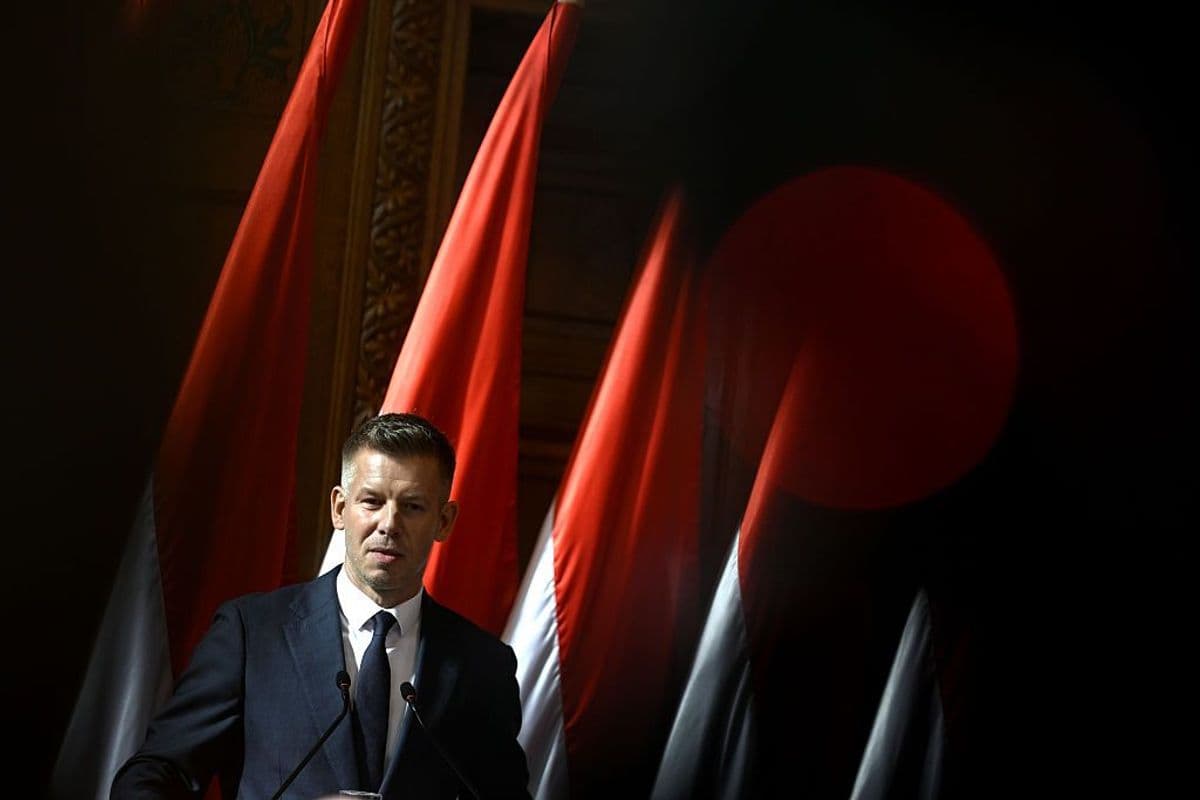
Peter Magyar, prime minister of Hungary, holds an extraordinary press conference in the Hungarian Parliament building in Budapest, Hungary, on June 22, 2026. (Balint Szentgallay/NurPhoto via Getty Images)
 on Google
Ukrainian officials had looked for a reset with Budapest after Viktor Orban's defeat. Instead, Hungary's new prime minister, Peter Magyar, has taken a hard line of his own.
After a promising start, Budapest is yet again stalling Kyiv's EU bid until Ukraine puts into effect earlier agreements on the rights of its roughly 80,000-strong Hungarian community.
As the standoff has dragged on, Magyar has raised the stakes: he skipped the Ukraine-hosted Carpathian summit, traded barbs with Ukrainian officials online, and flatly rejected a deal to deepen cross-border energy cooperation.
Yet there are fundamental differences between Hungary's current leader and his pro-Kremlin predecessor.
While Orban had held Ukraine and its Hungarian community hostage for his own political gains, Magyar may actually want to see the matter through — while using whatever leverage available to him, experts believe.
A new draft law on national minority education rights, drafted by the Ukrainian government on the basis of a June deal with Hungary, could clear the path forward. It may reach parliament as early as October.
But ultimately, both sides will have to rethink their diplomatic strategies and put in real work to move past the "ghost of Orban," says Sergiy Solodkyy, director of the New Europe Center think tank in Kyiv.
From deal to deadlock
Magyar has made no secret that any reset of ties with Ukraine is conditional.
Weeks after his election victory, Hungary's new leader called upon Kyiv to address what he called discrimination against its Hungarian ethnic minority, living chiefly in the westernmost Zakarpattia Oblast.
But the initial contacts between Magyar's government and Ukraine were constructive, especially compared with Orban's openly hostile attitude.
After a series of expert-level talks in May, Magyar announced on June 3 that a deal aimed at strengthening the linguistic, educational, and cultural rights of the Hungarian minority had been reached.

Kyiv could celebrate — Budapest lifted the Orban-imposed veto on Ukraine's accession, allowing the launch of the first two accession clusters over the summer.
But then talks hit the wall yet again. Hungary renewed its blockade, demanding that Kyiv take further steps to implement the June agreement before allowing the opening of additional clusters.
Officials in Kyiv then also grew increasingly exasperated with what seemed to be Magyar's avoidance of a summit with Zelensky — even though he himself proposed holding it as early as June.
Responding to the Kyiv Independent, President Volodymyr Zelensky explained at the Carpathian Eight Summit on Sept. 18 that Budapest wants Ukraine to adopt a relevant law based on the June agreement before unblocking the EU talks.
"I don't see a real big problem with this between us," Zelensky added at the Ukraine-organized event snubbed by most higher-ranking Hungarian officials.
Days later, Magyar showed Zelensky just how mistaken he was.
The Hungarian prime minister denied that his country was participating in the Carpathian Eight, contradicting Zelensky. He did not detail the motivation for snubbing the event.
Magyar also categorically ruled out the construction of Ukrainian oil storage facilities on Hungarian territory, despite Ukraine's Naftogaz and the Hungarian Mol signing a memorandum on that very project at the Carpathian summit.
Kyiv was left blindsided.
Same tune, different goals
"We are surprised by the Hungarian prime minister's unnecessarily confrontational statements toward Ukraine," Foreign Minister Andrii Sybiha said on X.
Ukraine's chief diplomat voiced confusion over Budapest's rejection of the Carpathian initiative and drew comparisons to the Orban-era "obstructionism and isolationism."
Magyar responded under the post by scolding Kyiv for making claims about Hungary's participation without prior consultations — illustrating his point with a metaphor about village football.
Sybiha was not the only one to see parallels with Hungary's former leader.
Ukrainian lawmaker and head of the parliament's foreign affairs committee Oleksandr Merezhko told the Kyiv Independent that "Magyar remains a hostage to the anti-Ukrainian propaganda unleashed by Orban, which remains rather deep-rooted in Hungarian society."
For years, Orban's media empire has painted Ukraine as a threat to Hungary's security and prosperity. This has left its mark on Hungarian society, even beyond Orban's electorate.

An April poll showed that most people who voted for Magyar — himself a renegade from Orban's Fidesz party — oppose sending aid to Ukraine, and that fewer than half supported restarting Kyiv's EU accession talks.
Merezhko also noted that the Ukrainian parliament on Sept. 3 passed a resolution aimed at improving ties — specifically, one condemning Soviet repressions against Zakarpattia's Hungarians between 1944 and 1946.
While Hungary welcomed the move, Merezhko said he doesn't see an effort by Budapest "to meet us halfway."
Solodkyy acknowledges that Magyar has been a disappointment for many in Ukraine, adding that the "anticipated reset has not materialized."
According to Daniel Hegedüs, deputy director at the Institute for European Politics (IEP), the crux of the problem lies in Hungary's viewing of Ukraine solely through the lens of domestic politics.
The Magyar government can't conceive of Hungary's interests in Ukraine outside the scope of the Hungarian minority, Hegedüs says, pointing to its rejection of the "win-win" oil storage and regional summit proposals.
This is "obviously a very narrow-minded approach to Hungarian interests," the expert told the Kyiv Independent.
Nevertheless, many observers push back against comparisons between Magyar and Orban.
Zsuzsanna Vegh, an expert in Central European politics at the German Marshall Fund of the United States, calls it "simplistic."
Orban saw Kyiv merely through the prism of his relationship with the Kremlin or as a tool for boosting domestic support, not as a sovereign partner, she argues in comments for the Kyiv Independent.
In contrast, the incumbent Hungarian prime minister engages Kyiv as a counterpart — albeit still on transactional grounds.
Vegh agrees that concerns about Ukraine-skeptical attitudes among Hungarian voters might guide Magyar's rejection of military support.
However, the Hungarian minority rights are a separate matter, she notes.
Much like Orban, Magyar, coming from a similar ideological background, has made bolstering ties with Hungarian communities abroad a central part of his platform.
Where Orban was never interested in putting the minority dispute to rest and easing tensions, Magyar seems genuinely intent on a settlement — hoping to score a win that his predecessor promised but did not achieve, Vegh concludes.
Under Orban, the minority dispute was in a deadlock, with no resolution in sight.
Now, there has been tangible progress, and Budapest has even set out a timetable for Ukraine to implement the June agreement — education changes should be in place by the end of the year, and the rest by 2027.
And while during clashes with Orban, Kyiv had at least tacit backing of the EU, Brussels now seems to be of a similar mind as Budapest.

"Ukraine's progress towards EU membership also requires further steps on the protection of persons belonging to national minorities and their education rights, in line with European standards and practice," reads a Sept. 14 letter sent by the European Commission to the Ukrainian parliament, seen by the Kyiv Independent.
But some still worry that Magyar's gloves-off diplomatic style may have consequences, regardless of the intent behind it.
"Undiplomatic statements and public confrontations can acquire their own momentum and make future compromise more difficult," Solodkyy notes.
Path forward
The key to moving forward appears to be the draft bill on Ukraine's national minorities, which has yet to be brought to the parliament floor.
And the Ukrainian parliament has increasingly faced scrutiny for delays in passing legislation crucial for Kyiv's EU accession and disbursement of foreign aid.
Adding to the uncertainty is the ongoing weeks-long break in the parliament's plenary sessions — even though committees continue to work.
Nevertheless, some lawmakers are optimistic that the draft law, overseen by Ukraine's Deputy Prime Minister for European Integration Vsevolod Chentsov and reviewed by the EU and Hungary, can be put to a vote in the coming weeks.
Mykyta Poturaiev, a lawmaker for Zelensky's Servant of the People party, explained that the draft law must first be reviewed by the Education Committee and then by the Humanitarian and Information Policy Committee — the one he himself chairs.
He confirmed that the bill focuses specifically on national minority education issues and concerns all of Ukraine's national minorities — not just the Hungarian community.
In contrast to the public sparring between top officials, Poturaiev praised the dialogue with the Hungarian side.
"It's a normal process. We hear the Hungarian side, and they hear us," Poturaiev told the Kyiv Independent, adding that Ukraine is in touch with representatives of other national communities as well.
"Everything will move fast. We are ready to bring the bill to the floor as early as Oct. 12."
Budapest appears content with this timeline, as Hungary's Foreign Minister Anita Orban confirmed that she expects the law to be introduced in the Ukrainian parliament in October.
A quick passage through parliament would give Kyiv a solid chance to stick to its plan: open two more clusters in October and the remaining two by the end of the year.
There are other signals that a thaw is possible.
Anita Orban said her meeting with Sybiha on the sidelines of the U.N. General Assembly earlier this month helped resolve "misunderstandings" regarding the Carpathian Eight Summit.
She did not rule out Hungary joining the format in the future.
Parliament Speaker Ruslan Stefanchuk's recent announcement that he received an invitation from his Hungarian counterpart, Agnes Forsthoffer, also offers reasons for optimism — especially since only a few weeks ago, Forsthoffer reportedly turned down Stefanchuk's earlier offer to meet.
According to Hegedüs, the passage of the national minorities bill could provide an "opening" to put Ukraine-Hungary relations back on track.
But more work is needed: not only the long-delayed Magyar-Zelensky summit, but also an effort by Hungarian civil society to change public perception toward Ukraine — a cause that currently does not have a champion in Hungary, the expert adds.
Solodkyy stresses that responsibility rests on both sides.
Ukraine, he says, must also be more cautious in diplomatic communication, particularly on topics sensitive to Hungary — especially as stable ties with Budapest remain a key to Ukraine's EU bid.
"Regardless of which side feels offended or believes itself to be right in a particular dispute, both will need to demonstrate strategic restraint," Solodkyy says.
"The continued deterioration of Ukrainian-Hungarian relations benefits only one country — Russia."
Note from the author:
Hi, this is Martin Fornusek.
I hope you enjoyed this article. In our team, we believe fact-based and truthful reporting should be available to all – that's why we don't use any paywall.
If you'd like to help us provide you with more in-depth coverage of Ukraine's struggle against Russian aggression, European politics, and other topics, please consider joining the Kyiv Independent community.