What really happened during the clash at a National Guard facility near Kyiv?
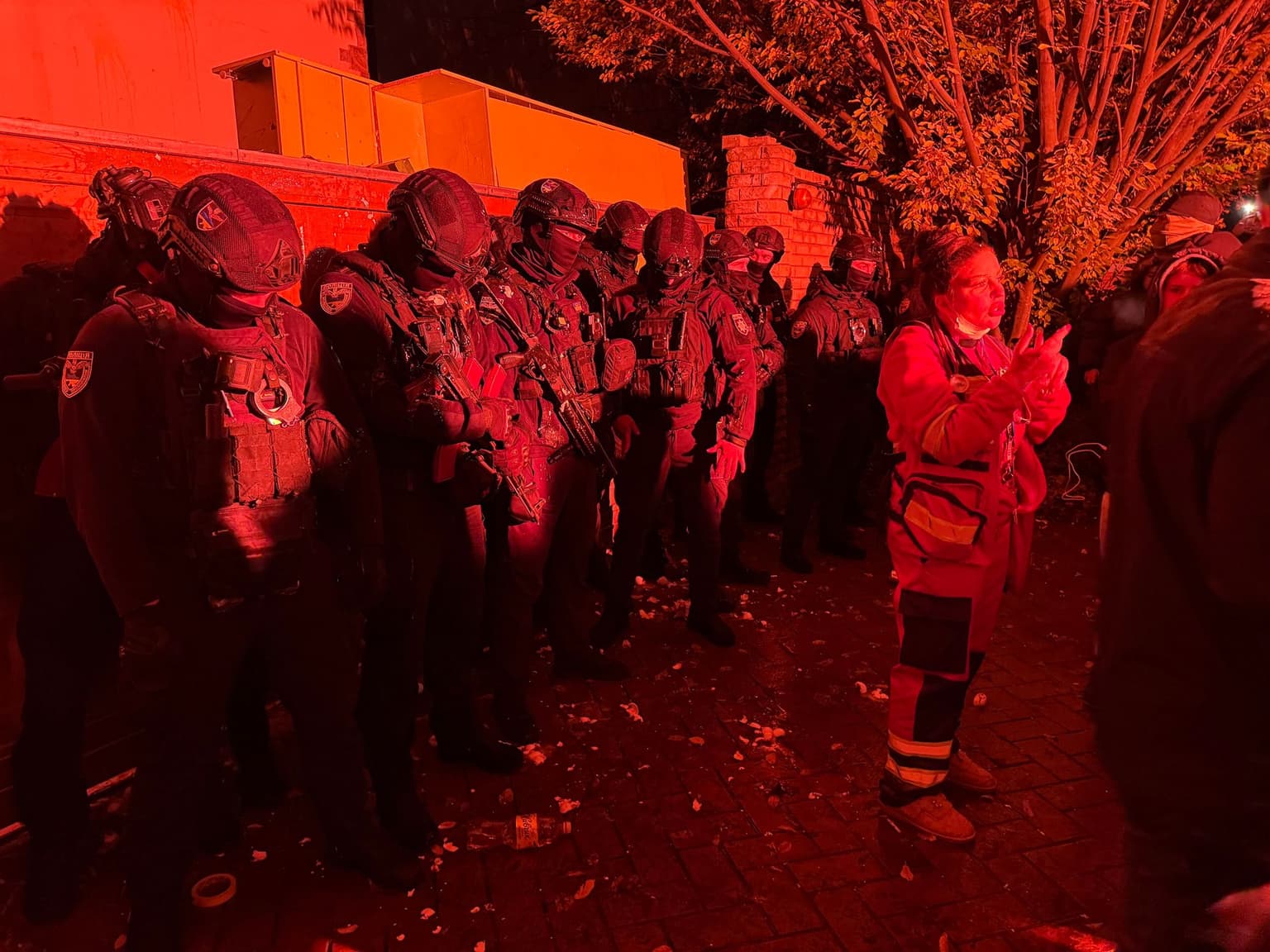
National Guard troops block protesters from entering a house where detained conscripts were being held in Petropavlivska Borshchahivka, Kyiv Oblast, Ukraine, on Nov. 2, 2026. The woman in the photo appears to be Valentyna Moloda, the individual who initially spread the information that sparked the protests. (Francis Farrell/The Kyiv Independent)
 on Google
KYIV OBLAST — A clash between an angry mob and Ukraine's National Guard and law enforcement on a sleepy street in the Petropavlivska Borshchahivka suburb of Kyiv on Nov. 2 has fueled the information war around Ukraine's mobilization.
The incident, involving roughly 200 people attacking law enforcement officers, military personnel and vehicles, prompted a response that included tear gas and warning shots fired into the air.
The arrival of President’s Office Head Kyrylo Budanov further underscored the gravity of the situation. The Kyiv Independent was present at the site of the clash.
The episode has since escalated into one of the most visible outbreaks of internal unrest in Ukraine since Russia launched its full-scale war.
During the incident and in its immediate aftermath, verifiable facts about what happened on the western outskirts of Kyiv remained few and far between.
Early reports pointed to alleged illegal detention and abuse of mobilized Ukrainian men by a National Guard unit as the source of anger — seemingly a symptom of well-known issues in the state's handling of the sensitive challenge that is forced mobilization.
But as more details emerged about the series of events and the key people involved in triggering the violence, suspicion has since grown that the clash was a product, at least in part, of a planned provocation and information operation working in Russia's interest.
Budanov, however, cautioned against dismissing the incident as merely an act of provocation, arguing that it had exposed deeper societal tensions and longstanding unresolved issues.
The standoff
According to the earliest news reports, the police were called by a supposed private ambulance crew which had attempted to enter the building, an unmarked suburban house.
The National Guard used the house, surrounded by a brick wall, in Petropavlivska Borshchahivka as a transition point to hold mobilized men between the time when they are taken in by draft officers and undergo their medical examination, and the time when they are taken to basic training.

Four of the men held in the building had been caught after leaving their post or unit without permission, and were later taken to hospital with injuries, according to the 1st Azov Corps of the National Guard.
About an hour and a half after first reports of clashes in the suburb emerged, a crowd had gathered outside the house, yelling at the police and National Guard manning the entrances.
The group was mostly made up of younger men, alongside a few women and teenagers, all demanding that the remaining men held inside be let out.
At the epicenter of the clash were two workers of the supposed private ambulance, seemingly attempting to negotiate with the National Guard to enter the building, while also addressing the crowd.
The supposed female paramedic, who introduced herself to the media as Valentyna Moloda, was actually a full-time cosmetologist, according to information uncovered by independent Ukrainian media Slidtsvo.info

The private company she claimed to represent, Med-Prestyzh, had stopped working in 2023, its owner, Mykhailo Furman, told Slidtsvo.info. The ambulance marked with the company's logo had been sold in 2024.
As time passed in front of the building, tensions continued to escalate despite attempts at dialogue.
While Moloda spoke to journalists describing serious injuries, including spinal fractures, that the men inside the building supposedly suffered, others alleged that 35 to 40 men were kept in the facility.
People inside the crowd lit flares, and threw eggs and water bottles at law enforcement personnel and National Guard soldiers. Some of the men in the mob went further, striking and pulling at the police and National Guard soldiers, who remained in tight formation and did not respond.
To the left of the building's main gate, a teenage boy with shoulder-length blonde hair climbed a tree, from where he started filming the yard and yelling insults at the soldiers inside.
Soon, the boy began throwing bricks, one after another, handed to him by members of the crowd. Eventually, he was seen falling off the fence into the yard.
Further down, a dozen or so young men began breaking down part of the brick wall around the building. After a few minutes of coordinated pushing, the top of the wall buckled, prompting National Guard soldiers inside the yard to respond with tear gas and firing shots into the air.
At the main entrance, meanwhile, the gates opened, and seventeen men — on their feet and carrying personal belongings — exited the yard and got onto an awaiting National Guard bus.
How did the government respond?
As events unfolded, the 1st Azov Corps of the National Guard issued a statement, confirming that the building belonged to unit number 3121, which is part of the corps' structure.
"The National Guard command, in cooperation with law enforcement agencies, has taken control of the investigation of the situation," the corps said. "If the fact of illegal violent actions on the territory of the military facility is established, the perpetrators will be justly punished."
The 1st Corps also confirmed earlier comments by National Guard Head Oleksandr Pivnenko — who had arrived at the scene early in the clashes — that the building was housing both mobilized men and those caught after leaving their post or unit without permission.
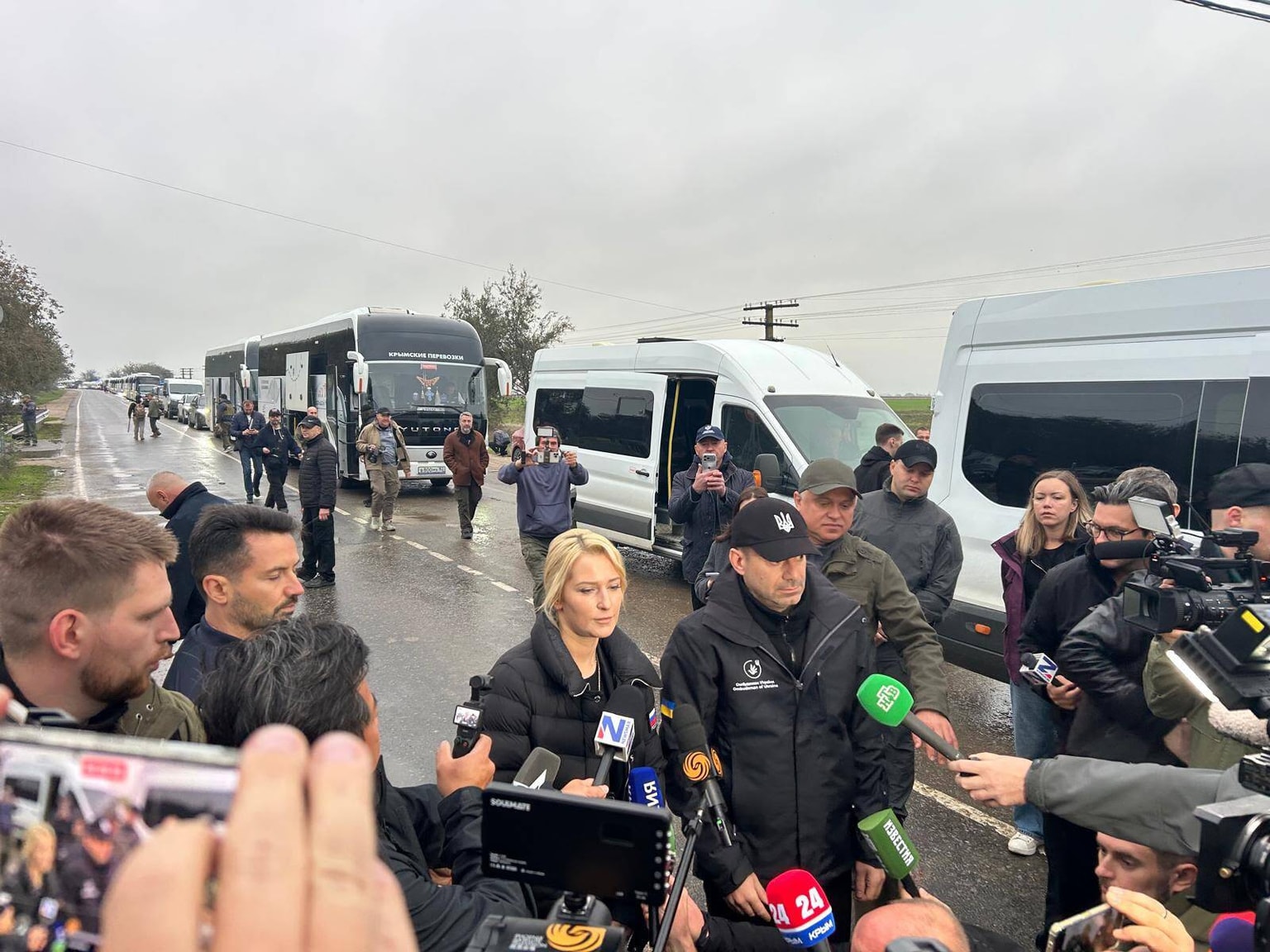
Around 10 p.m., President’s Office Head Budanov arrived at the scene, placing himself in the middle of the crowd.
"I came here to figure out what the hell is going on," Budanov said.
"This is something that simply shouldn't be happening, and it’s not right," he added, referring to the attacks on soldiers and law enforcement, as well as the blocking of the bus with the men inside.
"It is already known for certain that yesterday's events on Petropavlivska Borshchahivka did not take place without influence."

As more evidence emerged that Moloda was not the paramedic she claimed to be, the idea that the clash was an engineered provocation designed to undermine Ukrainians' trust in the state and military began to take hold.
In comments on the following morning, Budanov adopted a firmer tone.
"It is already known for certain that yesterday's events on Petropavlivska Borshchahivka did not take place without influence," he said.
"The specific individuals and initiators of these events will definitely be identified and punished, (and) conclusions will be drawn within the security forces."
Later in the day, authorities announced that Moloda had been arrested.
Is there evidence Russia was involved?
As of the afternoon of Nov. 3, there is no verified or official information detailing how Moscow or other pro-Russian forces may have engineered and stoked the clash outside the National Guard facility.
While the events in Petropavlivska Borshchahivka show signs of a Russian information operation, their escalation is built on real, simmering tensions in Ukrainian society around the topic of mobilization.
Ukraine's martial law provides for forced mobilization, meaning that people can also be taken and held against their will by draft officers, and that further restriction of the draftees' freedom to leave continues until and into basic training.

These early stages of the process have been reported to sometimes be the site of abuse and violence, most notably among units of the Assault Forces, which Ukrainian independent media have investigated over cases of personnel deaths on base.
Despite mobilization being at the core of Ukraine's ability to man the defense of its front line — and in turn stay in the fight against Russia — Ukraine's leadership, from President Volodymyr Zelensky to members of parliament, has consistently avoided carrying out necessary reforms to the process.
This has left a vacuum in which draft officers carry out their unpopular work in a manner they see fit, without a proper military justice system that can hold those responsible for abuse accountable.
Cases of individual and group violence against draft officers have increased in frequency over the last two years.

Some of them end with recruiters killed or seriously wounded, while others see more spontaneous involvement from bystanders, such as a major public attack on a conscription team in Lviv in July.
At the same time, societal tension over mobilization — exacerbated by grievances over corruption — has not moved Ukrainians closer to capitulation or acceptance of Russia's terms.
According to a poll released in late October 2026 by the Kyiv International Institute of Sociology, 63% of respondents said they were ready to endure the war as long as possible.
Information explosion
Regardless of the actual series of events that unfolded in Petropavlivska Borshchahivka, the story of the protest in defense of the allegedly illegally-held men quickly took on a life of its own.
On the ground, dozens of phones livestreaming the events to social media vastly outnumbered the journalists working in the area.
Almost immediately, photos and footage flooded the murky ecosystem of Ukrainian and Russian Telegram channels.

Many of Ukraine's most popular Telegram news channels are run by anonymous administrators. While some are run directly by pro-Russian figures or have links to Russia, these channels universally thrive on shocking news and imagery, providing a steady supply of fuel for the information fire.
Descriptions of mobilized men being unlawfully detained were twisted within hours into a narrative of "Zelensky's torture chambers" being stormed by supposed patriotic Ukrainians who have had enough of their countrymen being used as cannon fodder.
Images of the same teenage boy who had climbed the wall and thrown bricks, being led out of the yard, wrapped in a blanket and seemingly in a state of shock, went particularly viral.
Intentionally or not, these photos gave grounds to a new narrative, that even minors were being held and tortured in the National Guard facility.
By the next morning, public figures, including figures who regularly promote pro-Russian narratives and call for the end of Western support for Ukraine, shared this narrative across the Western information space.

Most notable among them was Alice Weidel, leader of the far-right Alternative for Deutschland (AfD) party, which continues to gather momentum in German polls.
"I expect the federal government to address this today in Berlin during the Zelensky visit," Weidel wrote, sharing pictures of the teenage boy.
Zelensky, who on Oct. 3 met German Chancellor Friedrich Merz in Berlin, has not yet commented on the clash publicly.
As investigations are launched, the extent of Russia's possible role in the information storm will likely become clear with time.
In the meantime, the incident might compel Ukraine's leadership to finally face the country's mobilization tensions and grapple with necessary reform.