Ukraine's unfinished fight to reform its law enforcement agencies
The latest corruption investigation has put renewed pressure on Kyiv to overhaul its police, prosecution and Security Service.
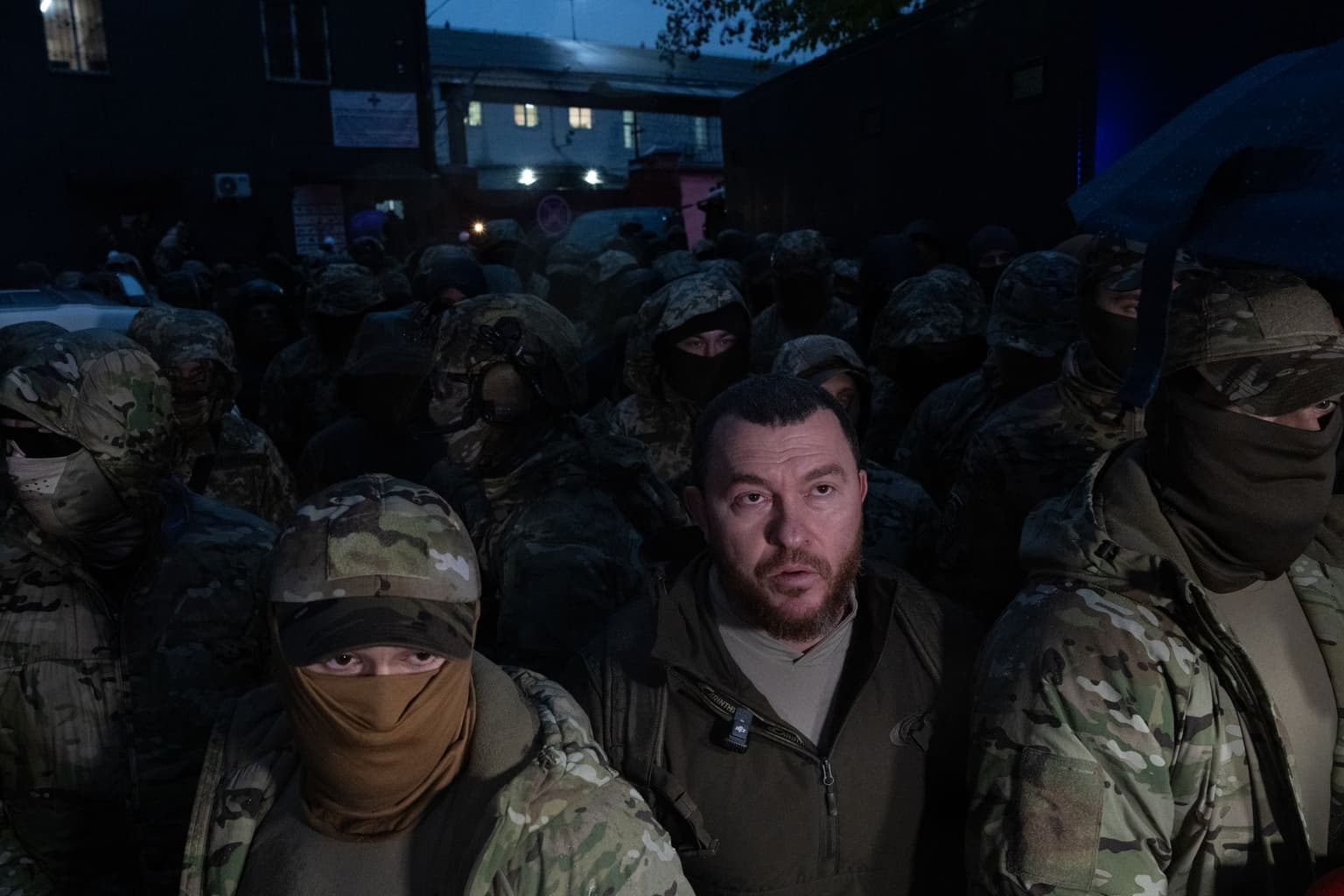
Serhiy Duka (C), former first deputy head of the SBU’s Department for the Protection of National Statehood, is seen near a pre-trial detention center after being released on bail on Nov. 13, 2026 in Kyiv, Ukraine. (Oleksandr Magula/Suspilne Ukraine/JSC "UA:PBC"/Global Images Ukraine via Getty Images)
 on Google
A sweeping investigation by Ukraine's anti-corruption agencies this year has exposed a long-standing problem within the country's law enforcement system and renewed calls for reform.
Officials within Ukraine's unreformed law enforcement agencies have allegedly worked in concert with organized crime groups, providing protection for illegal activities they were supposed to investigate.
In recent months, an investigation by the National Anti-Corruption Bureau (NABU), known as Operation Carthage, uncovered an alleged criminal network involved in protecting scam call centers, trafficking drugs, producing counterfeit currency, and using violence to intimidate critics and opponents.
The transnational drug trafficking network, known as Khimprom, was allegedly led by fugitives Andrii Osipov and Yehor Burkin, with extensive links to Russia.
According to investigators, the group also included senior officials from the Prosecutor General's Office, the Security Service of Ukraine (SBU), and the police.
The case highlights the failure of previous efforts to reform the police and prosecution service, while the Security Service remains largely unreformed, experts say.
"The Carthage operation has once again demonstrated just how urgent (law enforcement) reforms remain, even as the relevant bills are stalled in parliament or making little progress," Kateryna Ryzhenko, an expert at Transparency International Ukraine, told the Kyiv Independent.
"If the Carthage operation is not enough to spur lawmakers into action, what will it take to get them to address the reforms of the prosecution service, the SBU, and other law enforcement agencies?"
The Kyiv Independent has requested comments from the three agencies involved, the President's Office, the government, and parliament's law enforcement committee. Their responses will be published once received.
Unreformed prosecutors
The Prosecutor General's Office allegedly played a substantial role in the corruption scheme uncovered by the NABU.
In September, the Anti-Corruption Bureau charged Serhii Kropyva, a top prosecutor, as part of the investigation. Then Prosecutor General Ruslan Kravchenko was fired and fled Ukraine the same month amid speculation that he could face charges in the same corruption case.
"If the head of the Prosecutor General's Office flees at a time when he is likely to face charges over his personal involvement in corruption, then the Prosecutor General's Office itself is probably the institution most urgently in need of reform," Yaroslav Yurchyshyn, a lawmaker from the opposition Holos party, told the Kyiv Independent.
Following the pro-Western 2013-2014 EuroMaidan Revolution, there were attempts to reform the Prosecutor General's Office under prosecutor generals Viktor Shokin, Yuriy Lutsenko and Ruslan Riaboshapka. But ultimately all of them were unsuccessful, analysts say.
The latest one, under Riaboshapka, included the dismissal of 56% of prosecutors at the central office as part of vetting procedures in 2019-2020.
Vitaly Tytych, a lawyer and ex-head of the civic watchdog Public Integrity Council, and Viktor Gorbatuk, a former top investigator at the Prosecutor General's Office, criticized the reform at the time. They argued that it was not consistent and did not envisage a thorough investigation of prosecutors' backgrounds and professional qualities.
Moreover, at least hundreds of prosecutors fired during the vetting procedure have been reinstated by courts. They have been paid millions of hryvnias in compensation, and many keep receiving salaries despite not being appointed to any specific positions.
In 2025, the authorities went even further by eliminating prosecutors' procedural independence and competitive selection procedures for top prosecutorial jobs, which was seen as a blow to European legal standards.
Following Operation Carthage, the Ukrainian parliament on Nov. 11 passed a bill that seeks to reintroduce competitive selection procedures for top prosecutorial jobs, except for the prosecutor general.

However, anti-corruption activists and legal experts have lambasted the recent prosecution reform bill because it does not envisage the participation of any independent or international experts. Prosecutors will dominate all the bodies supposed to reform the prosecution service.
"Essentially, the authorities are now trying to repeat the sham reform carried out under Yuriy Lutsenko, when the prosecution service was left to reform itself," Yurchyshyn said. "As experience has shown, that approach leads nowhere. Unless independent experts are involved in the selection processes, the reform will be meaningless."
Another problem is that contests for top prosecutors' jobs will only be launched in a year, not immediately.
Moreover, the unreformed Council of Prosecutors, a self-regulatory body whose current members were appointed under Kravchenko, will have great influence over prosecutors' appointments, Oleksandr Banchuk, an expert at the Center of Policy and Legal Reform, told the Kyiv Independent.
Another crucial issue is the appointment of the prosecutor general.
According to Ukraine's interim benchmarks for EU accession, Kyiv "needs to depoliticize the position of the prosecutor general, including by making the selection and dismissal procedures more objective, transparent and merit-based, taking into account European standards."
In June, Anastasia Radina, head of parliament's anti-corruption committee, submitted a bill seeking to select the prosecutor general in a transparent contest with the participation of international experts.
The Ukrainian authorities have refused to consider the bill so far.
Radina's opponents argue that a contest for the prosecutor general's job contradicts Ukraine's constitution, while she denies the accusation.
Banchuk believes that, to require the president to pick a candidate chosen through a transparent contest, Ukraine would need to change the constitution, which is impossible in wartime.
However, there are still solutions for making the appointment of the prosecutor general transparent, and for depoliticizing it, he said. An advisory body screening candidates, including international experts, would not contradict the constitution, he argued.
Need for yet another police reform
Apart from prosecutors, the recent investigations alleged the involvement of top police officials in protecting scam call centers.
In November, the Anti-Corruption Bureau charged Volodymyr Tsenov, acting head of the National Police's strategic investigations department, and Oleksandr Demyanchuk, a top official at the Kyiv Oblast police, as part of the investigation.

Following the 2014 Euromaidan Revolution, Ukraine's police force has undergone multiple rounds of reform, some widely regarded as inadequate and others as merely cosmetic.
Georgian reformers were invited to Ukraine and appointed to senior police positions. In 2015, a new traffic police force was established independently of the traditional police structure.
The same year, a vetting process for the entire police force was launched.
However, in 2016, several civil society groups announced they were withdrawing from the vetting process because the Interior Ministry under Arsen Avakov had blocked the reform and sidelined independent commission members.
"The police vetting process failed," Olga Khudetska, a Ukrainian journalist who was a member of a police vetting commission, told the Kyiv Independent.
The Kyiv Independent has requested comment from Avakov.

Banchuk also argued that vetting procedures at various law enforcement agencies, including the police and prosecution service, had not yielded any major results.
Khudetska said that several of the controversial police officers identified by civil society in 2015-2016 during the vetting process kept their jobs and are now under investigation in the ongoing corruption probe.
"This means that none of this was stopped at the time, and that it eventually evolved into the criminal network uncovered by Operation Carthage," she said.
Khudetska said that "an untouchable elite remains at the top of these law enforcement agencies, and these people have no interest in making the agencies under their control transparent, accountable to the public, or law-abiding."
"The first priority, therefore, must be to change how law enforcement chiefs are appointed," she added. "There should be competitive selection procedures and safeguards against politically motivated dismissals."
Holos lawmaker Yaroslav Zheleznyak told the Kyiv Independent that he would soon submit to parliament a bill to introduce a transparent contest for the head of the National Police.
Polarizing Security Service
A number of officers from the Security Service (SBU) were also implicated in the recent scandal.
In November, the Anti-Corruption Bureau charged Serhiy Duka, a deputy head of the Security Service's department for the protection of national statehood.
Anti-corruption prosecutors said that ring leader Osipov was in close contact with Duka, who allegedly advised the latter on how to escape prosecution.
Ukraine's Western partners have demanded a reform of the Security Service for years. The reform envisages stripping the agency of investigative functions and making it focus exclusively on counter-intelligence and anti-terrorism.
In 2021, parliament passed the first reading of a bill stripping the Security Service of all investigative functions, but the reform was essentially halted when Russia launched its full-scale invasion in 2022.
"The need to strip the Security Service of functions unrelated to its core mandate, particularly in the economic sphere, is long overdue, as we can clearly see," Yurchyshyn argued. "So what we need in this case is genuine reform, starting with transparent recruitment and selection procedures and effective audit mechanisms."
He said that the reform "has been sitting in parliament for a long time" and "finally needs to get underway."
"We keep hearing that security agencies cannot be reformed during wartime. Well, if that's the approach, we'll keep seeing generals like Duka and others like him emerge again and again," Yurchyshyn added.

Yevhen Krapyvin, an expert at the Agency for Legislative Initiatives, argued that a thorough reform of the Security Service was unlikely during the full-scale invasion but called for strengthening parliament's control of the SBU's activities.
He proposed reforming Duka's department for the protection of national statehood and potentially splitting it into several units.
The department is seen as controversial and has been accused of fabricating political cases against Anti-Corruption Bureau employees.
Recordings released by the Anti-Corruption Bureau document an alleged effort by the Burkin-Osipov criminal group and a Security Service official to falsify evidence against an Anti-Corruption Bureau detective in cooperation with Russia's Federal Security Service.
The invasion also enabled Security Service officials to either not file asset declarations at all or hide them from the public for security reasons. This dealt a further blow to the agency's transparency and accountability.
On Nov. 9, Zelensky submitted a bill seeking to require Security Service officials who are not engaged in military missions to file asset declarations during the full-scale invasion.
The bill would also allegedly make most top SBU officials' asset declarations public.