Disgraced top prosecutor’s attack on anti-corruption bodies may trigger a political crisis
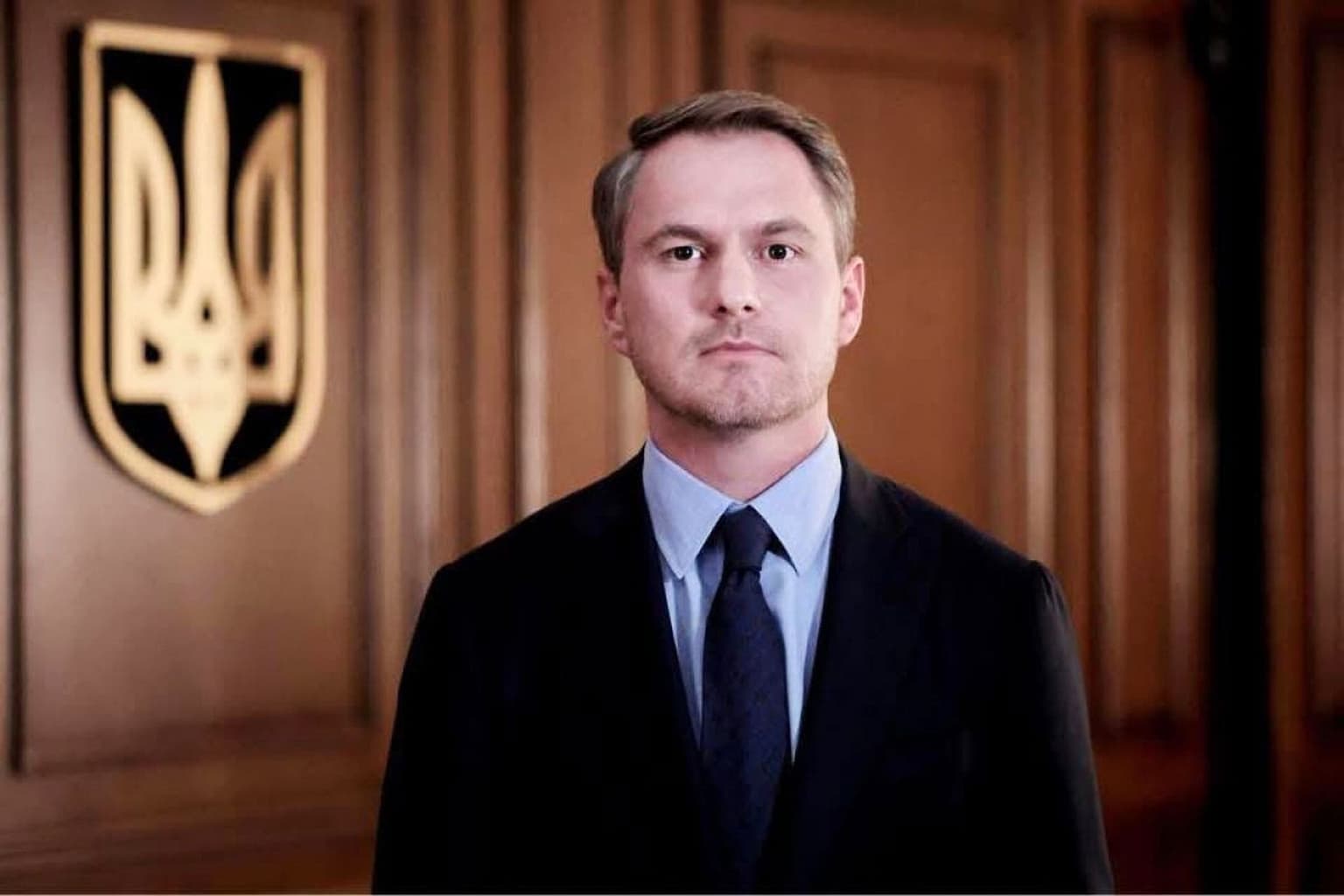
Prosecutor General of Ukraine Ruslan Kravchenko poses for a photo in his office in Kyiv, Ukraine, in an undated photo. (Ukrainian Prosecutor General's Press Office / AP)
 on Google
Ukraine’s disgraced Prosecutor General Ruslan Kravchenko’s Sept. 14 revenge charges against the country’s top anti-corruption official could trigger a major political crisis if this becomes a full-on crackdown on anti-corruption institutions, analysts say.
But everything depends on whether Kravchenko’s announcement of the charges was a desperate tantrum intended to save himself or part of a crackdown backed by President Volodymyr Zelensky’s administration.
The charges against Semen Kryvonos, head of the National Anti-Corruption Bureau (NABU), and an unnamed “close associate” of Oleksandr Klymenko, chief of the Special Anti-Corruption Prosecutor’s Office (SAPO), were seen by many as a petty vendetta rather than pursuit of justice.
The charges were announced after Kravchenko was forced to resign amid a large-scale NABU and SAPO corruption investigation that engulfed the Prosecutor General’s Office earlier this month.
Within the investigation, a top prosecutor described as a “confidant” of Kravchenko was charged, and the prosecutor general’s personal office was searched. Publicly revealed evidence hints at Kravchenko being implicated.
In a bizarre twist, Kravchenko left Ukraine early on Sept. 14, simultaneously with announcing the charges, under the pretext of an official trip to a conference in Paris. But the organizers told the Kyiv Independent that they had not expected him to attend, strengthening the suspicions that the trip was a fig leaf for fleeing Ukraine to avoid potential charges.
To add to the confusion, late on Sept. 14 the Prosecutor General's Office posted a statement that seemed to signal division between the agency and its outgoing boss. The statement claimed the reported charges were "not true" but also "canceled" — by whose authority, it remains unclear.
The Kyiv Independent has requested comments from Kravchenko and the President’s Office and will publish their responses once they are received.

On Sept. 14, Zelensky issued a decree to suspend Kravchenko from office and submitted a motion to parliament to fire him. Lawmakers are set to vote on his dismissal on Sept. 15.
Charges against Kryvonos
One of the charges against Semen Kryvonos concerns allegedly falsified paternity documents used by the NABU chief in court to avoid punishment in a 2007 bribery case. Back then, Kryvonos stood accused of vote buying in a local election.
Kryvonos is also accused of agreeing to illegally allocate a land plot in exchange for a $72,000 bribe in 2014. The scheme was uncovered before it was completed, according to the Prosecutor General's Office.

Kryvonos said at a press briefing on Sept. 14 that he had not seen any charges against him and had not been formally served with them. He called Kravchenko's accusations fabricated.
Kravchenko claimed to have sent the charges to Kryvonos by mail. But Olena Shcherban, a lawyer at the Anti-Corruption Action Center, said that, under Ukrainian law, they can be sent by mail only if it’s impossible to serve them to a suspect in person.
The unnamed Klymenko associate was charged with influencing judges of the High Anti-Corruption Court, offering bribes to them, and helping potential conscripts evade the draft, Kravchenko said. He did not elaborate.
There was speculation in the media that this could refer to Klymenko’s wife but Klymenko said that no members of his family had been charged as of the evening of Sept. 14.
Late on Sept. 14, Mariana Hayovska, a spokesperson for the Prosecutor General’s Office, told the Kyiv Independent that she did not have any information on the charges.
Revenge?
Observers describe the charges as revenge against the anti-corruption agencies.
“I believe there are signs that Kravchenko abused his office,” Yaroslav Yurchyshyn, a lawmaker from the liberal opposition Holos party, told the Kyiv Independent. “In trying to evade possible charges in the case involving the protection of call centers, he also put the president in a difficult position by accusing him of interfering in investigative actions.”
“Now the empire is striking back.”
The investigation into Kravchenko’s office alleged that his subordinates ran a wide-ranging scheme that granted protection to scamming operations known as “call centers” in exchange for cash.
“Now the empire is striking back,” a lawmaker from Zelensky’s Servant of the People party told the Kyiv Independent, speaking on condition of anonymity due to the sensitive nature of the subject. “If there were any legitimate grievances against the NABU, they should have been raised earlier — not after he was fired as prosecutor general.”
The lawmaker argued that Kravchenko was trying to “weaken NABU and undermine public trust in the agency.”
This is not Kravchenko’s first standoff with NABU and SAPO.
He played a crucial role in the authorities' infamous attack on the two agencies in July 2025.

At the time, Zelensky and the parliament attempted to eliminate the independence of the anti-corruption agencies by subordinating them to the prosecutor general. However, the bureau's independence was soon restored amid protests and Western pressure.
The same month, Kravchenko's Prosecutor General's Office, the Security Service of Ukraine (SBU), and the State Investigation Bureau conducted at least 70 raids, including at the homes of NABU employees. Two detectives of the bureau were arrested and charged with high treason and aiding Russia.
Critics argued that the crackdown was intended to impede the NABU investigations against Zelensky allies involving state nuclear power monopoly Energoatom, the biggest corruption investigation during Zelensky's presidency.
Klymenko said at a press briefing on Sept. 14 that an associate of Kravchenko he called “a hacker lawyer” had been involved in the attacks on the NABU in July 2025 and in September 2026 — a likely reference to Dmytro Borzykh, a lawyer and former prosecutor, according to Dzerkalo Tyzhnia, a Ukrainian media outlet currently sued by Borzykh.
A work trip or attempt to flee?
Although Kravchenko officially left Ukraine on a work trip, the circumstances surrounding his departure raise suspicions he was fleeing justice.
Kravchenko claimed he was headed abroad on a business trip to brief partners on the "real state of affairs" in Ukraine's anti-corruption system and "signs of uncontrolled influence" within the agencies.
A source in the President's Office told the Kyiv Independent that Kravchenko signed off on his own travel order.
The document dated Sept. 13 and seen by the Kyiv Independent says Kravchenko was due to travel to Paris for a PACE parliamentary network hearing on "Ukrainian children in the context of international responsibility."
However, the organizers told the Kyiv Independent he was not expected to attend the event in any capacity.
The Prosecutor General's Office’s press service initially said it knew nothing about Kravchenko's trip but later confirmed he was due to travel to Paris.
“Someone — clearly someone very influential — must have given him assurances that both he and his wife would be taken care of abroad.”

“He fled to escape accountability,” Daria Kaleniuk, executive director of the Anti-Corruption Action Center, told the Kyiv Independent. “Someone must have given him assurances that he would be taken care of abroad.”
read also
Is Zelensky involved?
A crucial question for the future of the scandal is whether Kravchenko brought the charges on his own initiative or whether they were quietly approved by Zelensky, who picked Kravchenko for the top prosecutor job.
Experts’ opinions on the matter are divided.
The lawmaker from Zelensky’s party said that Kravchenko “was allowed to cross the border, and it’s hard to imagine that happening without a decision being made somewhere higher up.”
Kaleniuk argued that Zelensky and David Arakhamia, the notoriously powerful head of the president’s faction in parliament, were behind Kravchenko’s charges against Kryvonos. Arakhamia ridiculed the allegation, telling the Kyiv Independent: "I also approved the murder of (John F.) Kennedy and the poisoning of the Skripals."
“These charges are a continuation of the attack on NABU and SAPO — an attack that had been in the works and for which Kravchenko was appointed to the post in the first place, back in June last year,” Kaleniuk said. “Neither President Zelensky nor those around him have any interest in seeing the anti-corruption agencies continue to operate effectively. This was not a decision Kravchenko made on his own, despite the President’s Office already claiming that it was his initiative.”
Indeed, a source close to Zelensky said that Kravchenko “obviously lost his mind” and the president was allegedly “furious when he found out” about Kravchenko’s decision to charge Kryvonos.
«Kravchenko has lost his mind — that much is obvious.»

Political analyst Volodymyr Fesenko also argued that the charges “were primarily in Kravchenko’s own interests.”
“For him, it was a means of protecting himself,” he told the Kyiv Independent. “He probably suspected that he could become a suspect in the ‘Carthage’ case (the NABU investigation into the Prosecutor General’s Office’s racketeering of scam centers). That, I think, is why he decided to flee and leave the country.”
Fesenko argued that Kravchenko could portray the case against him as a “conflict of interest” and an “institutional conflict” and could use this situation to fight his potential extradition.
read also
Political implications
It is not clear whether the charges against Kryvonos and the Klymenko associate, announced by Kravchenko on his way out, will be recognized by courts as valid and lead to the suspension or dismissal of the anti-corruption officials from their jobs.
Tetiana Shevchuk, a lawyer at the Anti-Corruption Action Center, said that one of the prosecutors involved in the case has the authority to cancel the charges if they are deemed unlawful.
If the officials are suspended, Kryvonos’ senior deputy Denys Hyulmukhamedov is expected to take over as acting chief of the bureau, while Klymenko’s functions are expected to be fulfilled by the incoming prosecutor general.
If the crackdown on the NABU and SAPO continues, experts predict a full-on political crisis.
The previous attempt to eliminate their independence in July 2025 resulted in the first large protest movement since the start of Russia’s full-scale invasion. A similar major protest movement was triggered recently when Zelensky fired the popular Defense Minister Mykhailo Fedorov in July 2026.
"Zelensky has effectively spent the past two months lurching from one crisis to another without a break.”

“I think that in a situation like this, with so much tension, frustration, and trauma in society, when almost anything could trigger public discontent, it’s better not to take any chances — not to make a move that could spark protests,” the lawmaker from Zelensky’s party said.
Fesenko said that “Zelensky has effectively spent the past two months lurching from one crisis to another without a break.”
“What Zelensky needs now, on the contrary, is to defuse the situation, bring this relentless cycle of crises to an end, and achieve at least some degree of stability,” Fesenko said. “For Zelensky, (a crackdown on the NABU and SAPO) wouldn’t solve the problem — it would only escalate it. It would mean yet another crisis, possibly another wave of protests, and problems with our international partners.”
“A little more of this and defeat in the war will be all but guaranteed,” he added.