'One of the holiest places' — Why Kyiv's ancient Pechersk monastery is so important for Ukraine
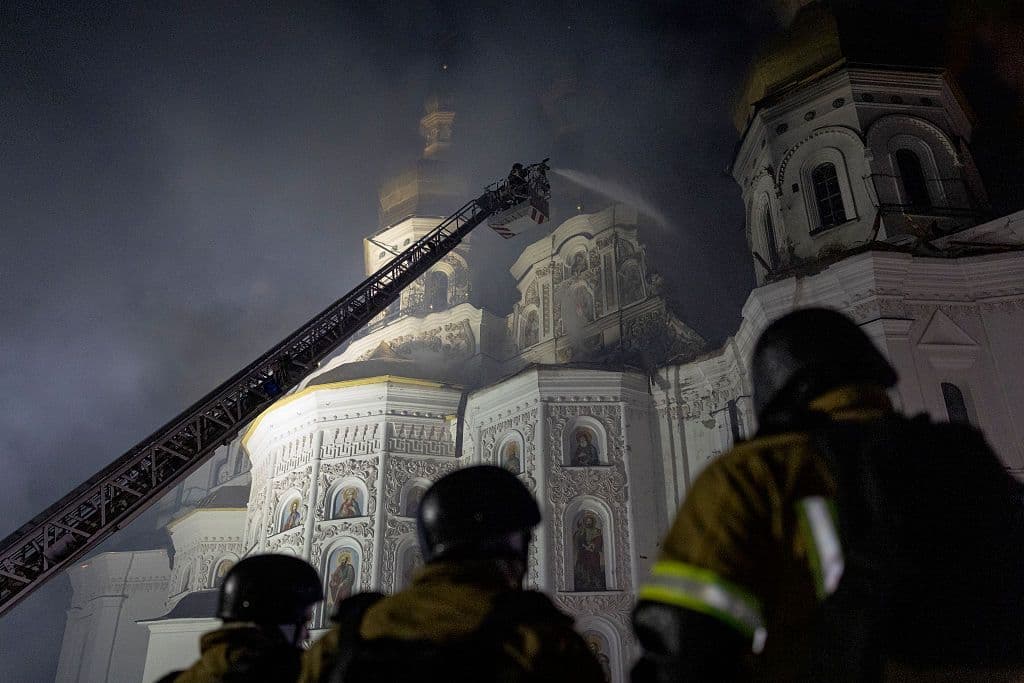
A view at the historic Kyiv Pechersk Lavra following a massive overnight Russian missile and drone attack on Kyiv, Ukraine, on June, 2026. (Andriy Dubchak/Frontliner/Getty Images)
 on Google
The Dormition Cathedral of the Kyiv Pechersk Lavra, one of Orthodox Christianity's oldest and most sacred monasteries, was among the targets in Russia's latest overnight attack on June 15.
Images of the religious site in flames sparked outrage and horror throughout Ukraine and the world.
"(T)he roof of one of the holiest places in the Christian world — the Dormition Cathedral of the Kyiv Pechersk Lavra — is burning," Metropolitan Epiphanius, head of the Orthodox Church of Ukraine, wrote on X on the night of the attack.
The strike on the Lavra, which the Security Service of Ukraine (SBU) said was conducted with a Russian Shahed-type drone, is not the first time it's been damaged since the start of the full-scale war. In another Russian mass attack against Kyiv that occurred in late January, a blast wave damaged several buildings and part of the caves on the monastery grounds.

However, the images of the Dormition Cathedral's roof ablaze recall a level of violence against this holy site not witnessed since World War II, when the Soviets, retreating before the German advance, rigged it with explosives. They blew the cathedral up on Nov. 3, 1941, after German troops took Kyiv.
It was fully rebuilt and reconsecrated only in 2000.
Founded by Anthony of Kyiv in 1051 as a place of prayer, the Lavra evolved into not only a famous religious sanctuary but a vibrant regional center of intellectual and cultural exchange. The Lavra's long history is a testament to the richness of Ukrainian culture — and Russia's longstanding efforts to destroy it.
According to Olha Petrenko-Tseunova, a lecturer at Kyiv-Mohyla Academy who has written extensively about the Lavra's cultural history, it was always a place oriented toward Europe and attracted visitors from all walks of life — from impoverished peasants who traveled thousands of kilometers to European monarchs.
"From its very beginnings, the identity of the Lavra has been founded on the principle of inner freedom," Petrenko-Tseunova told the Kyiv Independent.
"It was in the Lavra that the medieval ascetic culture of monastic life first flourished and took shape, and later where the Ukrainian Baroque tradition developed in all its manifestations — from philosophical scholarship, theological thought, and the distinctive Lavra style of liturgical chant to painting, iconography, and gold embroidery."
The first book printed in Kyiv, in 1616, was produced within the Lavra's walls. A number of intellectuals across professions, from art to medicine, lived and worked there.
Among them was Petro Mohyla (1596-1647), who was instrumental in promoting the printing of Ukrainian-language books and the preservation of cultural landmarks in Kyiv and elsewhere in Ukraine. Mohyla established a school at the Lavra in the mid-17th century that would later merge with another to become the Kyiv Mohyla Academy, which remains one of Ukraine's most prestigious higher education institutions today.
The intellectual life of the Lavra is partly what made Kyiv, not Moscow, the leading intellectual center of East Slavic Orthodoxy.
In 1686, however, the Kyiv Metropolis' jurisdiction was transferred from Constantinople to the Moscow Patriarchate, and Russia forced the Lavra under its ecclesiastical influence.
This takeover, which occurred gradually over time, coincided with the dismantling of the semi-autonomous Cossack Hetmanate, a society of warriors and freemen that is widely acknowledged as one of the predecessors to the modern Ukrainian state.
In the 18th and 19th centuries, the Russian Empire also began to aggressively promote a revisionist history of Kyivan Rus, portraying Ukrainians, Russians, and Belarusians as branches of a single "all-Russian" people. The Russification policies that took shape during this period were meant to weaken Ukrainian linguistic and cultural traditions of institutions like the Lavra.
Yet the Lavra remained an institution that ensured the continuity of Ukrainian history and culture even when Ukrainians had temporarily lost their statehood, Petrenko-Tseunova said. This is due in part to the amount of relics and other artifacts that accumulated at the monastery over centuries — making it one of the largest museums in Ukraine today.
Even in the 1920s, when Ukraine was fighting a war for its independence, the Lavra became home to restoration workshops where some of Ukraine's leading art historians and cultural scholars worked to save and preserve the country's cultural heritage, according to Petrenko-Tseunova.
The reality of what life in Soviet-controlled Ukraine would entail was foreshadowed by events like the torture and murder of Metropolitan Volodymyr of Kyiv at the monastery by Bolshevik troops in 1918. The Soviets also temporarily transformed the grounds of the site into a museum for anti-religious propaganda.
In the late 1980s, as the Soviet Union was nearing collapse, part of the Lavra was handed over to the Ukrainian Orthodox Church of the Moscow Patriarchate, governed from Russia. The reach of the Moscow Patriarchate, an entity within the Russian Orthodox Church, allowed Russia to maintain a foothold in Ukraine.

"After the collapse of the USSR, the Moscow Patriarchate became the newest instrument of Russian colonialism, using the (Lavra), rebuilt in the 1990s, for decades as a platform to promote the ideology of the so-called Russian world," Petrenko-Tseunova said, referring to Russia's concept of a "transnational" Russian civilization.
The scandals involving Metropolitan Pavlo, who led the Lavra under the Moscow Patriarchate, are one of the clearest examples of how Russia's weaponization of religion was tied to its political agenda.
Nicknamed "Pasha (Pavlo) Mercedes" for his flashy lifestyle and collection of luxury cars, he is notorious for his openly pro-Russian views. During the EuroMaidan Revolution, he supported police abuse of the protestors, and after the full-scale invasion began, he openly cheered Russian advances and promoted Kremlin conspiracy theories, with Ukrainian authorities charging him with "inciting interreligious hatred and justifying Russia's armed aggression against Ukraine."

In 2023, Ukraine officially ended the Moscow Patriarchate's lease on the Lavra, handing it over to the Ukrainian Orthodox Church, and for the first time in years, a church service in the Lavra was held in Ukrainian.
A direct attack on the Lavra's ancient grounds long seemed unthinkable to many — not only because it has been a UNESCO World Heritage site since 1990 and is therefore protected under international law. But after the overnight attack on June 15, Russia's willingness to destroy anything it can't control — even religious sites — has become undeniable.
"This is an existential war because our cultural heritage is what makes us feel Ukrainian," Culture Minister Tetyana Berezhna told the Kyiv Independent at the site of the attack.
"It is what connects us to our history, strengthens our identity, and helps us remain resilient throughout this war. Russia attacks and destroys everything it cannot appropriate. This aggression has no limits."
Polina Moroziuk contributed to this reporting.