How Russian drones are making routine stops for gas on Ukraine’s roads deadly
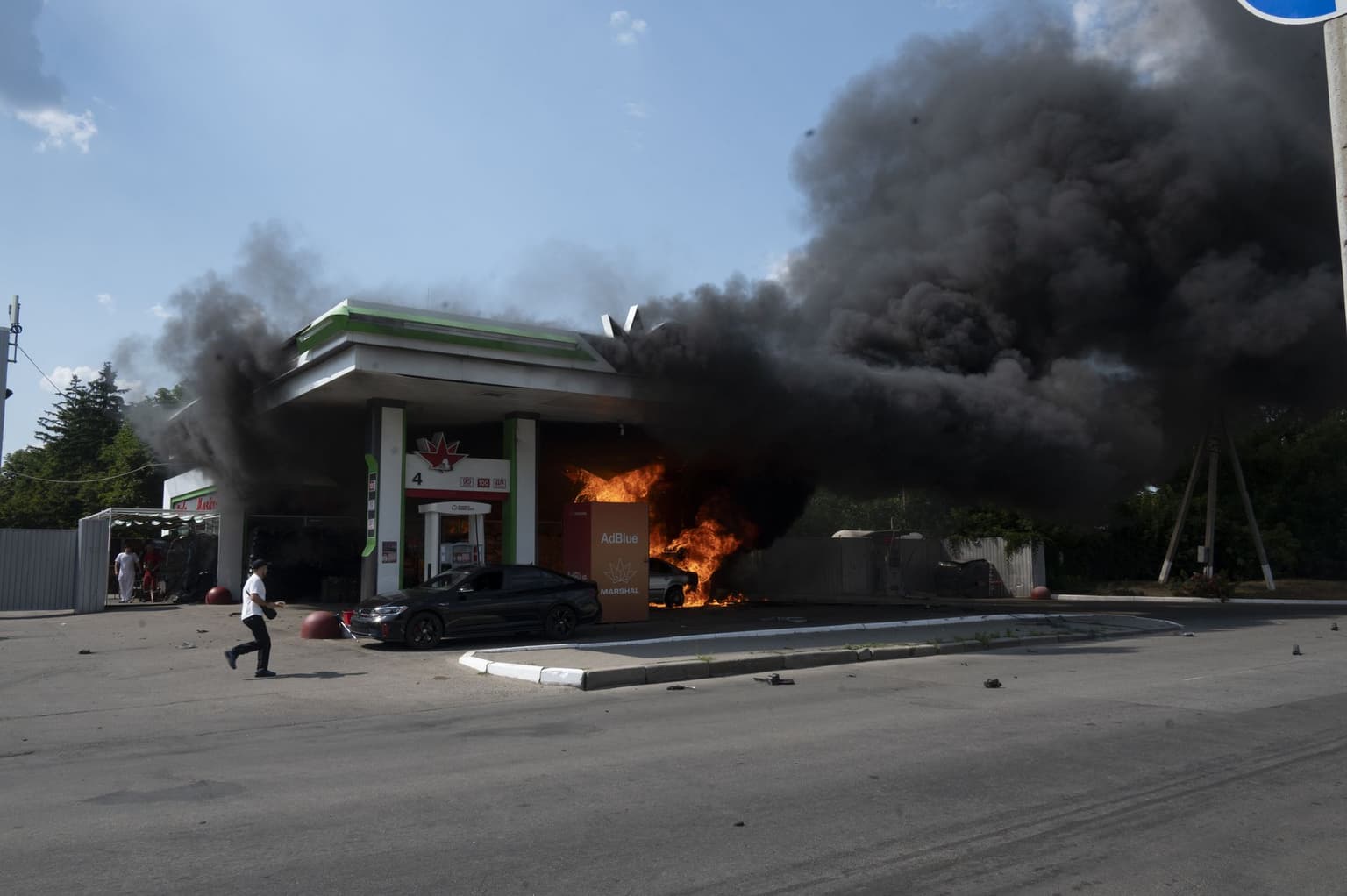
Flames rise from a car and a fuel dispenser following a Russian drone attack on a gas station near the city center of Kharkiv, Ukraine, on July 3, 2026. (Serhii Masin / Anadolu / Getty Images)
 on Google
The drive back from Ukraine's front line had become familiar to Frida Stoltz. After another aid mission, the 37-year-old Swedish volunteer and her team stopped to refuel in the town of Pyriatyn in Poltava Oblast, hundreds of kilometers from the fighting.
Stoltz was sitting in the car, waiting for her turn at the pump, when the loudest explosion she had ever heard tore through the station.
"I saw a gas station employee suddenly start running right in front of my car. And he was running away from the station itself," she told the Kyiv Independent. "Then there was a really loud bang and a lot of light — I could feel the window on my side start to shatter."
A Geran drone weighing about 200 kilograms slammed into the roof of the gas station, damaging its equipment and several vehicles on the forecourt. The July 3 strike injured six people, including Stoltz, according to local authorities.
It was one of a growing number of Russian attacks targeting gas stations across Ukraine this summer. What began as strikes concentrated in the east and south has expanded into central Ukraine, leaving more towns and stretches of highway without a functioning gas station.
The widening campaign has raised concerns that sustained attacks on fuel infrastructure could eventually disrupt supplies across the country. Yet for officials and fuel retailers, the more pressing challenge is how to defend thousands of gas stations spread across Ukraine — a network too vast to shield in its entirety.
"Of course we're worried (about these strikes)," Valerii, an employee at a gas station belonging to one of Ukraine's largest fuel chains in Kharkiv, told the Kyiv Independent. "We're worried about everything."
No safe stop
After the attack, Stoltz said she would plan her journeys more carefully and avoid stopping to refuel whenever possible. But unlike the Swedish volunteer, who returns home after each mission, Ukrainians cannot opt out of the danger. For them, stopping for fuel has become another routine task that can turn deadly in an instant.
The Center for Information Resilience (CIR), a nonprofit that investigates human rights abuses and war crimes, recorded 66 Russian attacks on gas stations across Ukraine in June, up 340% from 15 in May.
French open-source researcher Clément Molin said on X that he has mapped 160 gas stations hit across Ukraine in recent months, including at least 23 in Kharkiv Oblast, 19 in Sumy Oblast, and 15 in Zaporizhzhia Oblast.
It significantly complicates operations in the front-line zone.

According to defense expert Viktor Kevliuk, Russia's campaign against Ukrainian gas stations is aimed primarily at civilians, seeking to disrupt daily life and restrict fuel supplies to front-line areas.
Serhii Kuiun, director of fuel market consultancy A-95, echoed this view, adding that the campaign also serves a propaganda purpose, unfolding as Ukraine has stepped up its strikes on Russia's oil industry.
"This is meant to show Russians standing in line for gas: 'Look, we're doing our job too. As you can see, (Ukrainians) are suffering as well,'" Kuiun told the Kyiv Independent.
In the meantime, Russian media reported that Ukrainian forces had also intensified attacks on gas stations in Russia's Belgorod Oblast, which borders Ukraine's Sumy, Kharkiv, and Luhansk oblasts, striking 19 facilities over a five-day period in late July.
Military expert and former Security Service of Ukraine (SBU) officer Ivan Stupak said the strikes should not be viewed as a response to similar Russian attacks, as they serve a different purpose.
"In my view, these strikes are aimed at reducing pressure on this sector," Stupak told the Kyiv Independent. "The goal is to make the logistics of supplying everything needed to sustain offensive operations in these areas as difficult as possible, and to ease the situation for us, at least to some extent."
Stupak said that the attacks on gas stations in Belgorod Oblast are targeting routes leading toward the villages of Lyptsi and Kozacha Lopan, as well as the embattled city of Vovchansk in Kharkiv Oblast — key directions in northeastern Ukraine where Russian forces are attempting to advance.
The expert added that Russian troops use these commercial gas stations to refuel vehicles such as cars, buggies, quad bikes, and minibusses, as well as to fill fuel canisters for later use, including to power generators.
"You refuel a generator, you have electricity. You have electricity, you can charge an FPV drone and strike Kharkiv Oblast and other settlements within its range," Stupak added.
Russian attacks on commercial gas stations also affect Ukrainian forces, defense expert Kevliuk said. The strikes complicate fuel logistics for Ukrainian troops, who still rely "heavily" on the country's network of gas stations behind the front line.
While the military has its own fuel depots and gas stations, they cannot meet the full demand, particularly under constant Russian strikes, Kevliuk added.
Kevliuk said localized fuel shortages are already emerging in some front-line regions, particularly in Sumy, Kharkiv, and Zaporizhzhia oblasts. The shortages are affecting both civilians and soldiers, who also rely on commercial gas stations to refuel light vehicles, generators, and other equipment.
"This is not a critical blow to the entire army, but it significantly complicates operations in the front-line zone," Kevliuk said.
read also
Can Ukraine's fuel network hold?
The attack on Stoltz in Pyriatyn underscored another shift in Russia's campaign. The town lies about 30 kilometers (20 miles) from Kyiv Oblast, a sign that strikes on gas stations are moving farther west and edging closer to the capital.
Major transportation corridors are increasingly coming under attack as well, including the Kyiv-Kharkiv and Dnipro-Kharkiv highways.
Kevliuk said Russia is likely to face greater difficulty expanding the campaign into central and western Ukraine, where denser air defense and electronic warfare networks make drone strikes more challenging. The longer distances drones must travel to reach those regions also work in Ukraine's favor.
Even so, isolated attacks on logistics hubs and gas stations along key transportation corridors remain a credible threat, the expert added.
"How do you protect all of them [gas stations]?"

According to Kuiun, director of fuel market consultancy A-95, the attacks are inflicting heavy losses on fuel retailers. Rebuilding a gas station can cost anywhere from about $500,000 to several million dollars.
"It goes without saying that if a missile hits a facility worth millions, no one will invest another million there," he said.
"But what are the alternatives? Shut down the gas stations? Then you lose any chance of bringing them back. Once you do that, you might as well write off the rest of the business."
Despite the damage, most stations can be repaired. Because fuel tanks are buried underground, restoring a station usually means replacing the above-ground infrastructure, particularly the pumps, at a cost of about $20,000 to $30,000, Kuiun said.
At the same time, gas station owners are investing not only in repairs but also in protecting their facilities. They are installing mobile shelters for staff and customers, removing liquefied gas tanks or encasing them in concrete protective structures, and reinforcing vulnerable areas with gabions.
"But then again, with so many stations spread across such a vast area, how do you protect all of them?" Kuiun said.
According to defense expert Kevliuk, one way to reduce the risk is to disperse and camouflage fuel stockpiles while expanding the use of mobile refueling stations. Unlike military fuel caches, the locations of commercial gas stations have long been known and cannot be hidden.
Kevliuk said fuel storage sites also need stronger air defense and electronic warfare protection, but providing it is the state's responsibility. While an individual gas station may not qualify as critical infrastructure, he argued, fuel depots certainly do.
But with Ukraine still facing a persistent shortage of air defense assets, providing that level of protection remains a challenge.
Still, Ukraine's fuel market has so far withstood the pressure. According to the Ukrainian Oil and Gas Association, there is no nationwide fuel shortage.
"The market remains diversified, the situation is stable and fully under control, and there are sufficient supplies," Yaroslav Starovoitenko, president of the association, told the Kyiv Independent.
Starovoitenko acknowledged that distributing fuel in front-line regions in eastern and southern Ukraine has become more difficult because of constant shelling and their proximity to the fighting. Even so, he said fuel supplies to local communities and critical infrastructure have continued uninterrupted.
Stoltz, who was injured in the Russian strike in early July and is now recovering at home in Sweden, told the Kyiv Independent she still plans to return to Ukraine with humanitarian aid.
The vehicle she was driving will never make another aid run. It was damaged beyond repair in the attack, and Stoltz hopes to bring it back to Sweden and put it on display as a stark reminder of Russia's war against Ukraine — and of the risks faced by foreign volunteers.
"(After the strike), none of the volunteers said, 'I'm done. I'm finished,'" she said. "Everyone is still eager to help, but we need to do it safely."
Jimmy Rushton contributed to this report.