Remains of 20th-century Ukrainian military leader reburied near Kyiv
 on Google

Editor's note: The article was updated with additional information.
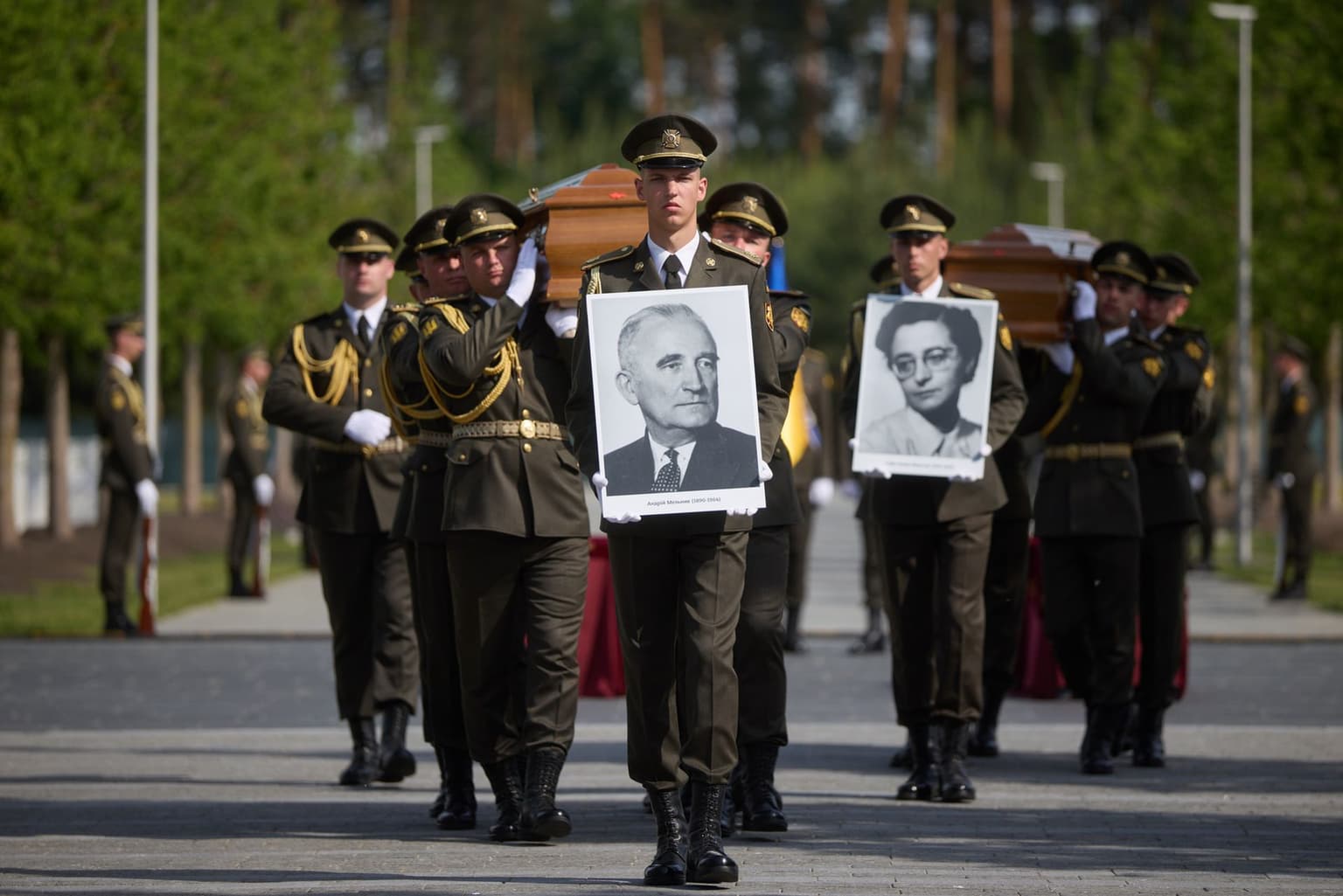
The remains of 20th-century Ukrainian military leader Andrii Melnyk and his wife, Sofiia Fedak-Melnyk, were reburied at the National Military Memorial Cemetery near Kyiv on May 25.
The ceremony, attended by President Volodymyr Zelensky and other senior political and cultural figures, comes less than a week after Melnyk's exhumation in Luxembourg for reburial in his homeland.
Melnyk was one of the leaders of the Organization of Ukrainian Nationalists (OUN), a 20th-century organization that opposed both Soviet and Polish rule over Ukraine.
"Today we all see that the Ukrainian idea can overcome what once seemed absolutely insurmountable," Zelensky said, speaking at the event attended by Prime Minister Yuliia Svyrydenko, Presidential Office head Kyrylo Budanov, and former President Viktor Yushchenko, among others.
"Now, when we are on Ukrainian soil, under our Ukrainian flag, to the sound of the Ukrainian national anthem, paying due tribute to our Ukrainian heroes, we feel in our hearts everything that Ukrainians were forced to go through, everything our people had to endure."
Born in 1890, Melnyk emerged as the OUN leader after the assassination of his predecessor, Yevhen Konovalets. In 1940, the organization split into two factions: the OUN-M, led by Melnyk, and the more radical OUN-B, led by Stepan Bandera.
Both the OUN-M and OUN-B remain the subject of controversy today due to their wartime activities, which involved periods of tactical collaboration with Nazi Germany during World War II.
This collaboration was driven by a shared opposition to the Soviet Union, which both OUN factions viewed as a major threat to Ukrainian national identity.
However, Nazi Germany opposed an independent Ukrainian state and turned against Melnyk and other Ukrainian leaders. Melnyk was placed under house arrest and later transferred to the Sachsenhausen concentration camp.
He died in Germany in 1964 and was buried in Luxembourg.
During his post-war years in exile, Melnyk continued to advocate for Ukraine's independence and worked to unite the Ukrainian diaspora. He was among the initiators of the idea for the World Congress of Ukrainians, which was officially established three years after his death, in 1967.
"As we were bringing Colonel Andrii Melnyk and his wife Sofiia back to Ukraine — through Zakarpattia and then across half the country to our free capital, Kyiv — this path was not marked by the discord that had so often knocked us, and Ukraine, off our feet in the past," Zelensky said on X.
"There were no doubts about who Ukraine's true enemy is, and who its friends, partners, and brothers are."