Russia's latest assault on Kyiv turns Ukraine's cultural heritage into another front line
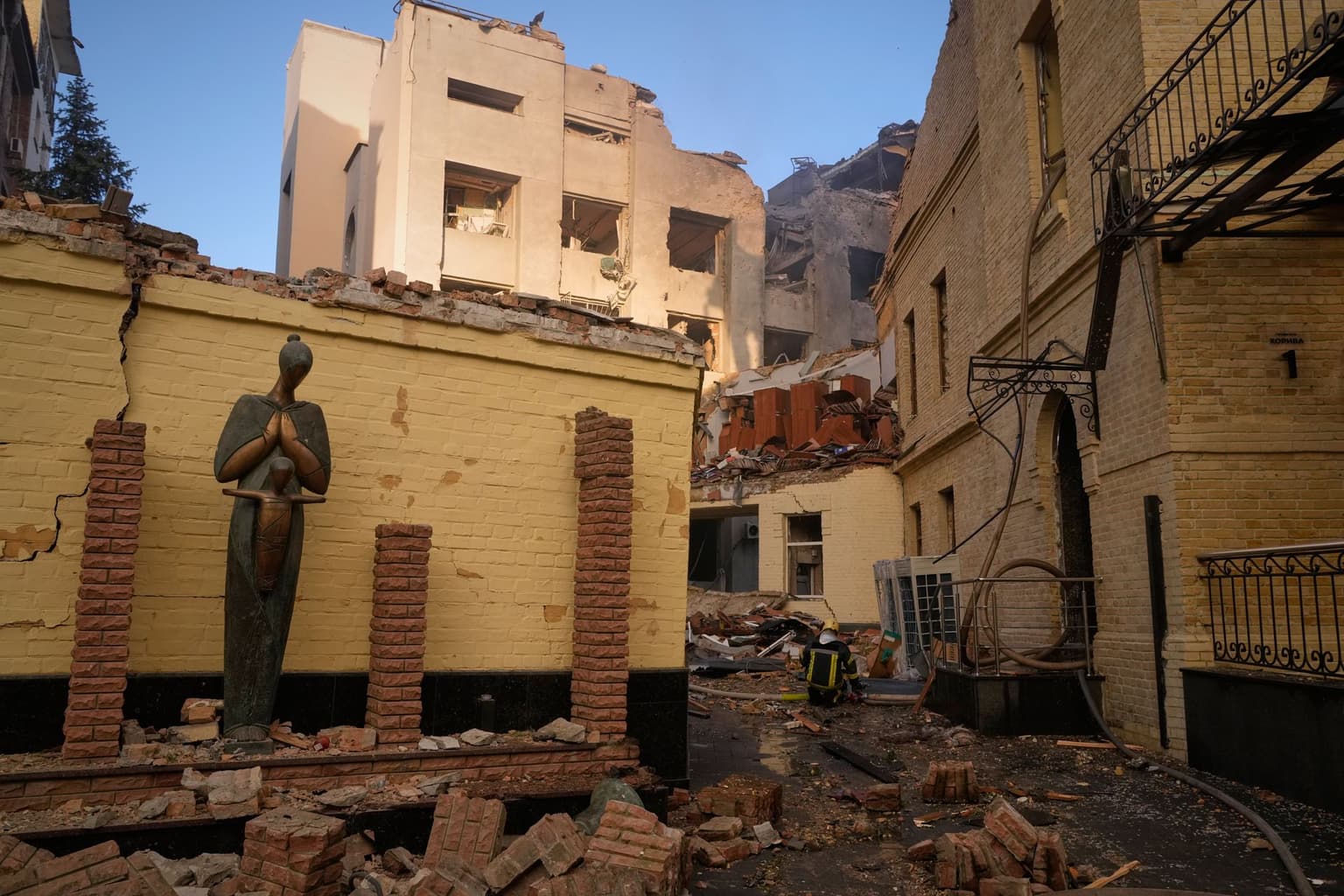
Firefighters work at the damaged Chornobyl Museum following a Russian missile attack in Kyiv, Ukraine, on May 24, 2026. (Efrem Lukatsky / AP)
 on Google
In one of the most devastating attacks on Kyiv since the start of the full-scale war, Russia’s missiles and drones targeted some of the city’s most treasured cultural landmarks.
The National Art Museum, the Chornobyl Museum, the National Philharmonic, the Ukrainian National Academy of Music, the Kyiv Opera Theater, the Yaroslav Mudryi National Library, the Ukrainian House, and a number of other cultural institutions all reported varying levels of damage after the May 24 assault.
The Foreign Ministry building — a historic architectural landmark built in 1939 — also suffered minor but notable damage for the first time since World War II.
“The Russian strikes targeted a historic area, the very center of the ancient (Kyivan) Rus,” Foreign Minister Andrii Sybiha wrote on X, formerly known as Twitter.
Photos released by the Culture Ministry show doors at the National Art Museum blown off their hinges by shockwaves, partially collapsed ceilings, and debris scattered across the floors.
The museum houses the world’s most comprehensive collection of Ukrainian art, with more than 40,000 pieces in its collection spanning from the 12th century to the present day.
While the National Art Museum’s collection wasn’t harmed, the Chornobyl Museum suffered a more unfortunate fate. Around forty percent of the museum’s collection has been destroyed, the museum reported on May 25. The full assessment of damage is still ongoing.


“These are unique historical testimonies and artifacts which, unfortunately, can no longer be restored,” the museum said.
“Our museum, which for years preserved the memory of one of the largest man-made disasters in human history, has itself become a victim of a brutal war.”
Many of the cultural institutions damaged in the attack sit at the heart of Kyiv, including the Ukrainian Institute on the city’s central Kreshchatik Street. Though only the dome’s windows and part of the facade were shattered, the strike served as a stark reminder: nowhere in Kyiv, or in Ukraine, is beyond the reach of the war.
Since the outset of the full-scale invasion, Ukraine’s cultural heritage has remained under relentless threat from Russian attacks. According to the Culture Ministry, as of May 2026, at least 1,783 cultural heritage sites and 2,540 pieces of cultural infrastructure have been damaged or destroyed.
Kyiv Oblast is one of the hardest-hit regions, alongside Donetsk, Kharkiv, Kherson, Sumy, and Mykolaiv.
Since the start of the full-scale war, the United Nations Educational, Scientific and Cultural Organization (UNESCO) has moved to help protect Ukraine’s cultural heritage, placing dozens of sites under “enhanced protection” to signal their global significance and discourage attacks.
The international agency has also rolled out emergency assistance programs and set up systems to monitor damage across the country.
However, none of these measures are enough to shield Ukraine’s heritage from Russian missiles and drones.
The Kyiv-Pechersk Lavra, an ancient monastery that has been listed as a UNESCO World Heritage site since 1990, was damaged for the first time since World War II during a Russian attack in late January.

The deliberate destruction of cultural heritage in wartime can constitute a war crime, and in some cases, a crime against humanity, according to Professor Roger O’Keefe, an international law expert at Bocconi University.
“The individuals responsible can in principle be prosecuted by any state that gets its hands on them or, where such a court or tribunal enjoys jurisdiction over those individuals, before an international criminal court or tribunal,” O’Keefe told the Kyiv Independent.
“The second mechanism, which is more about compensation for the destruction but which can at least potentially deter this destruction, is by holding the state in question, in this case Russia, responsible. When it comes to states, they can be held responsible too in certain circumstances for collateral damage.”
Both mechanisms have “severe practical limitations even at the best of times” and there also remains the challenge of distinguishing between intentional destruction and unintentional collateral damage to cultural heritage — but it can be done, according to O’Keefe.
“The problem is tracking down and managing to detain such people (who are responsible).”
Tetyana Filevska, creative director of the Ukrainian Institute, told the Kyiv Independent that despite the fatigue that has settled in after more than four years of full-scale war, Russia's targeting of Ukraine's cultural heritage only strengthens the resolve of Ukraine’s cultural community to fight back.
"After all, over centuries under Russian rule, we already endured the loss of vital cultural monuments, archives, and even entire cities — from the library of the Kyiv Pechersk Lavra burned by Peter I to the collection of early printed books destroyed in the 1960s, and even cities such as Baturyn," Filevska said.
"Yet we did not lose our cultural memory or our identity. No missile is capable of changing or destroying that."